How to Choose an Eye Cream if You Get Milia
Milia are the small, firm white bumps that appear around the eye, and almost everything written about them online contains the same confusion. They are not clogged pores. They are tiny cysts filled with keratin, sitting in a closed pocket with no opening to the surface — which is why they will not squeeze out, and why a comedogenic rating, which measures something else entirely, is a shaky tool for choosing products here. The widely repeated advice to avoid rich eye creams is plausible, commonly observed, and much less well evidenced than its confidence suggests. Here is what can honestly be said.
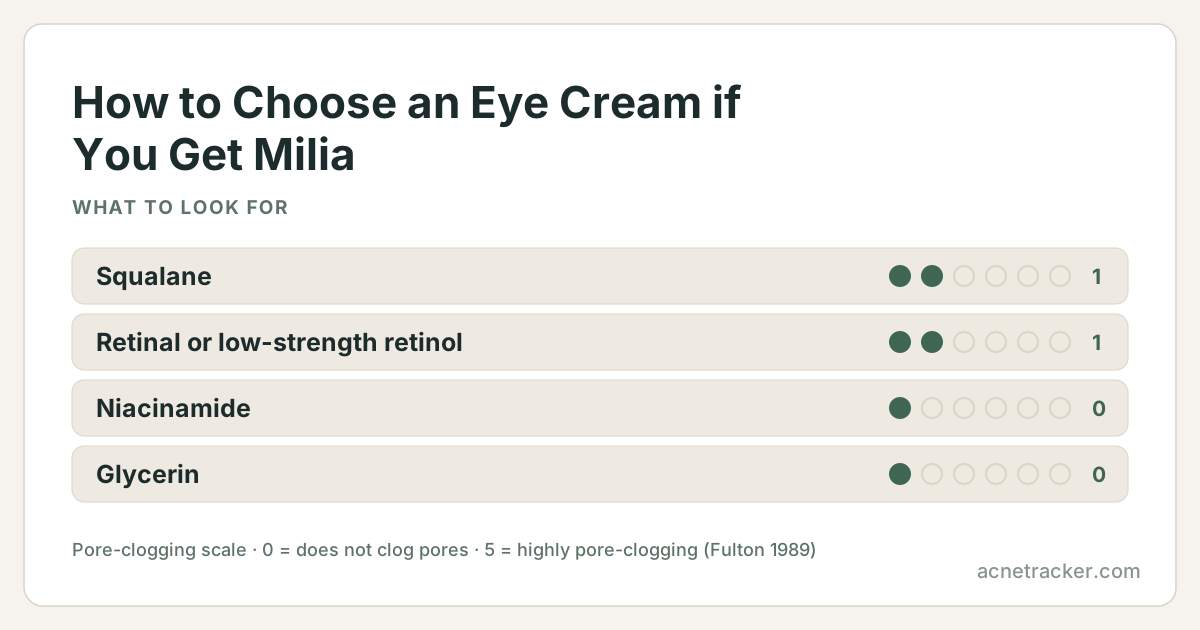
Ingredients to look for
| Ingredient | Why it matters |
|---|---|
| Squalane | Fulton rates it 1, from his own table. It moisturises the eye area without the weight of a balm, which is a reasonable choice if you want to reduce occlusion while the evidence stays uncertain. |
| Retinal or low-strength retinol | Retinoids normalise how keratinocytes shed, which is the mechanism most plausibly relevant to keratin cysts. Dermatologists commonly use topical retinoids for milia, though good controlled trials are scarce. |
| Niacinamide | A light-textured way to support the barrier so you are not forced into heavy occlusives. It has no direct evidence against milia and is here as a texture strategy rather than a treatment. |
| Glycerin | Delivers hydration with essentially no occlusive load. If your working theory is that heavy formulas contribute, a humectant-led routine is the low-risk way to test it. |
| Lactic acid (gentle, off the lid) | Mild chemical exfoliation may help the surface layer over a milium thin. Keep it well away from the lid margin, and accept that this is mechanism-based reasoning rather than trial data. |
Ingredients to avoid
| Ingredient | Why it matters |
|---|---|
| Squeezing or needling them yourself | There is no opening to squeeze through, so pressure damages skin without emptying the cyst — and trauma is itself a recognised cause of secondary milia, so you can make more of them. |
| Heavy ester-rich eye balms, provisionally | Fulton rated several esters common in rich formulas high for comedogenicity: isopropyl myristate 5, isopropyl palmitate 4, ethylhexyl palmitate 4, myristyl myristate 5. That measures comedones rather than milia, so treat this as caution, not proof. |
| Assuming 'non-comedogenic' means milia-safe | The claim is unregulated and, more importantly, it refers to follicular plugging. Milia are not follicular plugs. The label is answering a question you are not asking. |
| Long-term topical steroid use on the lids without supervision | Prolonged steroid application to the eye area is a recognised cause of secondary milia among other effects, and lid skin is precisely where that risk is highest. This is a doctor's call, not a self-managed one. |
How to choose
Start by being clear about what the data can and cannot tell you, because this is a topic where confident advice outruns the evidence. Milia arise when keratin gets trapped in a small closed cyst. Primary milia appear spontaneously and are extremely common. Secondary milia follow trauma, burns, blistering conditions, laser treatment or prolonged topical steroids — that pathway is well established. What is not well established is the popular claim that rich eye creams cause milia. It is clinically plausible, many practitioners observe it, and there is no good trial demonstrating it. Notice also that comedogenicity ratings are the wrong instrument: Fulton's numbers describe comedone formation, and milia are a different structure entirely. Our own comedogenic data reflects this honestly — petrolatum and shea butter are listed at 0, but from reproduced tables rather than Fulton's original, while the high-rated esters like isopropyl myristate at 5 do come from his own table. Given all that, the reasonable approach is to favour lighter textures around the eye if you are prone, without believing that a jar caused your milia. And the actual removal of an existing milium is a physical procedure done by a professional, not a formulation choice.
How to apply
Keep the amount small and stay on the orbital bone. If you suspect texture is a factor, run a proper test: switch to a light hydrating fluid for eight to twelve weeks and see whether new bumps stop appearing, changing nothing else so the result means something. Do not exfoliate aggressively in the hope of dissolving them — you cannot exfoliate the roof off a cyst that sits below the surface, and irritated lid skin is worse than the bumps. Above all, leave them alone physically. Most primary milia resolve on their own over weeks to months, and the ones that do not are a two-minute job for a clinician.
Frequently asked questions
Do eye creams cause milia?
It is a widely repeated claim with surprisingly little evidence behind it. Occlusion is a plausible contributor and many clinicians observe the association, but no good controlled study demonstrates that rich eye creams cause milia. Trauma and prolonged topical steroids are the causes that are genuinely well established.
Can you use comedogenic ratings to avoid milia?
Not really, and this is the central confusion. Comedogenicity scales measure follicular plugging, and a milium is a keratin cyst rather than a plugged follicle — a different structure with a different origin. The ratings are a rough proxy for occlusive heaviness here, nothing more.
How do you get rid of milia around the eyes?
Existing ones are removed physically: a clinician nicks the overlying skin and lifts the keratin core out, which takes moments. No cream dissolves them because there is no route to the contents. Many primary milia also clear on their own given several weeks, so patience is a legitimate option.
Why can't I squeeze milia out like a whitehead?
Because there is no opening. A whitehead sits in a follicle with a pore leading to the surface; a milium is a fully enclosed cyst under intact skin. Squeezing just damages the surrounding tissue, and since trauma is a known cause of secondary milia, you risk creating more of them.
When should milia be checked by a doctor?
If bumps appear suddenly in large numbers, follow a burn, blistering or a new medication, are growing, changing colour or crusting, or if you are not certain they are milia — several other lesions look similar around the eye. And if you want them removed, that is a clinician's job rather than a bathroom one.
Sources & further reading
There is no single study of this exact question. The guidance here is reasoned from the ingredient profiles below, each of which carries its own references:
- Squalane3 refs
- Retinal3 refs
- Niacinamide2 refs
- Glycerin3 refs
- Lactic Acid3 refs
Show every reference behind this page (9)
- PubChem — Squalane compound summarycited by Squalane
- DermNet — Emollients and moisturiserscited by Squalane, Glycerin
- European Commission CosIng database — Squalanecited by Squalane, Retinal, Niacinamide, Glycerin, Lactic Acid
- PubChem — Retinaldehydecited by Retinal
- Kwon HS et al. Efficacy and safety of retinaldehyde 0.1% and 0.05% creams used to treat photoaged skin: A randomized double-blind controlled trial. J Cosmet Dermatol 2018 Jun (PubMed)cited by Retinal
- Niacinamide: mechanisms of action and its topical use in dermatology (PubMed)cited by Niacinamide
- PubChem — Glycerol compound summarycited by Glycerin
- PubChem — Lactic acid compound summarycited by Lactic Acid
- DermNet — Alpha hydroxy acidscited by Lactic Acid
Medical disclaimer
Ingredients mentioned on this page
Find your personal acne triggers
Our free Acne Tracker lets you log breakouts, sleep, stress and diet, and shows you which factors correlate with your flare-ups.