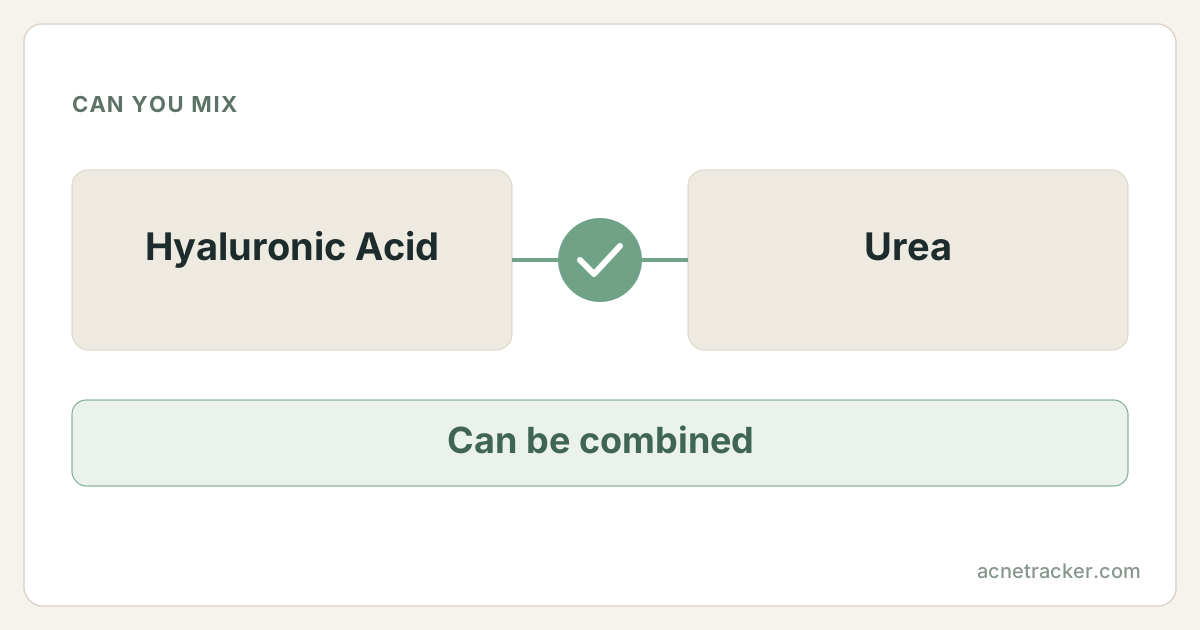
Can You Mix Hyaluronic Acid and Urea?
Yes, and urea is the humectant with the strongest clinical record of the pair. The critical thing to understand is that urea is not one ingredient behaving one way. Below roughly 10% it is a moisturiser; above that it starts breaking down keratin and becomes a mild exfoliant. The percentage on the tube tells you which ingredient you actually bought — and whether it belongs on your face at all.
How this pairing resolves
The two ingredients, their published numbers, and where they land together.
The numbers beside each ingredient are its published comedogenic rating and effective pH window, taken from its own profile page.
Show the numbers
| Ingredients | Metric | 0–5 |
|---|---|---|
| Hyaluronic Acid | Comedogenic rating | 0/5 |
| Hyaluronic Acid | Effective pH | no published pH |
| Urea | Comedogenic rating | 0/5 |
| Urea | Effective pH | no published pH |
Why
Urea is a small molecule your skin already makes. It is a component of natural moisturising factor, sitting inside corneocytes and binding water, and levels are measurably reduced in atopic dermatitis and ichthyosis — which is the rationale for putting it back. At low concentrations it hydrates by holding water where NMF normally would. At higher concentrations something different happens: urea disrupts hydrogen bonding in keratin, loosening the protein structure, which softens thickened skin and helps it shed. This is why 10% and 20% creams are standard for rough heels, keratosis pilaris and hyperkeratotic conditions, and why 40% is used to dissolve nails rather than moisturise anything. The same dose-dependence explains a second property: by disturbing the stratum corneum's structure, urea increases the penetration of other substances applied with it. That is useful when it is deliberate and a nuisance when it is not — an active that stings mildly on its own can sting considerably over a strong urea layer. Hyaluronic acid does none of this and is not affected by any of it. It is a surface polymer with no keratin interaction, no penetration-enhancing effect and no dose-dependent change of character. The two simply do different jobs at different depths, and urea's evidence base in dry-skin conditions is one hyaluronic acid cannot match.
How to combine them
Match the concentration to the site. On the face, 2–5% urea is the sensible range: a humectant, comfortable, no exfoliation to speak of. Layer it as you would any water-phase step — hyaluronic acid on damp skin, urea product over it or in the same formula, moisturiser to seal. On the body, where 10–20% earns its place on heels, elbows and keratosis pilaris, the exfoliating action is the point, and there the hyaluronic acid contributes little; a urea cream with occlusive lipids will outperform a hyaluronate gel on a heel every time. Do not carry a 20% body urea onto your face on the assumption that stronger is better — it is a different job. And be deliberate about what you layer over a high-percentage urea: it makes the skin more permeable, so a retinoid or acid applied on top hits harder than it would alone.
Example routine
| When | Steps |
|---|---|
| Face, morning | Cleanser → Hyaluronic acid on damp skin → Urea 2–5% cream → SPF 30+ |
| Face, evening | Cleanser → Hyaluronic acid → Urea 2–5% cream |
| Body (heels/KP) | Urea 10–20% cream on its own — hyaluronic acid adds little here |
| Caution | Do not layer strong actives over high-percentage urea — penetration rises |
Warning signs
Frequently asked questions
What urea percentage should I use on my face?
Roughly 2–5% is the usual face range, where urea acts as a humectant and little else. The 10–20% products are built for heels, elbows and keratosis pilaris, where keratin-softening is the aim — that action is not what facial skin needs.
Is urea an exfoliant or a moisturiser?
Both, depending on the dose. Low concentrations hydrate by replacing a natural moisturising factor component. Above about 10% it disrupts hydrogen bonding in keratin and starts loosening thickened skin, which is a different ingredient in practice.
Does urea make other products stronger?
It can. By disturbing stratum corneum structure, urea raises the penetration of what you layer over it — useful when a formulator intends it, less so when your retinoid suddenly bites. Be deliberate about the order if you use a high percentage.
Is urea in skincare made from urine?
No. Cosmetic urea is synthesised industrially, typically from ammonia and carbon dioxide. Your skin also makes its own as part of natural moisturising factor, which is the actual reason it works as a humectant.
Should I use hyaluronic acid or urea for very dry skin?
Urea has the stronger record in genuinely dry and hyperkeratotic conditions, and it is used clinically for them. Hyaluronic acid is a surface humectant with no keratin or barrier action. For rough, thickened dryness, urea plus an occlusive beats a hyaluronate gel.
Sources & further reading
There is no single study of this exact question. The guidance here is reasoned from the ingredient profiles below, each of which carries its own references:
- Hyaluronic Acid3 refs
- Urea2 refs
Show every reference behind this page (5)
- PubChem — Hyaluronic acid compound summarycited by Hyaluronic Acid
- European Commission CosIng database — Hyaluronic Acidcited by Hyaluronic Acid
- DermNet — Moisturisers and humectantscited by Hyaluronic Acid
- PubChem — Ureacited by Urea
- DermNet — Emollients and moisturiserscited by Urea
Medical disclaimer
Ingredients mentioned on this page
Find your personal acne triggers
Our free Acne Tracker lets you log breakouts, sleep, stress and diet, and shows you which factors correlate with your flare-ups.