How to Choose an Eye Cream for Wrinkles
Strip the eye-cream aisle of its adjectives and a short list survives. For established wrinkles — the ones present when your face is completely relaxed — retinoids have accumulated more controlled evidence than everything else on the shelf combined, and the effect they produce is moderate rather than dramatic. Everything else falls into three groups: ingredients with a plausible mechanism and thin data, ingredients that hydrate and temporarily blur, and ingredients that are there for the label. This page sorts the aisle into those groups, then deals with the specific problem of using the strongest available class on the thinnest available skin.
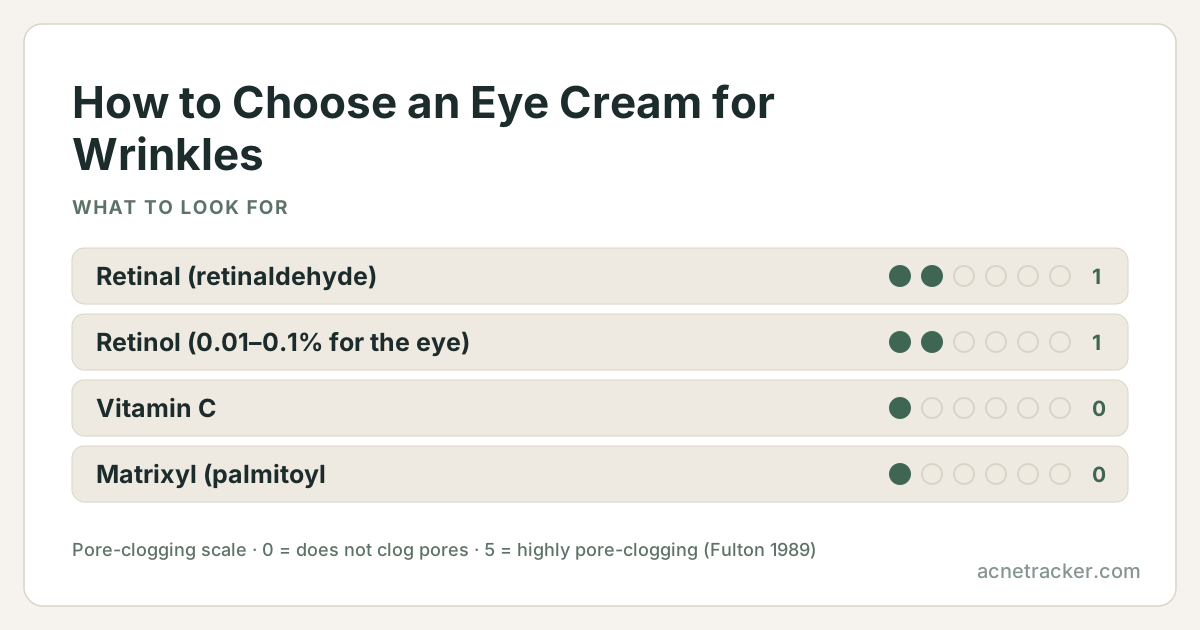
Ingredients to look for
| Ingredient | Why it matters |
|---|---|
| Retinal (retinaldehyde) | One conversion step from retinoic acid rather than two, so it is more potent than retinol at the same percentage while remaining better tolerated than prescription strength — a good fit for eye-area constraints. |
| Retinol (0.01–0.1% for the eye) | The most studied OTC retinoid. Trials show measurable reductions in wrinkle depth and increased dermal collagen over months. Eye formulas deliberately run far below face concentrations. |
| Vitamin C | A required cofactor for the enzymes that cross-link collagen, and an antioxidant against the UV-driven damage that causes photoageing in the first place. A genuine supporting act, not a retinoid substitute. |
| Matrixyl (palmitoyl pentapeptide-4) | Signals fibroblasts to produce matrix components. Published improvements are real but small next to retinoids, and it earns its place mainly by being tolerable when retinoids are not. |
| Peptide complexes generally | A broad, loosely regulated category. Some members have supporting data, many are included for the ingredient list. Judged honestly, peptides are the polite option rather than the powerful one. |
Ingredients to avoid
| Ingredient | Why it matters |
|---|---|
| Collagen listed as an active for wrinkles | The molecule is far too large to cross the stratum corneum, and applying it does not deliver it to the dermis. It is a decent surface humectant sold as something it cannot be. |
| Escalating retinoid strength to speed things up | Around the eye this reliably produces retinoid dermatitis, and inflamed skin both looks worse and forces a break, which costs you more time than the higher strength saved. |
| Any 'clinically proven' claim without a visible study | The phrase is unregulated marketing language. It may reference a twelve-person in-house study measuring hydration, and hydration is not wrinkle depth. |
| Skipping sunscreen while chasing wrinkles | UV is the dominant cause of periorbital photoageing. Treating wrinkles with actives and no sun protection is emptying a bath with the tap running. |
How to choose
Decide first whether your wrinkles are static or dynamic. Relax your face completely in a mirror: lines still visible are static and are what retinoids address; lines that only appear when you smile or squint are dynamic, are produced by muscle rather than skin, and are not a cream's problem at all. For static lines, the buying rule is unglamorous. Find a retinoid formulated for the eye area at a strength you can use nightly, prefer opaque air-restricted packaging because retinoids oxidise, and require fragrance-free because chronic low-grade irritation on lid skin cancels the collagen gains you are paying for. Ignore the concentration arms race: nightly 0.05% beats twice-weekly 0.3% that you keep abandoning. Add vitamin C in the morning if you tolerate it, and treat everything else — peptides, growth factors, exotic botanicals — as optional additions with weaker support and correspondingly weaker claims on your money. The realistic outcome is that lines soften and skin texture improves over six to twelve months. If you want them gone rather than softened, that is a procedural conversation with a doctor, not a purchase.
How to apply
Night only, on dry skin, a rice grain per eye placed on the orbital bone and along the outer corner. Start twice weekly and increase every two weeks if your skin stays calm. Keep a centimetre of clearance from the lash line — the formula will cover that distance overnight, and retinoid in the eye means a stinging red morning. Buffer with moisturiser underneath if you flake. Sunscreen every single morning, or you are undoing the work while it happens. Reassess at twelve weeks with a photograph in fixed lighting, never with a memory.
Frequently asked questions
Do eye creams actually reduce wrinkles?
Ones containing a retinoid can, moderately and slowly, and this is supported by repeated controlled trials measuring wrinkle depth and dermal collagen. Ones without an evidenced active mostly hydrate, which softens the look of lines temporarily and resets every day.
How long before an eye cream shows results on wrinkles?
Hydration effects appear in hours and mean nothing about collagen. Retinoid studies typically report the first measurable changes around twelve weeks, with results continuing to build through six to twelve months. Anyone promising a visible difference in a fortnight is describing water.
Is retinol or peptides better for eye wrinkles?
Retinol has substantially stronger evidence for reducing wrinkle depth. Peptides are gentler and worth using when retinoids irritate your lids, which is common. Framing them as equivalent is generous to peptides; framing peptides as useless is unfair, since some have real supporting data.
Can I use my regular face retinol around my eyes?
Usually not without trouble. Face serums commonly run five to twenty times the concentration used in eye products, and lid skin responds with redness, flaking and stinging. If you do experiment, apply only to the orbital bone, never the lid, and expect to dilute it with moisturiser.
What causes wrinkles around the eyes first?
The area combines the thinnest skin on the body, very few oil glands, constant movement from blinking and expression, and heavy sun exposure that rarely gets sunscreen. Those four factors together explain why the eye area ages visibly a decade before the rest of the face.
Sources & further reading
There is no single study of this exact question. The guidance here is reasoned from the ingredient profiles below, each of which carries its own references:
Show every reference behind this page (8)
- European Commission CosIng database — Retinalcited by Retinal, Vitamin C, Matrixyl
- PubChem — Retinaldehydecited by Retinal
- Kwon HS et al. Efficacy and safety of retinaldehyde 0.1% and 0.05% creams used to treat photoaged skin: A randomized double-blind controlled trial. J Cosmet Dermatol 2018 Jun (PubMed)cited by Retinal
- Improvement of naturally aged skin with vitamin A (retinol) (PubMed)cited by Retinol
- European Commission SCCS opinion on vitamin A in cosmeticscited by Retinol
- PubChem — Ascorbic Acid compound summarycited by Vitamin C
- DermNet — Topical vitamin Ccited by Vitamin C
- PubMed — Peptides: Emerging Candidates for the Prevention and Treatment of Skin Senescence: A Review (Biomolecules, 2025)cited by Matrixyl
Medical disclaimer
Ingredients mentioned on this page
Find your personal acne triggers
Our free Acne Tracker lets you log breakouts, sleep, stress and diet, and shows you which factors correlate with your flare-ups.