How to Choose a Face Mask for Large Pores
Pore size is set by three things you cannot mask away: genetics, how much sebum the follicle carries, and how much structural support the surrounding dermis still has. There is no cosmetic product that permanently reduces the diameter of a follicular opening, and any label promising to is either describing a temporary optical effect or simply lying. That sounds like a dead end, but it is not, because visibility and size are different problems. A pore looks bigger when it is full, when its rim is rough, and when it is casting a shadow. All three are addressable, and a mask can move one of them for an evening.
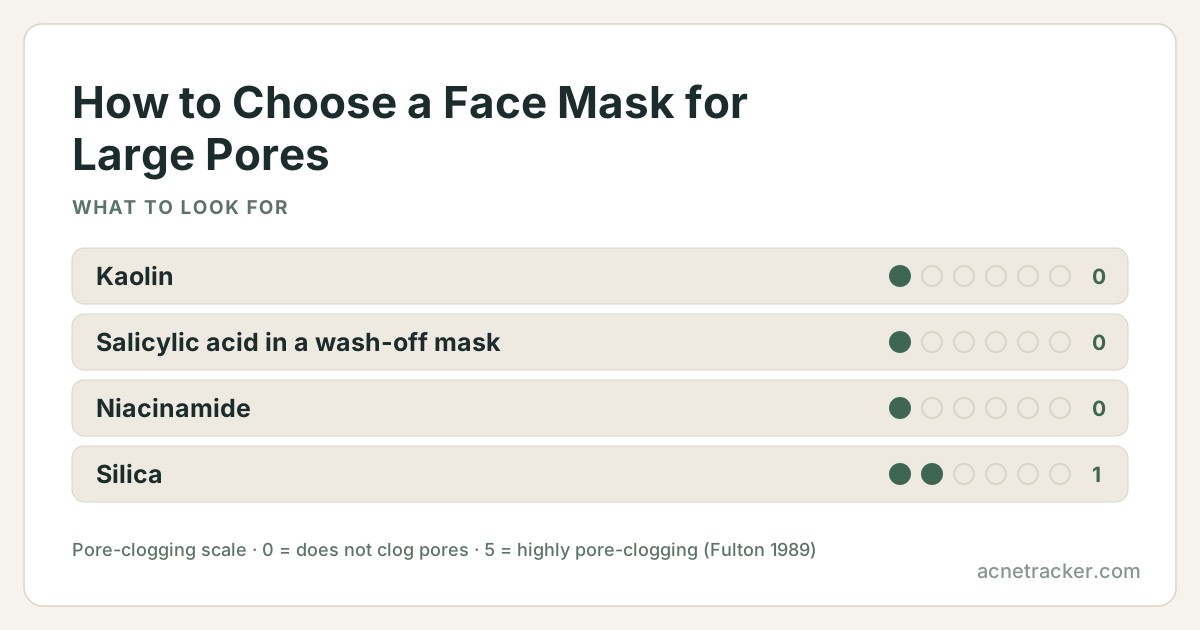
Ingredients to look for
| Ingredient | Why it matters |
|---|---|
| Kaolin | Emptying the opening of surface oil is the single fastest way to make pores photograph smaller. It is an optical change lasting hours, and it is real for as long as it lasts. |
| Salicylic acid in a wash-off mask | Over weeks, keeping the follicle less congested keeps the opening less distended. This is the closest thing to an actual mechanism in this category. |
| Niacinamide | The only ingredient with published evidence on the appearance of pores, from daily 4–5% leave-on use over months. A mask borrows the name, not the study design. |
| Silica | Blurs rather than treats: porous particles scatter light across the rim so the shadow softens. Honest cosmetics, no biology involved. |
| Glycolic acid in a short-contact mask | Smoothing the surface around the opening reduces the shadow the rim casts. Small effect, and contact time is the safety limit. |
Ingredients to avoid
| Ingredient | Why it matters |
|---|---|
| Anything claiming to 'shrink', 'tighten' or 'close' pores | The claim describes a structure that does not behave that way. Follicular openings have no musculature and no closing mechanism. |
| Ice-water rinses sold as pore-tightening finishes | Cold constricts blood vessels and can puff the surrounding skin very slightly. That is not the pore changing size — it is the neighbourhood swelling around it. |
| Astringent alcohol masks | The tightening sensation is dehydrated skin contracting, and the rebound oil that follows refills the openings you were trying to disguise. |
| Aggressive scrub masks | Roughening the rim of a follicle makes it catch more light, not less. Abrasion is the wrong tool for an opening you want to look smooth. |
How to choose
Judge a mask here on whether it is honest about which of the three levers it is pulling. Emptying the pore is what clay does, and it works within an hour and is gone by the next day — perfectly reasonable if you are buying it for a specific evening. Keeping the pore from re-distending is what a wash-off BHA contributes to slowly, and it is the lever most worth having, though a nightly leave-on BHA contributes far more than a weekly mask ever will. Improving the surrounding skin quality is a long game belonging to retinoids and to daily sunscreen, because photodamage degrades the dermal collagen that holds a follicular opening in shape — sun protection genuinely does more for pore appearance over a decade than every mask you will ever buy. What no mask does is change the diameter. If you internalise one thing here, make it this: you are managing how much light falls into an opening, not resizing it. That framing makes the category useful instead of endlessly disappointing.
How to apply
Apply only where the pores actually bother you — usually the nose, inner cheeks and centre of the forehead. Thin layer, rinse before it dries hard, moisturise after. If you are masking for an event, do it the night before rather than the same day: skin that has been rinsed, hydrated and left alone overnight sits better under makeup than skin that was masked an hour ago. Avoid combining with a physical exfoliant in the same session, and keep it to twice a week at most.
Frequently asked questions
Can a face mask make pores permanently smaller?
No. Pore diameter is driven by genetics, sebum output and the condition of the surrounding dermis. Masks can empty an opening and blur its rim for a few hours, which is worth having, but nothing about it is permanent.
Do pores open and close?
They do not. A follicular opening is a passive hole with no muscle around it. Heat and cold change the skin's blood flow and hydration, which alters appearance slightly, but the opening itself has no open or closed state.
Why do pores look bigger after a clay mask on some skins?
Usually because the mask was left on too long, dehydrating the skin so it contracts around each opening and throws a sharper shadow. Shorten the sitting and moisturise immediately afterwards.
Is niacinamide in a mask enough for pore appearance?
Unlikely. The published work uses roughly 4–5% left on the skin daily for two to three months. A mask contains an unstated amount for ten minutes twice a week — the same ingredient in a much weaker protocol.
What actually helps large pores long term?
Daily sunscreen and, where tolerated, a retinoid: both address the dermal support around the opening rather than its contents. It is slower and less satisfying than a mask, and it is the part that compounds.
Sources & further reading
There is no single study of this exact question. The guidance here is reasoned from the ingredient profiles below, each of which carries its own references:
- Kaolin3 refs
- Salicylic Acid2 refs
- Niacinamide2 refs
- Silica3 refs
- Glycolic Acid3 refs
Show every reference behind this page (9)
- European Commission CosIng database — Kaolincited by Kaolin, Niacinamide, Silica, Glycolic Acid
- PubChem — Kaolincited by Kaolin
- Fulton JE. Comedogenicity and irritancy of commonly used ingredients in skin care products. J Soc Cosmet Chem 40:321–333 (1989) — Table I, pp. 324–326 (source of the comedogenic rating)cited by Kaolin, Silica
- Salicylic acid as a peeling agent: a comprehensive review (PubMed)cited by Salicylic Acid
- FDA OTC monograph — acne drug products (salicylic acid 0.5–2%)cited by Salicylic Acid
- Niacinamide: mechanisms of action and its topical use in dermatology (PubMed)cited by Niacinamide
- PubChem — Silicon dioxidecited by Silica
- PubChem — Glycolic acid compound summarycited by Glycolic Acid
- DermNet — Alpha hydroxy acidscited by Glycolic Acid
Medical disclaimer
Ingredients mentioned on this page
Find your personal acne triggers
Our free Acne Tracker lets you log breakouts, sleep, stress and diet, and shows you which factors correlate with your flare-ups.