Methylparaben: Comedogenic Rating & Ingredient Analysis
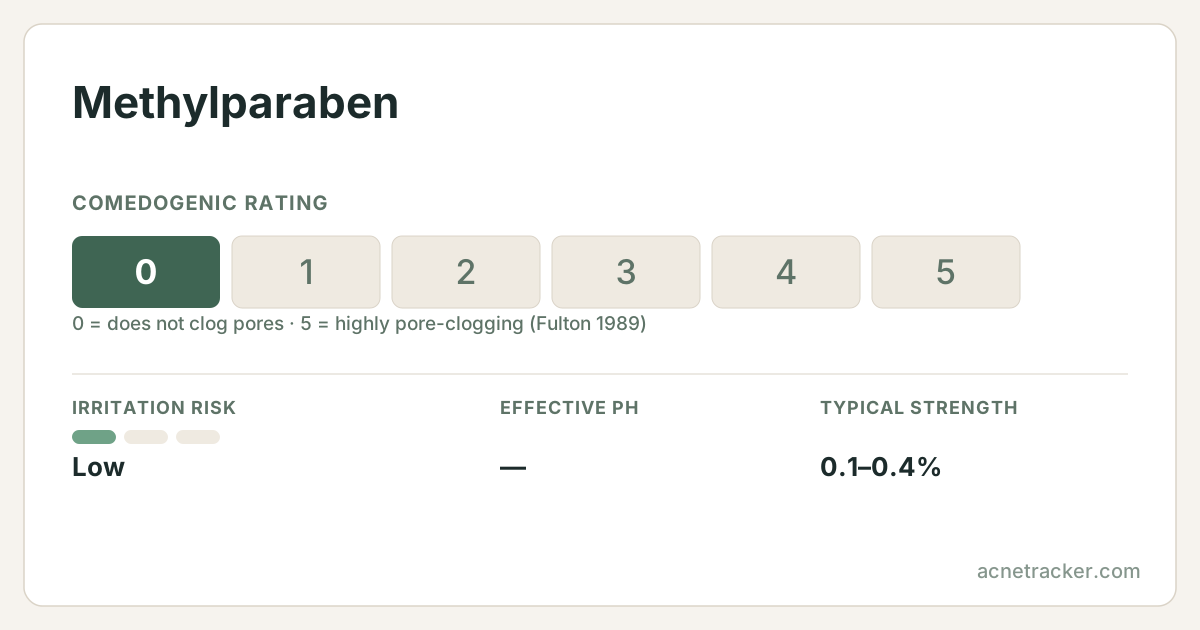
Methylparaben is a preservative from the paraben family and one of the most mischaracterised ingredients in skincare. Parabens became a marketing target in the 2000s, and "paraben-free" claims are now everywhere, yet the scientific and regulatory picture is far more reassuring than the reputation suggests. Methylparaben is the mildest and most water-soluble of the parabens, used for decades to protect products from bacteria and mould. Both the European Union's Scientific Committee on Consumer Safety and the US FDA have reviewed the evidence and permit its use, with the EU setting clear concentration limits rather than banning it.
Quick facts
- Comedogenic rating
- measured (Fulton 1989)
- Irritation risk
- Low
- Effective pH
- —
- Typical strength
- 0.1–0.4%
- Pregnancy
- Considered safe
- Suits skin types
- oilydrycombinationsensitivenormalacne-prone
Where this number comes from
Read directly from Table I of Fulton's 1989 paper — the primary source, not one of the copied tables that circulate online.
Fulton read his own scale as 0-1 not significant, 2-3 borderline, 4-5 positive. The assay is the rabbit ear at 10% dilution, which the paper itself calls extremely sensitive and not fully predictive of human skin. Ratings describe the raw ingredient; concentration and formulation change real-world behaviour.
Caution profile
The four published fields on this page, on one 0–5 scale. Further from the centre means more care is needed — never that the ingredient is worse.
Derived, not measured: pore-clogging is the published comedogenic rating; irritation maps low/moderate/high to 1/3/5; pregnancy maps safe/caution/avoid to 0/3/5; skin-type limits is how many of the seven skin types this entry does NOT list. Every input is printed in words in the quick-facts card above.
Show the numbers
| Metric | 0–5 | Published field |
|---|---|---|
| Pore-clogging | 0 | 0/5 |
| Irritation | 1 | Low |
| Skin-type limits | 0.7 | 6/7 |
| Pregnancy | 0 | Considered safe |
Working pH and typical strength
Where this ingredient is formulated to sit, and at what concentration.
Both bars come from the fields above: the pH window and the typical strength range published for this ingredient. The tinted column is healthy skin's surface pH (about 4.7–5.75).
Show the numbers
| Metric | 0–5 |
|---|---|
| Typical strength | 0.1–0.4% |
What is it?
Methylparaben is an ester of para-hydroxybenzoic acid, a compound that also occurs naturally in some fruits and plants. As a preservative it is effective mainly against moulds and yeasts and is usually combined with other parabens or preservatives for broad-spectrum protection. It has a long track record and a low irritation and allergy rate, which is one reason it stayed popular for so long. The controversy centres on the fact that some parabens can weakly mimic oestrogen in laboratory tests, but this activity is thousands of times weaker than the body's own hormones, and regulators concluded that methylparaben and ethylparaben are safe at permitted cosmetic levels.
Benefits
Protects against mould and yeast
Methylparaben is particularly effective against fungal contamination, helping keep water-based products safe and stable throughout their shelf life.
Very low irritation profile
Among preservatives it has one of the lowest rates of irritation and allergic reaction, which is why it was so widely used for decades.
Well studied and regulated
Few preservatives have as much safety data. The EU SCCS and FDA have reviewed it repeatedly and permit its use within defined limits.
Effective at low concentrations
It preserves formulas at fractions of a percent, minimising the total load of preservative needed while keeping products microbially safe.
How to use
Methylparaben is a background preservative — nothing to apply separately and no routine considerations. It is compatible with all common actives, including niacinamide, hyaluronic-acid, retinol and vitamin-c. There is no evidence-based reason to avoid it for skin health, and "paraben-free" is a marketing statement rather than a safety upgrade. If you personally prefer to avoid parabens, choose products preserved with phenoxyethanol, benzyl-alcohol or organic-acid systems such as sodium-benzoate and potassium-sorbate.
Side effects
Methylparaben is well tolerated by the large majority of users, with a lower rate of contact allergy than several of the preservatives that replaced it. Reactions, when they occur, are usually mild localised irritation. The widely repeated claims linking parabens to breast cancer come from a small 2004 study that detected parabens in tumour tissue but did not show they caused cancer; regulatory reviews since then have not supported a causal link at cosmetic exposure.
Who should avoid it
Only people with a confirmed paraben allergy need to avoid methylparaben, which is relatively uncommon. There is no general medical reason for sensitive or acne-prone skin to reject it. Those who prefer to avoid it for personal or precautionary reasons have many paraben-free options preserved with alternative systems.
Pairs well with
Frequently asked questions
Are parabens like methylparaben dangerous?
No, not at cosmetic levels. The EU SCCS and FDA have reviewed the evidence and permit methylparaben within set limits. Its reputation comes largely from misinterpreted studies rather than demonstrated harm in cosmetics.
Do parabens cause cancer?
There is no established causal link at cosmetic exposure. The cancer worry traces to a 2004 study that found parabens in tumour tissue but did not show causation. Later regulatory reviews did not confirm a risk.
Is methylparaben safe for acne-prone skin?
Yes. It has a comedogenic rating of zero, a low irritation rate, and does not clog pores, so it is a suitable preservative for acne-prone and sensitive skin alike.
Is paraben-free better?
Not inherently. Paraben-free is a marketing claim, and some replacement preservatives have higher allergy rates than parabens. Choose based on how your skin reacts, not on the paraben-free label alone.
Sources & further reading
Medical disclaimer
Find your personal acne triggers
Our free Acne Tracker lets you log breakouts, sleep, stress and diet, and shows you which factors correlate with your flare-ups.