Disodium EDTA: Comedogenic Rating & Ingredient Analysis
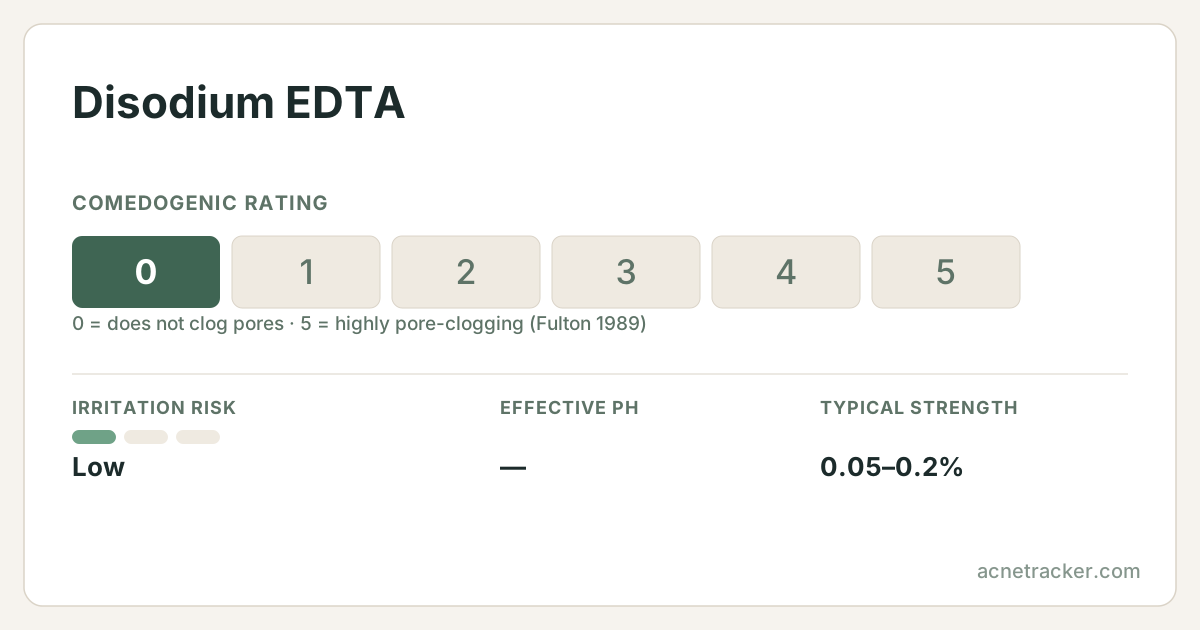
Disodium EDTA is a chelating agent, a type of ingredient whose job is to grab hold of metal ions in a formula and hold them inactive. It is not a preservative in the classic sense, but it acts as a preservative booster and a stabiliser, helping products stay effective and appealing over their shelf life. It appears in a huge range of cosmetics at very low concentrations, usually well under 0.2%, and is one of the more invisible workhorse ingredients — rarely marketed, rarely worried about, but present in a large share of the products in your bathroom.
Quick facts
- Comedogenic rating
- our estimate — not measured
- Irritation risk
- Low
- Effective pH
- —
- Typical strength
- 0.05–0.2%
- Pregnancy
- Considered safe
- Suits skin types
- oilydrycombinationsensitivenormalacne-prone
Where this number comes from
No one has published a comedogenic rating for this ingredient. Fulton's 1989 table tested about 250 raw materials and this was not among them, and we found no later study measuring it. The figure shown is our own reasoning from the ingredient's chemistry and how it is used — treat it as an estimate, not a measurement.
Fulton read his own scale as 0-1 not significant, 2-3 borderline, 4-5 positive. The assay is the rabbit ear at 10% dilution, which the paper itself calls extremely sensitive and not fully predictive of human skin. Ratings describe the raw ingredient; concentration and formulation change real-world behaviour.
Caution profile
The four published fields on this page, on one 0–5 scale. Further from the centre means more care is needed — never that the ingredient is worse.
Derived, not measured: pore-clogging is the published comedogenic rating; irritation maps low/moderate/high to 1/3/5; pregnancy maps safe/caution/avoid to 0/3/5; skin-type limits is how many of the seven skin types this entry does NOT list. Every input is printed in words in the quick-facts card above.
Show the numbers
| Metric | 0–5 | Published field |
|---|---|---|
| Pore-clogging | 0 | 0/5 |
| Irritation | 1 | Low |
| Skin-type limits | 0.7 | 6/7 |
| Pregnancy | 0 | Considered safe |
Working pH and typical strength
Where this ingredient is formulated to sit, and at what concentration.
Both bars come from the fields above: the pH window and the typical strength range published for this ingredient. The tinted column is healthy skin's surface pH (about 4.7–5.75).
Show the numbers
| Metric | 0–5 |
|---|---|
| Typical strength | 0.05–0.2% |
What is it?
EDTA stands for ethylenediaminetetraacetic acid, and the disodium salt is the common cosmetic form. Its function is chelation: it binds trace metal ions, such as iron and copper, that sneak into formulas from water, raw materials or packaging. Free metal ions can cause products to discolour, go rancid, lose the effectiveness of their preservatives, or destabilise sensitive actives. By locking these metals up, disodium EDTA improves clarity, colour stability and the performance of the preservative system, and it can help protect oxidation-prone actives such as vitamin-c. It has no direct treatment effect on skin and a comedogenic rating of zero.
Benefits
Boosts preservative performance
By removing metal ions that microbes can use, it strengthens the preservative system so lower levels of preservative work more effectively.
Stabilises the formula
It prevents discolouration, cloudiness and rancidity caused by trace metals, keeping products looking and performing as intended.
Protects sensitive actives
By controlling metal-catalysed oxidation, it can help preserve the potency of ingredients like vitamin C that degrade in the presence of metals.
Improves rinsing in hard water
In cleansers, chelators help surfactants perform in hard water by tying up the calcium and magnesium that otherwise reduce lather and leave residue.
How to use
Disodium EDTA is a background formulation aid — nothing to apply on its own and no routine considerations. It is compatible with essentially all actives, including niacinamide, vitamin-c, retinol and glycerin, and its presence is a sign of a well-stabilised formula rather than a concern. There is no benefit to avoiding it for skin health, and no special handling is needed. You will find it far down ingredient lists precisely because it is used at such low levels.
Side effects
Disodium EDTA has a very low irritation and allergy profile at cosmetic concentrations, and reactions are rare. Occasionally there is discussion of whether chelators could enhance the penetration of other ingredients, but at the low levels used in cosmetics this is not considered a meaningful safety issue by regulators. For the overwhelming majority of users it is an entirely uneventful ingredient.
Who should avoid it
There is no general reason to avoid disodium EDTA; only those with a specific, confirmed sensitivity need to. It sits in the formula as a chelator at fractions of a percent and never interacts with the pore, so sensitive and acne-prone skin has nothing to weigh here. Some environmentally focused consumers prefer products using more readily biodegradable chelators, which is an ecological preference rather than a skin-safety one.
Pairs well with
Frequently asked questions
What does disodium EDTA do in skincare?
It is a chelating agent that binds trace metal ions, which stabilises the formula, boosts the preservative system, and protects oxidation-prone actives. It has no direct treatment effect on the skin.
Is disodium EDTA safe?
Yes. At the low concentrations used in cosmetics it has a very low irritation and allergy profile and is permitted by regulators. It is one of the most common and least troublesome stabiliser ingredients.
Does disodium EDTA cause acne?
No. It has a comedogenic rating of zero, is used in tiny amounts, and does not clog pores, so it does not cause breakouts and suits acne-prone skin.
Why is disodium EDTA in so many products?
Trace metals from water and raw materials can spoil formulas and weaken preservatives. Disodium EDTA locks those metals away cheaply and effectively, which is why it is used across so many product types.
Sources & further reading
Medical disclaimer
Find your personal acne triggers
Our free Acne Tracker lets you log breakouts, sleep, stress and diet, and shows you which factors correlate with your flare-ups.