Phytosphingosine: Comedogenic Rating & Ingredient Analysis
Phytosphingosine is a lipid that punches above its weight in skincare. It belongs to the sphingolipid family — the same chemistry as ceramides — and it is actually a building block your skin uses to make its own ceramides. That gives it a genuine barrier-repair role. But phytosphingosine has a second, less common talent: it has antimicrobial and anti-inflammatory activity, with research suggesting it can help calm the bacteria and redness involved in acne. This combination of barrier support and blemish-calming makes it an unusually versatile ingredient, found in products for both dry, sensitive skin and acne-prone skin.
Quick facts
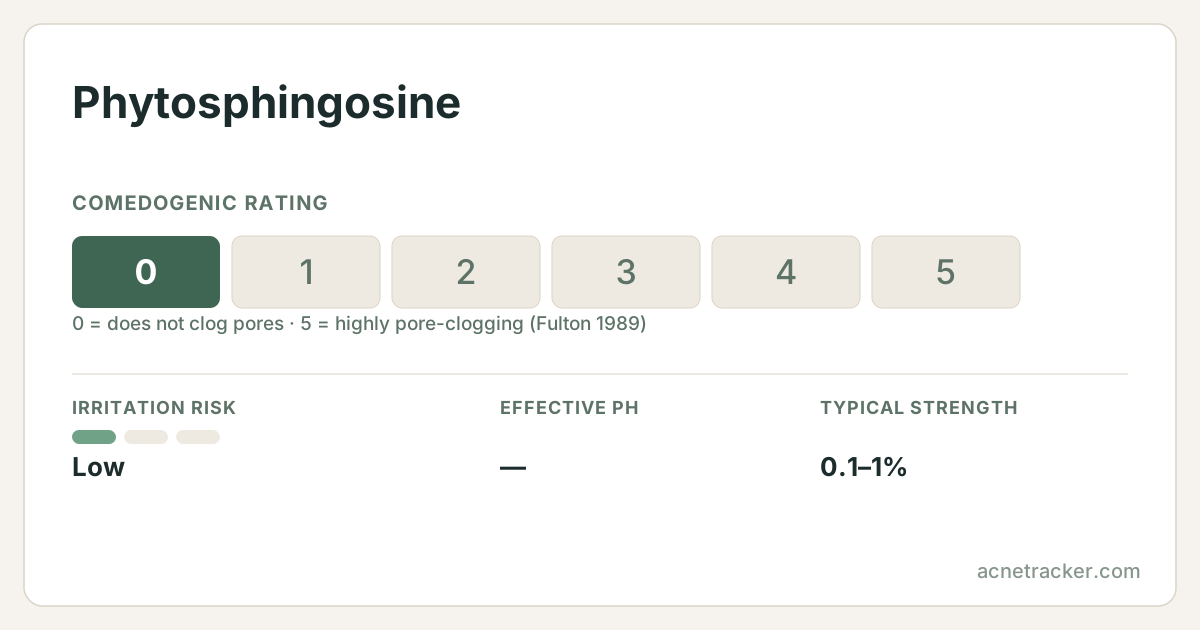
- Comedogenic rating
- our estimate — not measured
- Irritation risk
- Low
- Effective pH
- —
- Typical strength
- 0.1–1%
- Pregnancy
- Considered safe
- Suits skin types
- drysensitiveacne-pronenormalcombinationmature
Where this number comes from
No one has published a comedogenic rating for this ingredient. Fulton's 1989 table tested about 250 raw materials and this was not among them, and we found no later study measuring it. The figure shown is our own reasoning from the ingredient's chemistry and how it is used — treat it as an estimate, not a measurement.
Fulton read his own scale as 0-1 not significant, 2-3 borderline, 4-5 positive. The assay is the rabbit ear at 10% dilution, which the paper itself calls extremely sensitive and not fully predictive of human skin. Ratings describe the raw ingredient; concentration and formulation change real-world behaviour.
Caution profile
The four published fields on this page, on one 0–5 scale. Further from the centre means more care is needed — never that the ingredient is worse.
Derived, not measured: pore-clogging is the published comedogenic rating; irritation maps low/moderate/high to 1/3/5; pregnancy maps safe/caution/avoid to 0/3/5; skin-type limits is how many of the seven skin types this entry does NOT list. Every input is printed in words in the quick-facts card above.
Show the numbers
| Metric | 0–5 | Published field |
|---|---|---|
| Pore-clogging | 0 | 0/5 |
| Irritation | 1 | Low |
| Skin-type limits | 0.7 | 6/7 |
| Pregnancy | 0 | Considered safe |
Working pH and typical strength
Where this ingredient is formulated to sit, and at what concentration.
Both bars come from the fields above: the pH window and the typical strength range published for this ingredient. The tinted column is healthy skin's surface pH (about 4.7–5.75).
Show the numbers
| Metric | 0–5 |
|---|---|
| Typical strength | 0.1–1% |
What is it?
Phytosphingosine is a sphingoid base, one of the core backbones from which ceramides are assembled. The skin naturally uses sphingosine-type molecules to construct the ceramides that, with cholesterol and fatty acids, form the barrier's lipid matrix, so supplying phytosphingosine supports that native building process and reinforces the barrier. Beyond structure, it has documented antimicrobial activity against several skin microbes, including Cutibacterium acnes, the bacterium linked to inflammatory acne, and it has anti-inflammatory effects that help settle redness. It is used at low concentrations, has a comedogenic rating of 0, and is well tolerated, making it a rare ingredient that supports the barrier while also being genuinely useful for breakouts.
Benefits
Reinforces the barrier
As a ceramide building block, phytosphingosine supports the skin's own ceramide production and strengthens the lipid barrier against water loss.
Calms inflammation
Its anti-inflammatory action helps settle the redness and irritation that accompany both sensitive skin and active breakouts.
Antimicrobial against acne bacteria
It has activity against Cutibacterium acnes and other microbes, which is why it appears in products aimed at acne-prone skin.
Works with barrier lipids
It complements ceramides and cholesterol in the barrier lipid trio, making it a natural partner in barrier-repair formulas.
How to use
Use products containing phytosphingosine as directed, morning or night. It is present at low levels and needs no special handling. For barrier support, look for it alongside ceramides and cholesterol; for blemish-prone skin, it pairs well with calming actives like niacinamide. It layers over humectants and under richer creams without conflict. There is no adjustment period and no photosensitivity concern, so it fits easily into most routines, whether your focus is repairing the barrier or reducing breakouts.
Side effects
Phytosphingosine is well tolerated at the low levels used in cosmetics, with irritation and allergy being uncommon. As a skin-identical lipid, it is inherently compatible. Its comedogenic rating is 0, and unlike the acne actives it competes with, it adds no photosensitivity — an anti-blemish ingredient you can wear in the morning. For nearly all users it is comfortable, and its antimicrobial nature is gentle rather than stripping.
Who should avoid it
No skin type specifically needs to avoid phytosphingosine, including acne-prone skin, which often benefits from it. At 0.1–1% there is little present to provoke a reaction, but very reactive skin can patch test a new product first.
Pairs well with
Frequently asked questions
What does phytosphingosine do for skin?
It reinforces the barrier as a ceramide building block, calms inflammation, and has antimicrobial action against acne-linked bacteria, making it useful for both sensitive and acne-prone skin.
Is phytosphingosine good for acne?
It can help. It has anti-inflammatory and antimicrobial activity, including against Cutibacterium acnes, while also supporting the barrier, so it addresses breakouts without stripping the skin.
Does phytosphingosine clog pores?
No. It has a comedogenic rating of 0, is used at low levels and is a skin-identical lipid, so it does not clog pores and is suitable for acne-prone skin.
How is phytosphingosine related to ceramides?
It is a sphingoid base, one of the building blocks the skin uses to make ceramides. Supplying it supports the skin's own ceramide production and barrier lipids.
Sources & further reading
Medical disclaimer
Find your personal acne triggers
Our free Acne Tracker lets you log breakouts, sleep, stress and diet, and shows you which factors correlate with your flare-ups.