Cholesterol: Comedogenic Rating & Ingredient Analysis
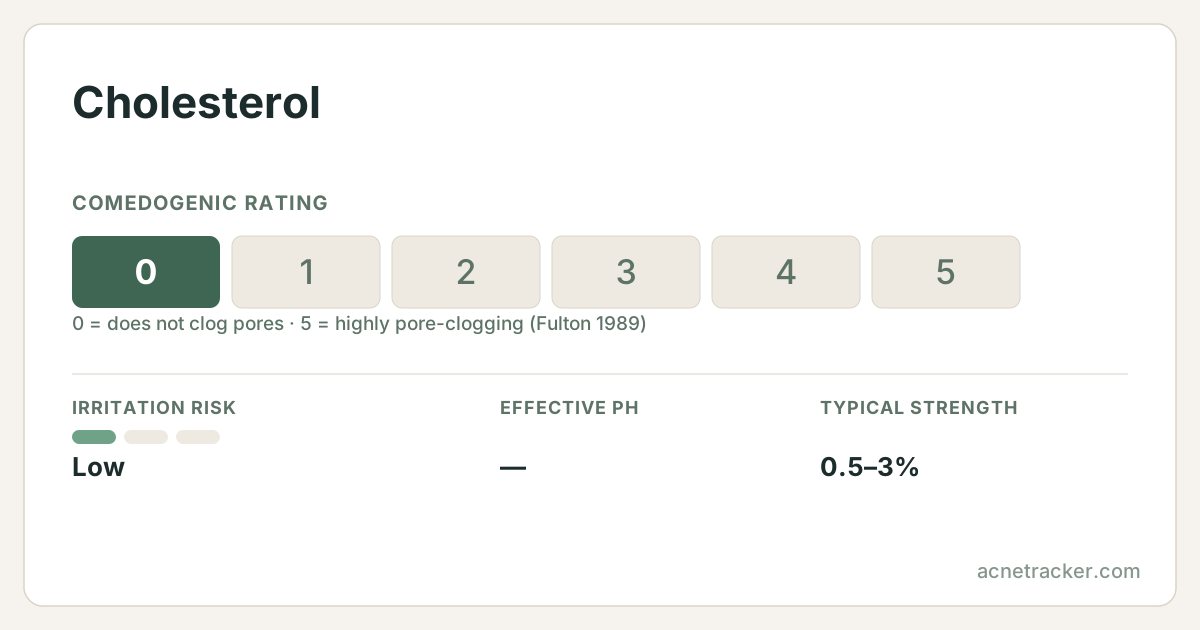
Cholesterol has an unfairly bad reputation from heart-health headlines, but on the skin it is essential. It is one of the three lipids — alongside ceramides and free fatty acids — that make up the mortar holding the outer skin cells together in a healthy barrier. Without enough cholesterol, that mortar cracks, and skin loses water, feels tight and reacts more easily. Replenishing it topically is a cornerstone of barrier repair, which is why cholesterol appears in moisturisers and creams for dry, mature and sensitive skin, most powerfully when combined with ceramides and fatty acids in the proportions the skin uses naturally.
Quick facts
- Comedogenic rating
- measured (Fulton 1989)
- Irritation risk
- Low
- Effective pH
- —
- Typical strength
- 0.5–3%
- Pregnancy
- Considered safe
- Suits skin types
- drysensitivematurenormalcombinationacne-prone
Where this number comes from
Read directly from Table I of Fulton's 1989 paper — the primary source, not one of the copied tables that circulate online.
Fulton read his own scale as 0-1 not significant, 2-3 borderline, 4-5 positive. The assay is the rabbit ear at 10% dilution, which the paper itself calls extremely sensitive and not fully predictive of human skin. Ratings describe the raw ingredient; concentration and formulation change real-world behaviour.
Caution profile
The four published fields on this page, on one 0–5 scale. Further from the centre means more care is needed — never that the ingredient is worse.
Derived, not measured: pore-clogging is the published comedogenic rating; irritation maps low/moderate/high to 1/3/5; pregnancy maps safe/caution/avoid to 0/3/5; skin-type limits is how many of the seven skin types this entry does NOT list. Every input is printed in words in the quick-facts card above.
Show the numbers
| Metric | 0–5 | Published field |
|---|---|---|
| Pore-clogging | 0 | 0/5 |
| Irritation | 1 | Low |
| Skin-type limits | 0.7 | 6/7 |
| Pregnancy | 0 | Considered safe |
Working pH and typical strength
Where this ingredient is formulated to sit, and at what concentration.
Both bars come from the fields above: the pH window and the typical strength range published for this ingredient. The tinted column is healthy skin's surface pH (about 4.7–5.75).
Show the numbers
| Metric | 0–5 |
|---|---|
| Typical strength | 0.5–3% |
What is it?
Cholesterol is a waxy lipid produced by the body and found throughout the skin barrier. In the stratum corneum, the outermost layer, dead skin cells are embedded in a lipid matrix made of roughly equal parts ceramides, cholesterol and free fatty acids. This 1:1:1 mixture forms the water-tight seal that keeps moisture in and irritants out. Cholesterol gives this matrix flexibility and fluidity, so the barrier is not brittle. Its production declines with age and is disrupted by over-cleansing, harsh actives and conditions like eczema, all of which weaken the barrier. Research on barrier repair shows that applying the three lipids together, in a physiological ratio, restores the barrier faster than any one alone. Cholesterol is non-comedogenic and very well tolerated.
Benefits
Repairs the skin barrier
As one of the three essential barrier lipids, cholesterol helps rebuild the mortar between skin cells, reducing water loss and sensitivity.
Softens and smooths
As an emollient it fills the gaps between surface cells, leaving skin feeling supple, smooth and comfortable rather than tight.
Works best in the lipid trio
Combined with ceramides and fatty acids in a 1:1:1 ratio, cholesterol restores the barrier faster than any single lipid used alone.
Valuable for mature skin
Because natural cholesterol production falls with age, replenishing it topically is especially helpful for dry and mature skin.
How to use
Cholesterol comes in leave-on moisturisers and barrier creams that you apply after your water-based serums, morning or night. For barrier repair, look for products that pair it with ceramides and fatty acids, ideally near a 1:1:1 ratio, as this physiological blend is the most effective. It layers over humectants like glycerin and hyaluronic acid to seal in the water they attract, and works well alongside other barrier lipids such as phytosphingosine and softening emollients like squalane. There is no adjustment period and no sun-sensitivity concern.
Side effects
Cholesterol is very well tolerated, and irritation or allergy is rare. As a physiological skin lipid, it is inherently skin-compatible. It has a comedogenic rating of 0 and, unlike some heavy oils, is unlikely to cause breakouts even on acne-prone skin. It does not increase sun sensitivity. For nearly all users it is a comfortable, restorative ingredient.
Who should avoid it
No skin type needs to avoid topical cholesterol. Even oily and acne-prone skin generally tolerates it well because it is non-comedogenic. Reacting to cholesterol would mean reacting to a lipid your own barrier is roughly one-third built from, which is why documented cases are so scarce; patch test if you have one on record.
Pairs well with
Frequently asked questions
Is cholesterol good for skin?
Yes. Cholesterol is one of the three essential barrier lipids, alongside ceramides and fatty acids. Replenishing it helps repair the skin barrier, reduce water loss and soften the skin.
Does cholesterol clog pores?
No. Topical cholesterol has a comedogenic rating of 0 and is a natural barrier lipid, so it does not clog pores and is generally fine for acne-prone skin.
Why is cholesterol used with ceramides?
The skin barrier is built from ceramides, cholesterol and fatty acids in roughly equal amounts. Using them together in a 1:1:1 ratio repairs the barrier faster than any single lipid alone.
Is skincare cholesterol bad for the heart?
No. Topical cholesterol acts only on the skin surface and has nothing to do with blood cholesterol or heart health, which relate to what you eat and your metabolism.
Where this ingredient shows up here
Counted across this database, not the web — these are the pages on this site that reason about this ingredient.
Sources & further reading
Medical disclaimer
Find your personal acne triggers
Our free Acne Tracker lets you log breakouts, sleep, stress and diet, and shows you which factors correlate with your flare-ups.