Carbomer: Comedogenic Rating & Ingredient Analysis
Carbomer is the invisible scaffolding behind most clear gels in your bathroom, from aloe gels and cleansing gels to lightweight moisturizers and hand sanitizer. It is a synthetic polymer of acrylic acid that, on its own, is a fine white powder with no thickening power. Only when it is dispersed in water and then neutralized with a base does it swell dramatically and lock the liquid into a transparent, non-drippy gel. Because it does this at tiny concentrations and produces a crystal-clear result, it has become one of the default thickeners in modern cosmetic chemistry.
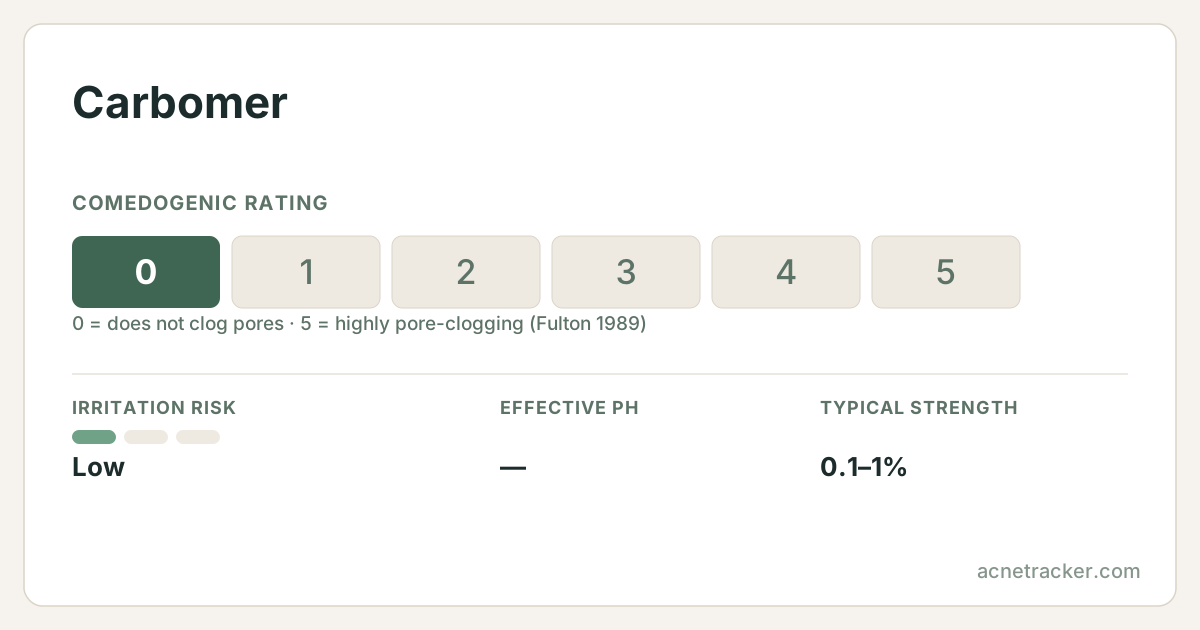
Quick facts
- Comedogenic rating
- our estimate — not measured
- Irritation risk
- Low
- Effective pH
- —
- Typical strength
- 0.1–1%
- Pregnancy
- Considered safe
- Suits skin types
- oilydrycombinationsensitivenormalacne-pronemature
Where this number comes from
No one has published a comedogenic rating for this ingredient. Fulton's 1989 table tested about 250 raw materials and this was not among them, and we found no later study measuring it. The figure shown is our own reasoning from the ingredient's chemistry and how it is used — treat it as an estimate, not a measurement.
Fulton read his own scale as 0-1 not significant, 2-3 borderline, 4-5 positive. The assay is the rabbit ear at 10% dilution, which the paper itself calls extremely sensitive and not fully predictive of human skin. Ratings describe the raw ingredient; concentration and formulation change real-world behaviour.
Caution profile
The four published fields on this page, on one 0–5 scale. Further from the centre means more care is needed — never that the ingredient is worse.
Derived, not measured: pore-clogging is the published comedogenic rating; irritation maps low/moderate/high to 1/3/5; pregnancy maps safe/caution/avoid to 0/3/5; skin-type limits is how many of the seven skin types this entry does NOT list. Every input is printed in words in the quick-facts card above.
Show the numbers
| Metric | 0–5 | Published field |
|---|---|---|
| Pore-clogging | 0 | 0/5 |
| Irritation | 1 | Low |
| Skin-type limits | 0 | 7/7 |
| Pregnancy | 0 | Considered safe |
Working pH and typical strength
Where this ingredient is formulated to sit, and at what concentration.
Both bars come from the fields above: the pH window and the typical strength range published for this ingredient. The tinted column is healthy skin's surface pH (about 4.7–5.75).
Show the numbers
| Metric | 0–5 |
|---|---|
| Typical strength | 0.1–1% |
What is it?
Carbomer is a family of high-molecular-weight polymers built from repeating acrylic acid units, often cross-linked into a coiled structure. Added to water it is acidic and stays coiled; when a pH adjuster such as triethanolamine, aminomethyl propanol or sodium hydroxide raises the pH toward neutral, the coils unwind and repel each other, absorbing water and thickening the whole system into a gel. This neutralization step is why carbomer is almost always found alongside a base on the ingredient list. The polymer is too large to penetrate skin, has no biological activity, and is used purely to control texture, stabilize emulsions and suspend particles.
Benefits
Makes crystal-clear gels
Unlike many natural gums that look cloudy, carbomer produces perfectly transparent gels, which is why it dominates aloe gels, serums and clear cleansers.
Thickens at very low levels
A few tenths of a percent are enough to turn water into a stable gel, so it adds almost no weight or residue to a formula.
Stabilizes emulsions
By thickening the water phase it helps keep oil droplets evenly dispersed, preventing creams and lotions from separating over their shelf life.
Controls flow and slip
It gives products a cushioned, non-runny feel and lets chemists fine-tune whether a gel is thick and standing or soft and spreadable.
How to use
Carbomer requires nothing from you as a user; it is fully formulated into the finished product and neutralized during manufacturing. You will see it in gels, serums, lightweight creams, masks and cleansers. If a gel feels slightly tacky or occasionally balls up under makeup, that is a sign of a carbomer level tuned a touch high, not a defect. Applying to damp skin and letting it absorb before layering minimizes any pilling.
Side effects
Neutralized carbomer in a finished product is considered non-irritating and non-comedogenic, with a rating of 0. It does not sensitize the skin. The only practical drawbacks are cosmetic: an over-thickened formula can feel sticky or pill. Reactions are essentially unheard of because the polymer neither penetrates nor reacts with skin.
Who should avoid it
There is no skin type that needs to avoid carbomer. It is suitable for sensitive, acne-prone and reactive skin, and is regarded as safe during pregnancy and breastfeeding. Anyone worried about a specific formula should judge it by its actives and preservatives, not the carbomer.
Frequently asked questions
Is carbomer safe for skin?
Yes. Once neutralized in a product it is inert, non-irritating and has a comedogenic rating of 0. It sits on the surface as a gel network and is not absorbed.
Why does carbomer need a pH adjuster?
In its raw acidic state carbomer stays coiled and does not thicken. A base such as triethanolamine or sodium hydroxide neutralizes it, unwinding the polymer so it swells into a gel.
Does carbomer clog pores?
No. It is a large surface-level polymer with a comedogenic rating of 0, so it does not penetrate or block pores and is fine for acne-prone skin.
Is carbomer natural?
No, it is a synthetic polymer of acrylic acid. It is manufactured rather than plant-derived, but it is well studied and considered safe for cosmetic use.
What is the difference between carbomer and xanthan gum?
Both thicken, but carbomer is synthetic and makes clear gels once neutralized, while xanthan gum is a natural fermentation product that looks slightly cloudy and needs no pH adjustment.
Sources & further reading
Medical disclaimer
Find your personal acne triggers
Our free Acne Tracker lets you log breakouts, sleep, stress and diet, and shows you which factors correlate with your flare-ups.