Lactobionic Acid: Comedogenic Rating & Ingredient Analysis
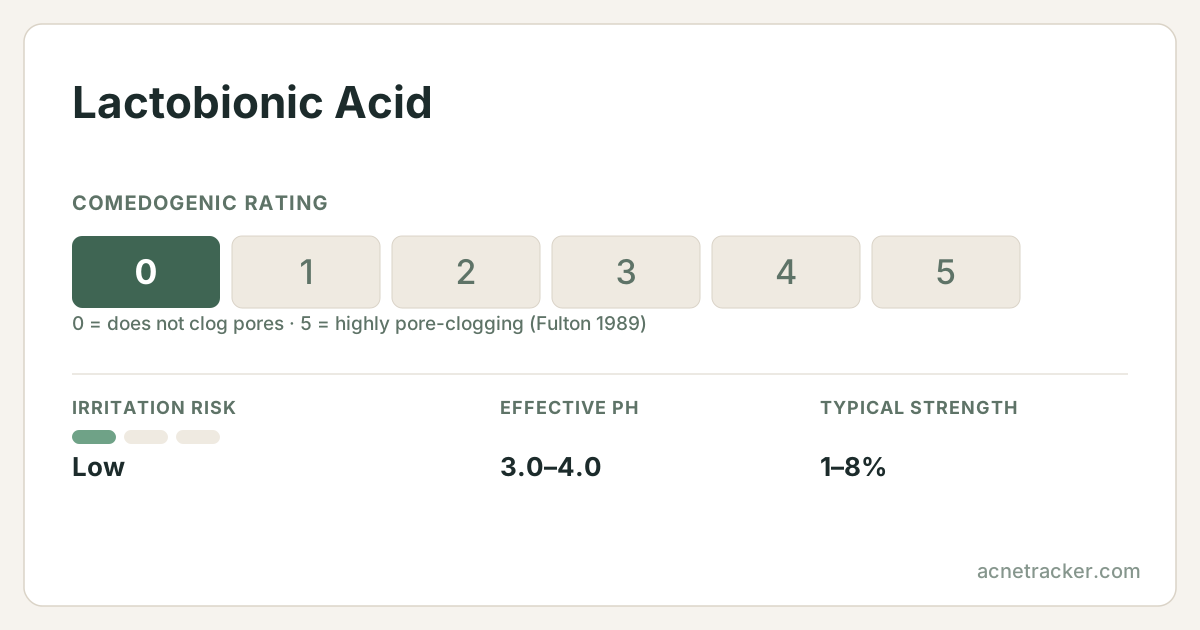
Lactobionic acid is a polyhydroxy bionic acid — a next-generation relative of the PHA family that shares gluconolactone's gentleness but with even stronger water-binding power. Made from lactose, it carries many hydroxyl groups that grab hold of moisture, so it hydrates conspicuously while it exfoliates. Its large molecule keeps penetration slow and irritation low, which makes it a favourite for sensitive and mature skin that wants smoother texture without the sting of stronger acids. It is also a recognised antioxidant and metal chelator, adding a protective dimension to its resurfacing role.
Quick facts
- Comedogenic rating
- our estimate — not measured
- Irritation risk
- Low
- Effective pH
- 3.0–4.0
- Typical strength
- 1–8%
- Pregnancy
- Considered safe
- Suits skin types
- drysensitivematurenormalacne-prone
Where this number comes from
No one has published a comedogenic rating for this ingredient. Fulton's 1989 table tested about 250 raw materials and this was not among them, and we found no later study measuring it. The figure shown is our own reasoning from the ingredient's chemistry and how it is used — treat it as an estimate, not a measurement.
Fulton read his own scale as 0-1 not significant, 2-3 borderline, 4-5 positive. The assay is the rabbit ear at 10% dilution, which the paper itself calls extremely sensitive and not fully predictive of human skin. Ratings describe the raw ingredient; concentration and formulation change real-world behaviour.
Caution profile
The four published fields on this page, on one 0–5 scale. Further from the centre means more care is needed — never that the ingredient is worse.
Derived, not measured: pore-clogging is the published comedogenic rating; irritation maps low/moderate/high to 1/3/5; pregnancy maps safe/caution/avoid to 0/3/5; skin-type limits is how many of the seven skin types this entry does NOT list. Every input is printed in words in the quick-facts card above.
Show the numbers
| Metric | 0–5 | Published field |
|---|---|---|
| Pore-clogging | 0 | 0/5 |
| Irritation | 1 | Low |
| Skin-type limits | 1.4 | 5/7 |
| Pregnancy | 0 | Considered safe |
Working pH and typical strength
Where this ingredient is formulated to sit, and at what concentration.
Both bars come from the fields above: the pH window and the typical strength range published for this ingredient. The tinted column is healthy skin's surface pH (about 4.7–5.75).
Show the numbers
| Metric | 0–5 |
|---|---|
| Working pH | 3.0–4.0 |
| Typical strength | 1–8% |
What is it?
Lactobionic acid is a bionic acid produced by oxidising lactose, giving a molecule with a sugar unit attached to a gluconic acid backbone and an unusually high number of hydroxyl groups. Those groups make it an excellent humectant — it can hold significant water and form a light moisturising film on the skin. Like other PHAs, it exfoliates by loosening the cohesion between dead surface cells, but slowly and gently, with negligible impact on sun sensitivity. It has been studied for its antioxidant behaviour and its ability to bind metal ions that drive oxidative damage, which is one reason it appears in formulas aimed at both smoothing and defending the skin.
Benefits
Deeply hydrating exfoliation
Its large number of water-binding groups make lactobionic acid one of the most moisturising exfoliants, so skin looks plumper and feels supple rather than tight.
Very gentle resurfacing
The bulky molecule penetrates slowly, refining rough, dull texture with minimal stinging — a good fit for skin that reacts to glycolic or lactic acid.
Antioxidant and chelating action
Lactobionic acid can neutralise free radicals and bind reactive metals, giving formulas an extra protective, stabilising quality alongside the exfoliation.
Supports mature skin
By smoothing surface texture while boosting hydration, it helps mature skin look more even and comfortable without the irritation risk of harsher acids.
How to use
Lactobionic acid features in serums, creams and masks, usually gentle enough for regular use. Apply after cleansing and follow with moisturiser; its humectant nature makes it a pleasant layering partner for hydrating serums and niacinamide. Although PHAs barely raise photosensitivity, keep using daily sunscreen while you exfoliate. Start every other day if your skin is reactive and build frequency as it stays comfortable.
Side effects
This is a low-risk exfoliant, but higher concentrations can still cause a little tingling or dryness in some people, and combining several actives can lead to over-exfoliation. A rash or lasting irritation is uncommon and a signal to reduce use. Being gentle does not mean it should be layered endlessly with other acids and retinoids.
Who should avoid it
Few people need to avoid lactobionic acid, and it is often chosen for sensitive skin. If your barrier is currently impaired, let it heal before introducing any acid. Patch test first if you have previously reacted to PHAs or exfoliating acids.
Pairs well with
Avoid combining with
Frequently asked questions
How is lactobionic acid different from other PHAs?
It is a bionic acid with even more water-binding hydroxyl groups than gluconolactone, so it is especially hydrating while still exfoliating gently and causing little irritation.
Is lactobionic acid good for dry skin?
Yes. Its strong humectant character means it draws water into the skin as it exfoliates, so dry and mature skin often finds it more comfortable than traditional AHAs.
Does it increase sun sensitivity?
Only slightly, far less than stronger AHAs. Daily sunscreen remains a good habit whenever you use an exfoliating acid of any kind.
Can I use lactobionic acid with niacinamide?
Yes. They layer well — apply the lactobionic acid product, then niacinamide. The combination supports the barrier while gently refining texture.
Is lactobionic acid safe during pregnancy?
Topical PHAs like lactobionic acid are generally regarded as low risk in pregnancy, but confirming your routine with your doctor is always the safe approach.
Where this ingredient shows up here
Counted across this database, not the web — these are the pages on this site that reason about this ingredient.
Sources & further reading
Medical disclaimer
Find your personal acne triggers
Our free Acne Tracker lets you log breakouts, sleep, stress and diet, and shows you which factors correlate with your flare-ups.