How to Choose an Eye Cream for Men
There is no ingredient that behaves differently on male skin, and no eye cream marketed to men contains anything a unisex one does not. That said, the category is not entirely fictional. Male facial skin does average thicker with higher collagen density and more sebaceous activity, and men as a group present later, wear sunscreen less, and prefer textures that vanish. Those are real differences — they just influence which product you should pick and how you use it, rather than requiring a different chemistry. This page separates the two so you can decide whether the version in the grey tube is worth what it costs.
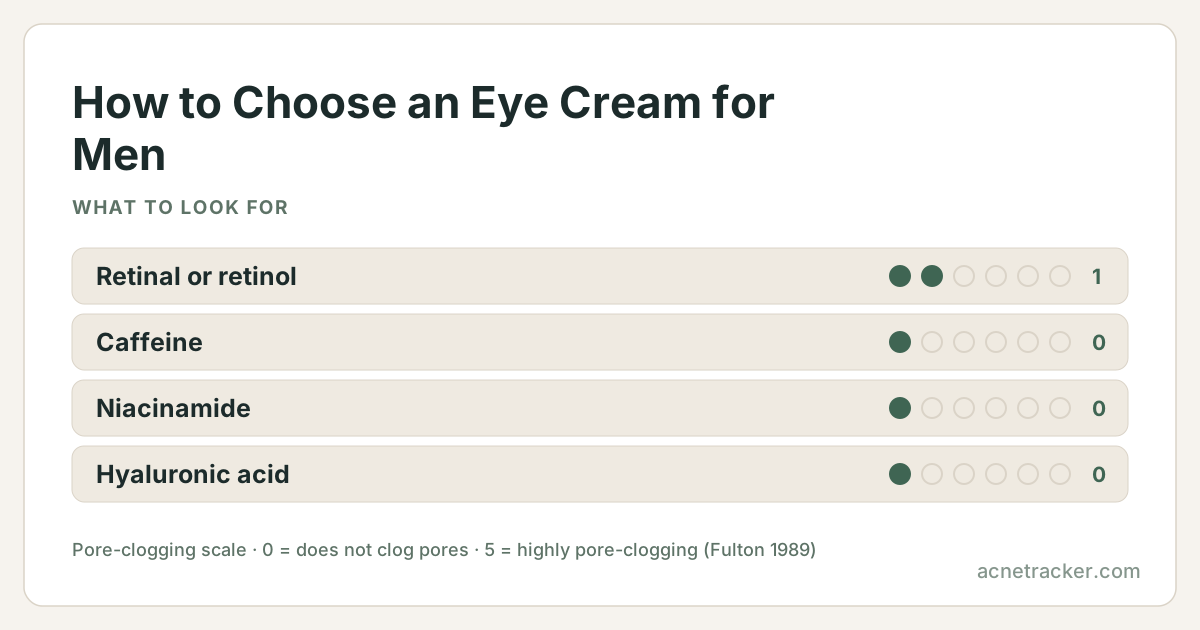
Ingredients to look for
| Ingredient | Why it matters |
|---|---|
| Retinal or retinol | The class with the strongest evidence for reducing wrinkle depth, and the only thing here doing meaningful anti-ageing work. Sex has no bearing on it: the same concentrations do the same thing. |
| Caffeine | Worth it if morning fluid puffiness is your main complaint, which is the most common reason men buy into this category at all. Temporary, mild, and it does nothing for structural bags. |
| Niacinamide | Supports the barrier without weight, and pairs sensibly with the fast-absorbing textures most men will actually keep using — compliance is the variable that decides results. |
| Hyaluronic acid | Gives visible improvement quickly in a light texture. Useful for anyone whose objection to eye cream is that it feels like wearing something. |
| Zinc oxide (in your morning sunscreen) | The genuinely important one. Men use less sun protection on average, and cumulative UV around the eye is the dominant cause of the lines an eye cream is then bought to fix. |
Ingredients to avoid
| Ingredient | Why it matters |
|---|---|
| Paying a premium for masculine packaging | The formula in the grey tube is generally the same technology as the one in the white jar, occasionally lighter in texture. You are choosing a texture and a design, and it is worth knowing that is the choice. |
| Fragrance-heavy men's grooming lines | Fragrance loads tend to run high in this segment, and the eyelid is the site most likely to react to it. A strongly scented product is a poor pick for the body's thinnest skin. |
| Applying eye cream straight after shaving | Freshly shaved skin has a temporarily compromised barrier, and actives applied to it sting and penetrate more than intended. Give it a few minutes and stay off the shaved zone with anything strong. |
| Expecting a cream to fix structural eye bags | Herniated fat pads are anatomy and no topical reaches them. This is worth knowing before rather than after the purchase, whoever the marketing is aimed at. |
How to choose
Decide what you are actually buying it for, since the honest answers split three ways. If it is morning puffiness, a light caffeine gel kept in the fridge covers it, and reducing late salt and alcohol covers more of it. If it is lines, you want a retinoid at eye-appropriate strength and the patience to use it for six months, and there is nothing sex-specific about that decision. If it is dark circles, run the stretch test from our dark circles page first, because the answer depends entirely on which of the three types you have. On texture, the preference for something weightless is worth respecting rather than overriding: the best eye cream is the one you use nightly, and a rich cream you abandon in a week beats nothing by nothing. Look for fragrance-free, since men's ranges are often heavily scented and the eyelid is where that bites. Beyond that, the highest-yield thing in this whole category for men is unglamorous and not an eye cream at all — daily sunscreen and sunglasses, applied to the decade before you started caring.
How to apply
Half a rice grain per eye, on the orbital bone, patted with the ring finger and left to absorb before anything else. Once nightly is enough to get results; twice adds little. Keep it off the lid itself and a centimetre from the lash line, since it travels overnight regardless. If you use a retinoid, evenings only, start twice a week and expect to need three to six months before a fair judgement. Shave first, wait, then apply. And the compliance point is not a throwaway: consistency over a year outperforms every ingredient decision on this page.
Frequently asked questions
Do men need a different eye cream than women?
No. No cosmetic ingredient works differently according to sex, and men's eye creams contain the same actives at the same concentrations. Male skin does average thicker and oilier, which can make lighter textures preferable, but that is a formulation preference rather than a different product category.
Is men's eye cream just marketing?
Mostly the packaging and the texture, and neither is worthless. Ranges aimed at men often use faster-absorbing bases, which genuinely helps if the alternative is not using anything. What you should not pay extra for is the implication that the chemistry inside is different, because it generally is not.
What causes dark circles in men?
The same three things as in anyone: blood showing through thin translucent skin, melanin in the skin, or a hollow casting a shadow. Sleep, alcohol and untreated allergies make the vascular type worse, and lower average sunscreen use makes the pigmented type more likely over time.
When should men start using eye cream?
Whenever there is something specific to address, which is the honest answer at any age. There is no preventive benefit to a moisturiser applied to skin that does not need it. If prevention is the goal, sunscreen and sunglasses from your twenties do vastly more than any eye cream started at forty.
Can I just use my face moisturiser around my eyes?
Frequently yes, provided it is fragrance-free and does not contain strong actives. That is the part the category prefers you not to know. The legitimate reasons to buy an eye-specific product are gentler active concentrations, no fragrance and ophthalmological testing, not a secret ingredient.
Sources & further reading
There is no single study of this exact question. The guidance here is reasoned from the ingredient profiles below, each of which carries its own references:
- Retinal3 refs
- Caffeine2 refs
- Niacinamide2 refs
- Hyaluronic Acid3 refs
- Zinc Oxide2 refs
Show every reference behind this page (10)
- European Commission CosIng database — Retinalcited by Retinal, Niacinamide, Hyaluronic Acid
- PubChem — Retinaldehydecited by Retinal
- Kwon HS et al. Efficacy and safety of retinaldehyde 0.1% and 0.05% creams used to treat photoaged skin: A randomized double-blind controlled trial. J Cosmet Dermatol 2018 Jun (PubMed)cited by Retinal
- PubChem — Caffeinecited by Caffeine
- DermNet — Cosmeceuticalscited by Caffeine
- Niacinamide: mechanisms of action and its topical use in dermatology (PubMed)cited by Niacinamide
- PubChem — Hyaluronic acid compound summarycited by Hyaluronic Acid
- DermNet — Moisturisers and humectantscited by Hyaluronic Acid
- FDA — Sunscreen: How to Read a Label and drug factscited by Zinc Oxide
- PubChem — Zinc Oxide compound summarycited by Zinc Oxide
Medical disclaimer
Ingredients mentioned on this page
Find your personal acne triggers
Our free Acne Tracker lets you log breakouts, sleep, stress and diet, and shows you which factors correlate with your flare-ups.