Ingrown Hairs on the Legs
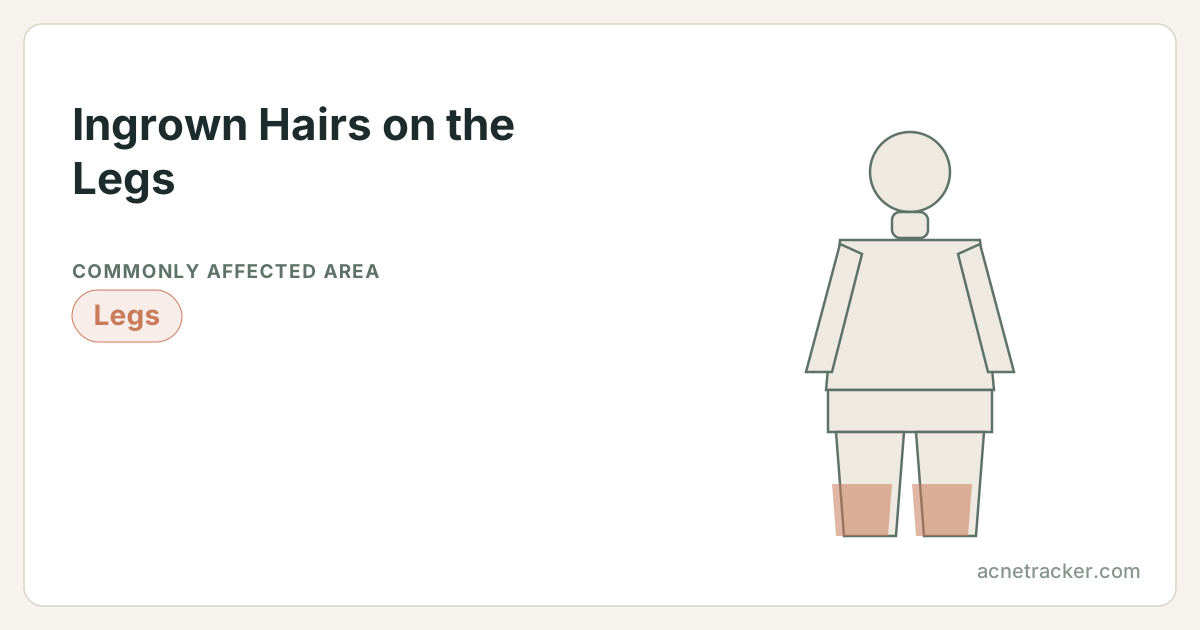
An ingrown hair is a mechanical event with an inflammatory consequence. A hair that should have grown out of the follicle instead grows into the wall of it, or fails to break through the surface and curls back under. The body treats the buried hair as what it is — a foreign object in the dermis — and mounts an inflammatory response around it. That response is the bump. Legs are prime territory because they are shaved and waxed more than any other site and because leg hair on many people is coarse enough to curve. Almost everything people do to ingrown hairs, particularly digging them out with tweezers, makes the resulting mark worse than the hair ever would have.
How to recognize it
A single raised bump, usually larger and firmer than a razor bump and often distinctly sore to press. The identifying feature is visible: look closely and you can frequently see a dark hair looping under the surface or curled inside the bump like a comma. It may develop a pustular top as the inflammation peaks, which people read as infection but is usually just the reaction to the hair. Unlike folliculitis it tends to be one or a few lesions rather than a crop, and unlike keratosis pilaris it is sore and it changes over days. Once settled it very commonly leaves a dark mark that outlasts the bump many times over.
What causes it
Hair cut below the surface
Shaving against the grain leaves the hair tip below skin level with a sharp angled point. When it resumes growing, that point is already aimed sideways into the follicle wall rather than up and out, which is the most common single origin of a leg ingrown.
Curl in the hair itself
A curved hair follicle produces a curved hair, and a curved hair emerging from the surface can arc straight back into the skin a few millimetres away. This is why some people get ingrowns from any hair removal method and others get none at all.
Dead surface skin blocking the exit
If the follicle opening is covered by a layer of built-up surface cells, a growing hair meets a lid instead of an exit and grows sideways under it. This is the one part of the mechanism that regular gentle chemical exfoliation genuinely addresses.
Waxing and epilating that snap the hair
Removing hair from the root should prevent ingrowns, and often does. But when a hair breaks rather than pulls cleanly, the fragment left in the follicle regrows from a broken end at an odd angle, which is why waxing produces its own crop of ingrowns a couple of weeks later.
Tight clothing over regrowth
Leggings, jeans and compression wear press regrowing hair flat against the skin at exactly the point it is trying to emerge. Occlusion does not create the curl, but it holds the hair down while it is deciding which direction to take.
Ingredients with evidence
| Ingredient | Role |
|---|---|
| Salicylic acid (BHA) | The most directly relevant active: it works inside the follicle opening to keep the exit clear, which is the one prevention lever that reliably works between hair removals. |
| Glycolic acid (AHA) | Surface-level smoothing so a hair does not meet a lid on the way out, plus slow work on the marks. A body-strength lotion, a few evenings weekly. |
| Azelaic acid | Calms the inflamed bump and works on the dark mark that follows it, which on legs is usually the part that lasts. |
| Niacinamide | Supports the barrier of skin under repeated hair removal and helps the redness phase settle. Tolerated alongside the exfoliants above. |
| Centella asiatica | Soothing support while an inflamed lesion resolves, for people who find acids too irritating in the days immediately after waxing. |
Building the routine
Prevention is the whole game, because an ingrown that has already formed mostly needs to be left alone. Between hair removals, use a salicylic or glycolic body product two or three evenings a week to keep follicle exits open. Shave with the grain with a fresh blade, or if you wax, do not go back over the same patch repeatedly. For a bump that has already appeared: warm compress, leave it alone, and let the hair work its own way out. Do not dig it out with tweezers or a needle — you will introduce bacteria into a follicle that was merely inflamed, and you will trade a bump that would have lasted a week for a mark that lasts a year. If a hair has visibly broken the surface on its own, lifting it free is reasonable; excavating for one that has not is the mistake.
When to see a doctor
Frequently asked questions
Should I pull out an ingrown hair with tweezers?
No, and this is the single most consequential answer on the page. Digging into the skin adds bacteria to an inflamed follicle and dramatically increases the mark left behind. If the hair has already broken the surface by itself, easing it out is fine. Excavating is not.
How long does an ingrown hair take to go away?
Usually one to two weeks if left alone, as the inflammation subsides and the hair either grows out or is broken down. The dark mark afterwards is the slow part and can take many months. Interfering with it extends both timelines considerably.
Does waxing cause more ingrown hairs than shaving?
Usually fewer, because a hair pulled from the root regrows with a soft tapered tip rather than a sharp cut angle. The exception is when hairs snap during the wax instead of pulling cleanly, which produces its own batch of ingrowns a week or two later.
Can an ingrown hair get infected?
Yes, though most are not infected — they are an inflammatory reaction to the hair itself, which is why they can look pustular without any infection present. Infection becomes a genuine concern mainly after someone has dug at it, or if the surrounding skin turns warm and spreading.
Sources & further reading
What this page cites about the condition itself:
There is no single study of this exact question. The guidance here is reasoned from the ingredient profiles below, each of which carries its own references:
- Salicylic Acid2 refs
- Glycolic Acid3 refs
- Azelaic Acid3 refs
- Niacinamide2 refs
- Centella Asiatica2 refs
Show every reference behind this page (9)
- Salicylic acid as a peeling agent: a comprehensive review (PubMed)cited by Salicylic Acid
- FDA OTC monograph — acne drug products (salicylic acid 0.5–2%)cited by Salicylic Acid
- PubChem — Glycolic acid compound summarycited by Glycolic Acid
- DermNet — Alpha hydroxy acidscited by Glycolic Acid
- European Commission CosIng database — Glycolic Acidcited by Glycolic Acid, Azelaic Acid, Niacinamide, Centella Asiatica
- PubChem — Azelaic acid compound summarycited by Azelaic Acid
- DermNet — Azelaic acidcited by Azelaic Acid
- Niacinamide: mechanisms of action and its topical use in dermatology (PubMed)cited by Niacinamide
- Bylka W et al. Centella asiatica in dermatology: an overview. Phytother Res 2014 Aug (PubMed)cited by Centella Asiatica
Medical disclaimer
Ingredients mentioned on this page
Find your personal acne triggers
Our free Acne Tracker lets you log breakouts, sleep, stress and diet, and shows you which factors correlate with your flare-ups.