Folliculitis from Gym Leggings
If bumps arrive on your thighs a day or two after training and clear by the time you go back, the leggings are the most likely culprit — and specifically what happened after the session rather than during it. Modern compression fabric is engineered to fit tightly against skin, and while it moves moisture better than cotton, it still holds a warm damp layer against several thousand hair follicles for as long as you keep it on. That is a near-perfect environment for the bacteria and yeast that already live on your legs to overgrow into follicles. The single biggest variable is not the brand, the fabric or your hygiene. It is the gap between finishing and showering.
How to recognize it
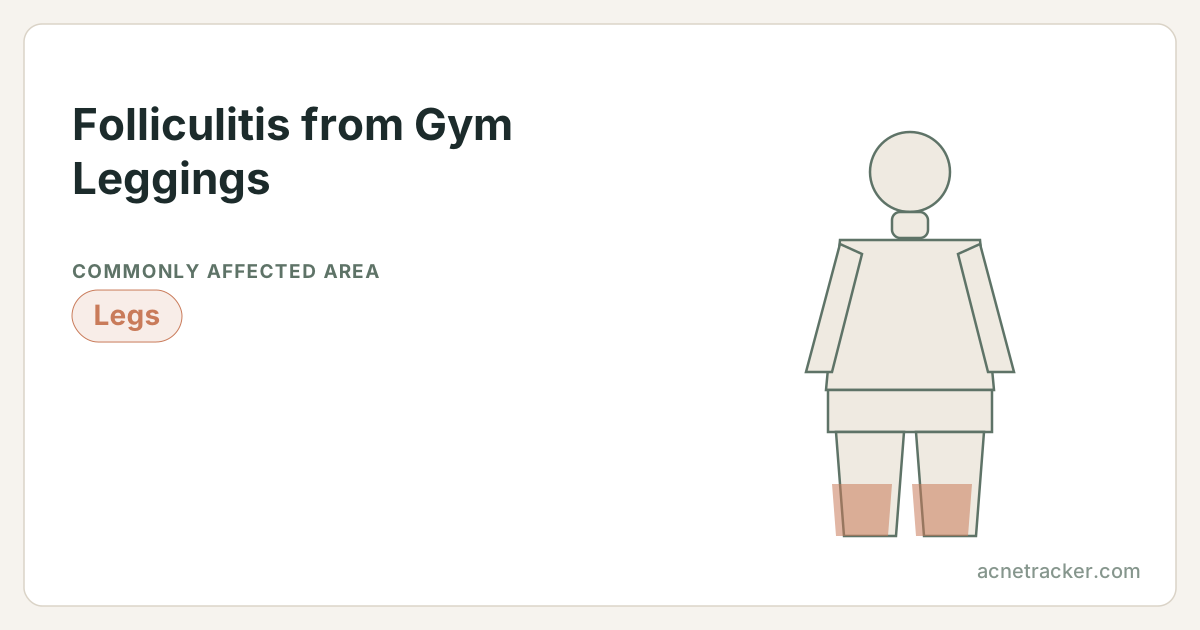
Crops of small red bumps, some with a tiny pustule at the follicle, on the thighs and the back of the legs — which is to say wherever the fabric was tightest and least ventilated. The timing is the giveaway: nothing during the session, bumps appearing over the following day or two, settling within a week if you leave them alone. They can be itchy or mildly sore. If the bumps are strikingly uniform in size and the itch is prominent, and antibacterial washes have done nothing over several weeks, Malassezia yeast is the more likely organism, and that changes what you should be asking a pharmacist for.
What causes it
The interval between training and showering
The overwhelming factor. Warm damp skin under fabric for twenty minutes is not a problem; the same skin for two hours through a commute and a coffee is. Almost everyone with this pattern is sitting in wet leggings far longer than they realise, and that alone often explains the whole thing.
Compression and mechanical pressure
Tight fabric presses directly on follicle openings for the length of a session. Pressure alone inflames a follicle without any organism involved, and it also grinds sweat and surface bacteria into the opening, which is why the tightest garments produce the most bumps.
Seams and waistbands
Crops that trace a seam line, an inner-thigh panel or a waistband are not a coincidence. Those are the points of highest sustained friction, and they reliably break out first, which is a useful way to confirm the clothing is the cause rather than something you ate or a new product.
Re-wearing kit without a proper wash
Synthetic athletic fabric holds oils and organisms stubbornly, and a cool quick cycle does not always shift them. Leggings worn twice between washes reintroduce the load onto skin that is about to be sweated on again — a small habit with a disproportionate effect.
Rich moisturiser under a tight layer
Applying a heavy body cream and then sealing it under compression fabric for two hours changes what the product does. Fulton's 1989 table rates several common emollient esters highly — isopropyl myristate at 5, isopropyl palmitate at 4 — so save the rich cream for after the shower, not before the session.
Ingredients with evidence
| Ingredient | Role |
|---|---|
| Benzoyl peroxide (wash) | The standard over-the-counter option for the bacterial version, used as a short-contact wash a few times weekly. Ask a pharmacist about strength and format; it bleaches leggings as readily as towels. |
| Salicylic acid (BHA) | Preventive between crops: keeps follicle openings clear so an occluded, sweaty follicle is less likely to block and inflame in the first place. |
| Azelaic acid | Calms inflammation and works on the brown marks each crop leaves behind, which on thighs are usually what persists long after the bumps have gone. |
| Niacinamide | Barrier support for skin under repeated compression and washing, with some effect on the residual redness between crops. |
| Glycerin | Hydration without occlusion — the right texture for legs that need moisture but must not be sealed under a tight layer for the next session. |
Building the routine
This one is mostly free. Shower straight after training rather than after the commute, and if that is genuinely impossible, at least change out of the wet leggings and into something loose immediately. Wash kit properly rather than reflexively, and do not re-wear it between sessions. Then add a benzoyl peroxide wash two or three times a week with a minute of contact before rinsing, and a light moisturiser afterwards — after the shower, not before the session. Judge the change after a month rather than a week. Do not squeeze the bumps; they release almost nothing and leave marks that outlast them by months. If crops persist despite dry kit and an antibacterial wash, stop escalating and consider Malassezia folliculitis, which is common in exactly this population and does not respond to antibacterials at all.
When to see a doctor
Frequently asked questions
Are my leggings causing the bumps on my thighs?
More precisely, the sweat trapped under them after you finish is. The garment supplies pressure and occlusion; the delay before showering supplies the time. Crops that trace seam lines and appear a day or two after training make the case fairly conclusively.
Should I stop wearing tight leggings to train?
You do not have to. Changing out of them promptly afterwards addresses most of the mechanism, since the session itself is rarely long enough to matter. If crops persist even with a fast shower, then trying a looser or more breathable option for a few weeks is a reasonable experiment.
Is it the gym equipment rather than the clothes?
Shared equipment is a common suspicion and usually the wrong one. The organisms involved already live on your own skin — they do not need to be delivered by a bench. The environment you create under the fabric matters far more than what you sat on.
Why does it only happen in summer?
Heat means more sweat and slower drying, so the damp layer under the fabric lasts longer and the resident flora have better conditions to overgrow. The same leggings and the same session in January often produce nothing at all.
Sources & further reading
What this page cites about the condition itself:
There is no single study of this exact question. The guidance here is reasoned from the ingredient profiles below, each of which carries its own references:
- Benzoyl Peroxide3 refs
- Salicylic Acid2 refs
- Azelaic Acid3 refs
- Niacinamide2 refs
- Glycerin3 refs
Show every reference behind this page (10)
- PubChem — Benzoyl peroxide compound summarycited by Benzoyl Peroxide
- DermNet — Benzoyl peroxidecited by Benzoyl Peroxide
- FDA — Drugs (OTC acne products)cited by Benzoyl Peroxide, Salicylic Acid
- Salicylic acid as a peeling agent: a comprehensive review (PubMed)cited by Salicylic Acid
- PubChem — Azelaic acid compound summarycited by Azelaic Acid
- DermNet — Azelaic acidcited by Azelaic Acid
- European Commission CosIng database — Azelaic Acidcited by Azelaic Acid, Niacinamide, Glycerin
- Niacinamide: mechanisms of action and its topical use in dermatology (PubMed)cited by Niacinamide
- PubChem — Glycerol compound summarycited by Glycerin
- DermNet — Moisturiserscited by Glycerin
Medical disclaimer
Ingredients mentioned on this page
Find your personal acne triggers
Our free Acne Tracker lets you log breakouts, sleep, stress and diet, and shows you which factors correlate with your flare-ups.