Can You Mix Benzoyl Peroxide and Sulfur?
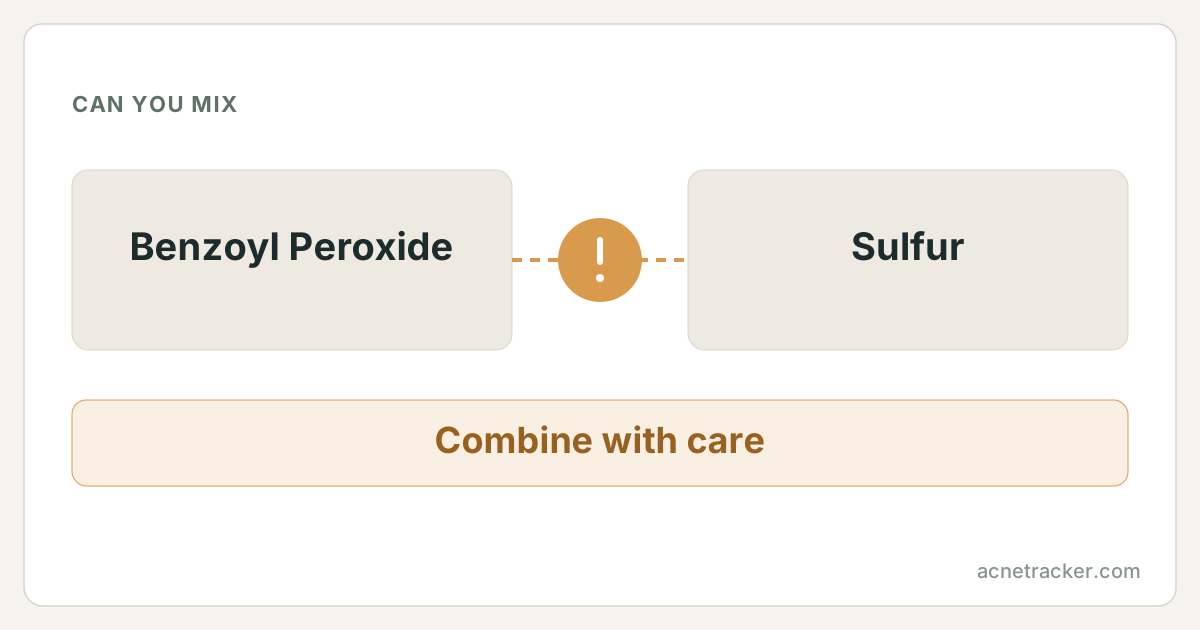
Not usually worth it. Sulfur and benzoyl peroxide both dry the skin and both suppress acne bacteria, so running them together doubles the side effects while adding little. There is no dangerous reaction — the argument against is redundancy. Sulfur is the better choice if benzoyl peroxide is too harsh for you or if you also have seborrhoeic or rosacea-type symptoms; use one or the other, not both at once.
How this pairing resolves
The two ingredients, their published numbers, and where they land together.
The numbers beside each ingredient are its published comedogenic rating and effective pH window, taken from its own profile page.
Show the numbers
| Ingredients | Metric | 0–5 |
|---|---|---|
| Benzoyl Peroxide | Comedogenic rating | 0/5 |
| Benzoyl Peroxide | Effective pH | no published pH |
| Sulfur | Comedogenic rating | 0/5 |
| Sulfur | Effective pH | no published pH |
Why
Sulfur has been in dermatology since long before controlled trials existed, and its mechanism is still only partly mapped. On skin it is slowly reduced to hydrogen sulfide, which is antibacterial and antifungal, and it is mildly keratolytic — it softens and loosens the plug rather than dissolving it the way salicylic acid does. That is a broadly similar destination to benzoyl peroxide, which reaches the follicle and releases oxygen radicals against Cutibacterium acnes. Two ingredients hitting the same target from slightly different angles produce overlapping benefit and fully additive dryness. There is also a formulation point people miss: sulfur is what gives many old-school pink drying lotions their smell and their chalky finish, and those products are usually already drying without help. Where sulfur genuinely earns its place is where benzoyl peroxide does not perform — its antifungal activity makes it relevant in seborrhoeic dermatitis and Malassezia-driven folliculitis, and it appears in prescription products for rosacea, a condition benzoyl peroxide can actively aggravate. Choosing between them is the skill; stacking them is not.
How to combine them
Treat this as an either/or in the same routine, and a maybe across the week. If you want both available, the workable version is benzoyl peroxide as a leave-on spot treatment two or three evenings a week and sulfur as a rinse-off mask on a separate evening, where its contact time is ten minutes rather than eight hours. Never layer a sulfur lotion over a benzoyl peroxide spot treatment on the same lesion the same night — that is where people report burning. Zoning is another sensible option: sulfur across an oily, congested T-zone or a seborrhoeic hairline, benzoyl peroxide on the specific inflamed lesions elsewhere. Moisturise after either. If you already find benzoyl peroxide drying at 2.5%, adding sulfur is not the answer; the answer is a ceramide moisturiser and fewer applications.
Example routine
| When | Steps |
|---|---|
| Evening (Mon/Wed) | Cleanser → Benzoyl peroxide 2.5% on inflamed spots → Moisturiser |
| Evening (Sat) | Cleanser → Sulfur mask 10 min → rinse → Moisturiser |
| Zoning option | Sulfur on congested T-zone · Benzoyl peroxide on individual spots elsewhere |
| Every morning | Gentle cleanser → Moisturiser → SPF 30+ |
Warning signs
Frequently asked questions
Is sulfur or benzoyl peroxide stronger for acne?
Benzoyl peroxide has the larger body of modern trial evidence for inflammatory acne. Sulfur is milder and older, with the advantage of antifungal activity that benzoyl peroxide lacks — different tools, not a simple ranking.
Can I use a sulfur mask on a benzoyl peroxide night?
Better to separate them. A rinse-off sulfur mask on one evening and benzoyl peroxide on another gives you both without asking the same skin to absorb two drying antibacterials in one sitting.
Do sulfur and benzoyl peroxide react with each other?
No hazardous reaction is described for the low concentrations used in cosmetics and over-the-counter products. The reason to space them out is that their drying and irritation add up, not that they are chemically incompatible.
Which one is better for fungal acne?
Sulfur, clearly. Malassezia folliculitis is driven by yeast, and sulfur has antifungal activity while benzoyl peroxide is aimed at bacteria. If your bumps are uniform, itchy and clustered, sulfur is the more logical trial.
Sources & further reading
There is no single study of this exact question. The guidance here is reasoned from the ingredient profiles below, each of which carries its own references:
- Benzoyl Peroxide3 refs
- Sulfur2 refs
Show every reference behind this page (4)
- PubChem — Benzoyl peroxide compound summarycited by Benzoyl Peroxide
- DermNet — Benzoyl peroxidecited by Benzoyl Peroxide
- FDA — Drugs (OTC acne products)cited by Benzoyl Peroxide, Sulfur
- PubChem — Sulfur (CID 5362487)cited by Sulfur
Medical disclaimer
Ingredients mentioned on this page
Find your personal acne triggers
Our free Acne Tracker lets you log breakouts, sleep, stress and diet, and shows you which factors correlate with your flare-ups.