Stearic Acid: Comedogenic Rating & Ingredient Analysis
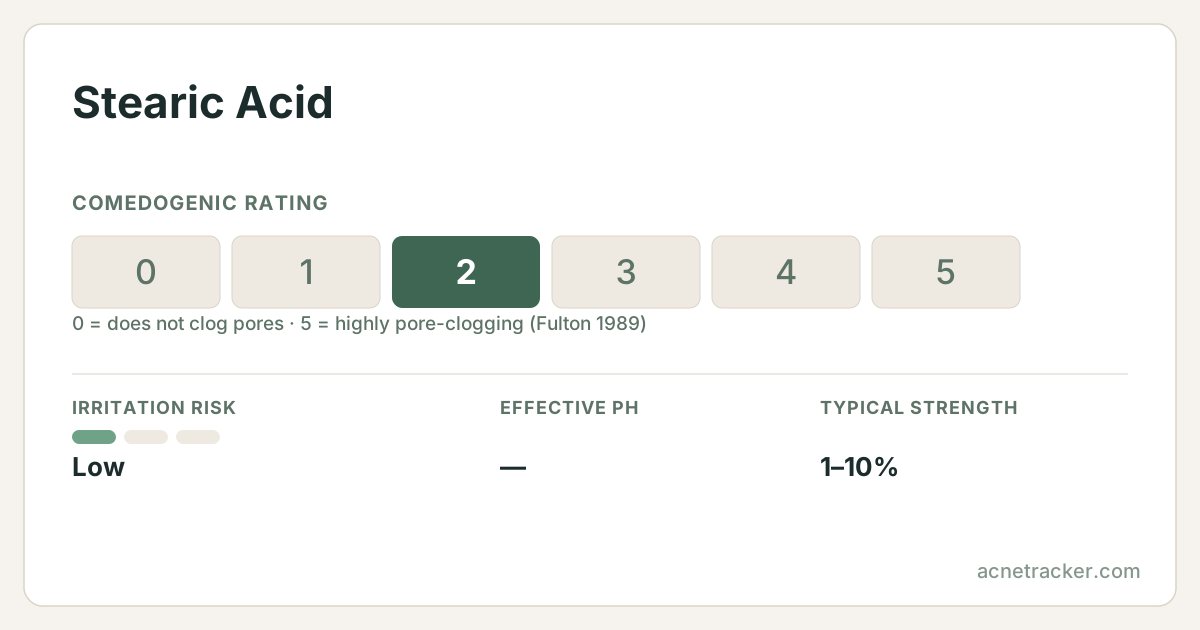
Stearic acid is one of the quiet workhorses on an ingredient list. You will rarely see it advertised on the front of a jar, yet it appears in a huge share of creams, cleansers and balms because it does the unglamorous structural jobs a formula needs: it thickens, it stabilises oil-and-water mixtures, and it leaves a soft, powdery-smooth finish on the skin. It is a saturated long-chain fatty acid found naturally in shea butter, cocoa butter and many animal and vegetable fats. For most people it is a supporting-cast ingredient rather than a hero active, but understanding what it does helps explain why so many rich moisturisers feel the way they do.
Quick facts
- Comedogenic rating
- measured (Fulton 1989)
- Irritation risk
- Low
- Effective pH
- —
- Typical strength
- 1–10%
- Pregnancy
- Considered safe
- Suits skin types
- drynormalcombinationsensitivemature
Where this number comes from
Read directly from Table I of Fulton's 1989 paper — the primary source, not one of the copied tables that circulate online.
Fulton read his own scale as 0-1 not significant, 2-3 borderline, 4-5 positive. The assay is the rabbit ear at 10% dilution, which the paper itself calls extremely sensitive and not fully predictive of human skin. Ratings describe the raw ingredient; concentration and formulation change real-world behaviour.
Caution profile
The four published fields on this page, on one 0–5 scale. Further from the centre means more care is needed — never that the ingredient is worse.
Derived, not measured: pore-clogging is the published comedogenic rating; irritation maps low/moderate/high to 1/3/5; pregnancy maps safe/caution/avoid to 0/3/5; skin-type limits is how many of the seven skin types this entry does NOT list. Every input is printed in words in the quick-facts card above.
Show the numbers
| Metric | 0–5 | Published field |
|---|---|---|
| Pore-clogging | 2 | 2/5 |
| Irritation | 1 | Low |
| Skin-type limits | 1.4 | 5/7 |
| Pregnancy | 0 | Considered safe |
Working pH and typical strength
Where this ingredient is formulated to sit, and at what concentration.
Both bars come from the fields above: the pH window and the typical strength range published for this ingredient. The tinted column is healthy skin's surface pH (about 4.7–5.75).
Show the numbers
| Metric | 0–5 |
|---|---|
| Typical strength | 1–10% |
What is it?
Stearic acid is a fully saturated eighteen-carbon fatty acid, solid and waxy at room temperature, which is why it is so useful as a thickener and structuring agent. When partially neutralised with an alkali it forms a mild soap-like emulsifier that binds the water and oil phases of a cream together, and it also acts as an emollient that softens and smooths the skin surface. It contributes to the opaque, pearly look of many lotions. It is a normal component of the skin's own surface lipids and of butters like shea and cocoa, so it is a very familiar molecule to human skin and is generally extremely well tolerated.
Benefits
Gives creams their body
Stearic acid thickens and stabilises emulsions, turning thin liquids into the rich, spreadable creams and balms that feel cushioning on dry skin.
Softens the skin surface
As an emollient it fills the microscopic gaps between skin cells, leaving a smooth, soft, powdery finish that many people find comfortable and non-greasy.
Helps water and oil mix
Partially neutralised, it works as a gentle emulsifier that keeps a moisturiser stable, so the water and oil phases do not separate on the shelf.
Supports the barrier feel
Because it mirrors a fatty acid already present in skin and in butters like shea, it blends seamlessly into barrier-supporting creams without a foreign or heavy feel.
How to use
There is nothing special to do with stearic acid, because it is a formulation ingredient rather than a stand-alone active. You will encounter it inside moisturisers, cleansing balms, sunscreens and rich creams, where the formulator has already balanced it against other ingredients. Simply use those products as directed. If you have very oily or congestion-prone skin and find that heavy stearic-rich balms feel occlusive or trigger small bumps, choose lighter gel or lotion textures instead. No layering rules or timing considerations apply.
Side effects
Stearic acid is one of the least irritating ingredients in cosmetics and allergy to it is rare. Its comedogenic rating is 2, so in very rich formulas it can contribute to clogged pores in people who are already prone to congestion, though as one ingredient among many the practical risk is usually low. If a cream feels too heavy or leaves you with small bumps, the overall formula rather than the stearic acid alone is likely the issue.
Who should avoid it
Almost no one needs to avoid stearic acid. People with very oily, breakout-prone skin may simply prefer to avoid the heaviest stearic-rich balms and butters in favour of lighter textures. Anyone with a specific documented allergy to stearic acid should of course check labels, but such allergies are uncommon.
Pairs well with
Frequently asked questions
Does stearic acid clog pores?
It has a comedogenic rating of 2, so it can contribute to clogged pores in rich formulas for people prone to congestion. As one of many ingredients in a balanced product, the practical risk is usually modest.
What does stearic acid do in skincare?
It mainly thickens and stabilises creams, acts as a gentle emulsifier that keeps oil and water blended, and works as an emollient that leaves a soft, smooth finish on the skin.
Is stearic acid natural?
It occurs naturally in shea butter, cocoa butter and many plant and animal fats. The cosmetic-grade version is usually derived from vegetable oils, though it can also be made synthetically.
Is stearic acid safe for sensitive skin?
Yes. It is one of the least irritating and best tolerated fatty acids in skincare, and true allergy is rare, which is why it appears in so many products for sensitive and dry skin.
Is stearic acid the same as stearyl alcohol?
No. Stearic acid is a fatty acid, while stearyl alcohol is the corresponding fatty alcohol. Both are emollient and thickening ingredients, but they are chemically distinct and behave a little differently in a formula.
Sources & further reading
Medical disclaimer
Find your personal acne triggers
Our free Acne Tracker lets you log breakouts, sleep, stress and diet, and shows you which factors correlate with your flare-ups.