Palmitic Acid: Comedogenic Rating & Ingredient Analysis
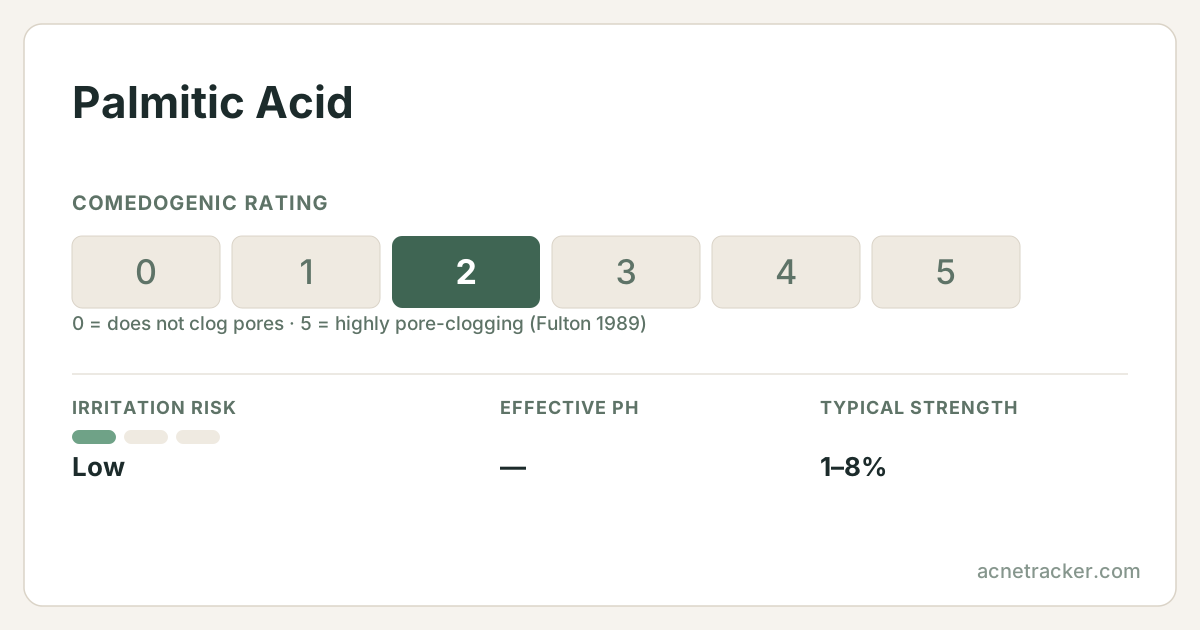
Palmitic acid is one of the most abundant fatty acids in nature and in human skin. It is the single most common saturated fatty acid in the body, a natural part of your surface sebum, and a normal building block of the skin barrier. In skincare it plays a role similar to stearic acid: it thickens, softens and helps stabilise creams while contributing a smooth, non-greasy finish. Because it is so familiar to skin, it is very well tolerated, and it turns up quietly in a large fraction of moisturisers, cleansers and balms. It is rarely a marketed hero ingredient, but it is part of what gives many rich formulas their comforting, cushioned texture.
Quick facts
- Comedogenic rating
- measured (Fulton 1989)
- Irritation risk
- Low
- Effective pH
- —
- Typical strength
- 1–8%
- Pregnancy
- Considered safe
- Suits skin types
- drynormalcombinationmature
Where this number comes from
Read directly from Table I of Fulton's 1989 paper — the primary source, not one of the copied tables that circulate online.
Fulton read his own scale as 0-1 not significant, 2-3 borderline, 4-5 positive. The assay is the rabbit ear at 10% dilution, which the paper itself calls extremely sensitive and not fully predictive of human skin. Ratings describe the raw ingredient; concentration and formulation change real-world behaviour.
Caution profile
The four published fields on this page, on one 0–5 scale. Further from the centre means more care is needed — never that the ingredient is worse.
Derived, not measured: pore-clogging is the published comedogenic rating; irritation maps low/moderate/high to 1/3/5; pregnancy maps safe/caution/avoid to 0/3/5; skin-type limits is how many of the seven skin types this entry does NOT list. Every input is printed in words in the quick-facts card above.
Show the numbers
| Metric | 0–5 | Published field |
|---|---|---|
| Pore-clogging | 2 | 2/5 |
| Irritation | 1 | Low |
| Skin-type limits | 2.1 | 4/7 |
| Pregnancy | 0 | Considered safe |
Working pH and typical strength
Where this ingredient is formulated to sit, and at what concentration.
Both bars come from the fields above: the pH window and the typical strength range published for this ingredient. The tinted column is healthy skin's surface pH (about 4.7–5.75).
Show the numbers
| Metric | 0–5 |
|---|---|
| Typical strength | 1–8% |
What is it?
Palmitic acid is a saturated sixteen-carbon fatty acid, solid and waxy at room temperature. It is named after palm oil, a major commercial source, but it is also present in butters, other vegetable oils and animal fats, and it makes up a meaningful share of the fatty acids in human sebum. In formulas it works as an emollient and co-emulsifier and helps build viscosity, and when partially neutralised it forms mild soap-like structures. As a natural component of the stratum corneum lipids, palmitic acid also supports the skin barrier, and it is a backbone for many gentle palmitate-based derivatives used elsewhere in cosmetics.
Benefits
Softens and smooths
As an emollient, palmitic acid fills gaps between surface skin cells, leaving skin feeling soft and smooth with a light, non-oily finish that suits everyday moisturisers.
Thickens and stabilises formulas
It adds body to creams and lotions and helps hold the water and oil phases together, which is why it is so common in rich, stable moisturisers.
A natural barrier lipid
Because palmitic acid is already part of the skin's own surface lipids and sebum, it blends into barrier-supporting products without feeling foreign or heavy.
Well tolerated by sensitive skin
Its low irritation profile and familiarity to skin make it a dependable choice in gentle formulas designed for dry and sensitive complexions.
How to use
Palmitic acid is a formulation ingredient, so you do not use it on its own. You will meet it inside moisturisers, cleansing balms and creams, where it has been balanced with emulsifiers, humectants and other lipids. Use those products as directed, morning or night. If your skin is very oily or congestion-prone and you notice that thick palmitic-rich balms feel heavy or leave small bumps, opt for lighter gel or lotion textures. There are no special layering, timing or pH considerations, and it pairs comfortably with virtually every active you might use.
Side effects
Palmitic acid is very low in irritation and allergy to it is uncommon. It carries a comedogenic rating of 2, so in heavy formulas it may contribute to clogged pores in people already prone to congestion, though as one lipid among several in a balanced product the practical risk is generally small. If a rich cream feels occlusive or triggers bumps, consider the overall formula rather than palmitic acid in isolation.
Who should avoid it
There is no group that must strictly avoid palmitic acid. People with very oily, acne-prone skin may simply prefer lighter textures over the heaviest palmitic-rich butters and balms. Anyone with a rare, specifically documented allergy should check ingredient lists, but such cases are unusual.
Pairs well with
Frequently asked questions
Does palmitic acid clog pores?
It has a comedogenic rating of 2, so it can contribute to clogged pores in rich formulas for congestion-prone skin. As one of several lipids in a balanced product, the everyday risk is usually modest.
What does palmitic acid do in skincare?
It works as an emollient that softens skin, a thickener that gives creams body, and a co-emulsifier that helps keep oil and water blended, while also acting as a natural barrier lipid.
Is palmitic acid natural?
Yes. It is the most common saturated fatty acid in nature and in the human body, found in palm oil, butters, other oils and in your own skin sebum and barrier lipids.
Is palmitic acid safe for the skin?
For topical use it is considered very safe and well tolerated, with a low irritation profile. It is a normal component of skin, which is part of why it is so widely used.
Is palmitic acid the same as palmitoyl peptides?
No. Palmitic acid is a fatty acid, while palmitoyl peptides attach a palmitic-derived tail to a peptide to help it penetrate. They are related in chemistry but serve very different roles.
Sources & further reading
Medical disclaimer
Find your personal acne triggers
Our free Acne Tracker lets you log breakouts, sleep, stress and diet, and shows you which factors correlate with your flare-ups.