Retinyl Palmitate: Comedogenic Rating & Ingredient Analysis
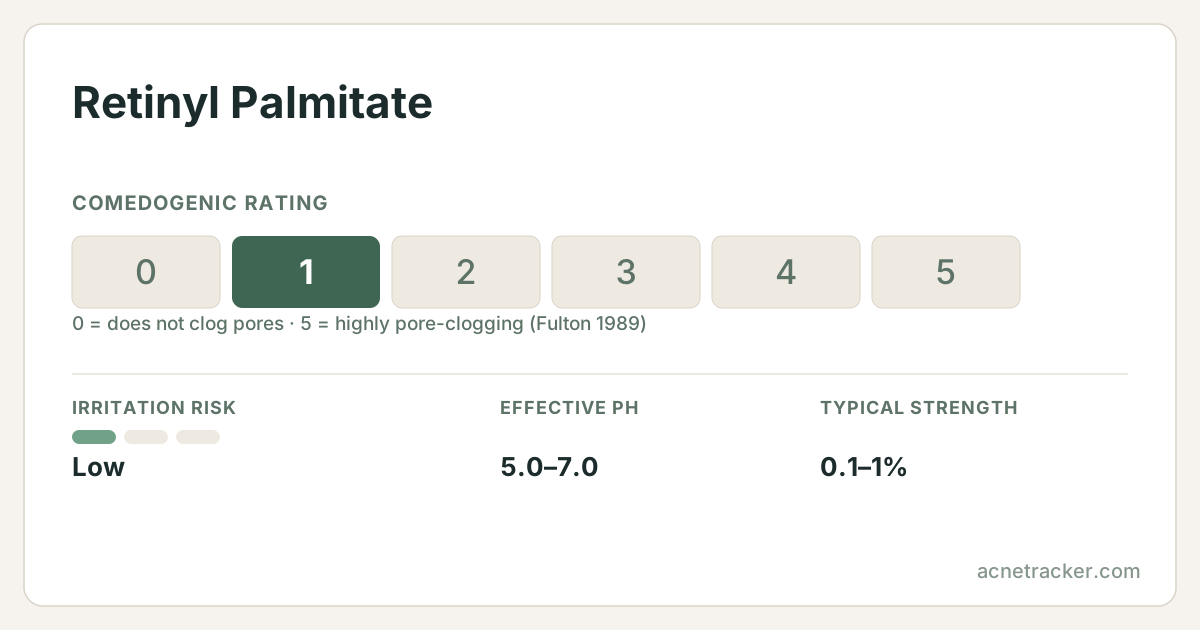
Retinyl palmitate is the mildest and most stable member of the vitamin A family used in skincare. It is an ester — retinol joined to palmitic acid, a fatty acid — which makes it less irritating but also considerably weaker, because the skin has to perform extra conversion steps before any of it reaches the active retinoic acid form. For that reason it is a poor choice for someone chasing dramatic anti-acne or anti-wrinkle results, but a sensible one for beginners with dry or reactive skin who want to ease into vitamin A, or for formulators who want a gentle antioxidant boost without the sting.
Quick facts
- Comedogenic rating
- measured (Fulton 1989)
- Irritation risk
- Low
- Effective pH
- 5.0–7.0
- Typical strength
- 0.1–1%
- Pregnancy
- Avoid
- Suits skin types
- drysensitivenormalmature
Where this number comes from
Read directly from Table I of Fulton's 1989 paper — the primary source, not one of the copied tables that circulate online.
Fulton read his own scale as 0-1 not significant, 2-3 borderline, 4-5 positive. The assay is the rabbit ear at 10% dilution, which the paper itself calls extremely sensitive and not fully predictive of human skin. Ratings describe the raw ingredient; concentration and formulation change real-world behaviour.
Caution profile
The four published fields on this page, on one 0–5 scale. Further from the centre means more care is needed — never that the ingredient is worse.
Derived, not measured: pore-clogging is the published comedogenic rating; irritation maps low/moderate/high to 1/3/5; pregnancy maps safe/caution/avoid to 0/3/5; skin-type limits is how many of the seven skin types this entry does NOT list. Every input is printed in words in the quick-facts card above.
Show the numbers
| Metric | 0–5 | Published field |
|---|---|---|
| Pore-clogging | 1 | 1/5 |
| Irritation | 1 | Low |
| Skin-type limits | 2.1 | 4/7 |
| Pregnancy | 5 | Avoid |
Working pH and typical strength
Where this ingredient is formulated to sit, and at what concentration.
Both bars come from the fields above: the pH window and the typical strength range published for this ingredient. The tinted column is healthy skin's surface pH (about 4.7–5.75).
Show the numbers
| Metric | 0–5 |
|---|---|
| Working pH | 5.0–7.0 |
| Typical strength | 0.1–1% |
What is it?
Chemically the palmitate ester protects the fragile retinol molecule, giving it better shelf stability and a lower risk of irritation than retinol or retinal. The cost of that stability is potency: retinyl palmitate must be cleaved to retinol, then oxidised to retinaldehyde, then to retinoic acid, and much is lost along the way. Estimates put its activity at a small fraction of retinol's. It still delivers real, if modest, antioxidant activity and a gentle nudge to cell renewal. You will find it in daytime moisturisers and eye creams where a light vitamin A presence is wanted without the tolerance hurdles of stronger retinoids.
Benefits
Extremely gentle introduction to retinoids
Its low potency and ester buffering make it one of the least irritating ways to expose sensitive or dry skin to vitamin A before stepping up to retinol.
Antioxidant protection
As a form of vitamin A it helps mop up free radicals generated by daylight and pollution, offering a mild defensive benefit within a moisturiser.
Conditioning and softening
The palmitic acid portion lends an emollient, skin-softening quality, so products feel nourishing rather than drying — unusual for a retinoid.
Stable in formulation
Because the ester resists breakdown better than pure retinol, products keep their vitamin A activity longer, which matters in jars and clear packaging.
How to use
Retinyl palmitate is forgiving enough that it can be used morning or night, though pairing any vitamin A with daily sunscreen remains wise. It is often already blended into a moisturiser, so simply apply as directed after your serums. If your goal is genuine acne or wrinkle improvement, treat retinyl palmitate as a stepping stone and plan to graduate to retinol or retinal once your skin is comfortable, since the ester alone rarely produces strong results. Keep expectations proportional to its low potency.
Side effects
Irritation is uncommon and usually mild — occasional dryness or slight sensitivity. Because so little converts to the active form, the classic retinoid purge and peeling are far less likely than with retinol. Any stinging is more often down to other ingredients in the formula. As with all vitamin A, do not assume 'gentle' means 'do more'; overloading offers no advantage.
Who should avoid it
Despite being the weakest retinoid, it is still a vitamin A derivative, so it is avoided during pregnancy and breastfeeding as a precaution. Anyone specifically wanting proven results against deep acne or established wrinkles will be better served by retinol, retinal or a prescription retinoid rather than this ester.
Pairs well with
Avoid combining with
Frequently asked questions
Is retinyl palmitate as good as retinol?
No. It is much weaker because the skin must convert it through several steps to reach active vitamin A, losing most potency on the way. It suits gentle introduction, not strong anti-acne or anti-ageing results.
Can retinyl palmitate be used in the morning?
It is stable and mild enough for daytime use, unlike stronger retinoids. Still, pair it with sunscreen, as any vitamin A programme benefits from consistent sun protection.
Does retinyl palmitate cause purging?
Rarely and mildly, because so little converts to active retinoic acid. If you break out heavily, the cause is more likely another ingredient or a comedogenic base than this ester.
Is retinyl palmitate safe in pregnancy?
It is still a retinoid and is avoided during pregnancy and breastfeeding as a precaution, even though it is the weakest form. Choose niacinamide or azelaic acid instead.
Sources & further reading
Medical disclaimer
Find your personal acne triggers
Our free Acne Tracker lets you log breakouts, sleep, stress and diet, and shows you which factors correlate with your flare-ups.