Polyglutamic Acid: Comedogenic Rating & Ingredient Analysis
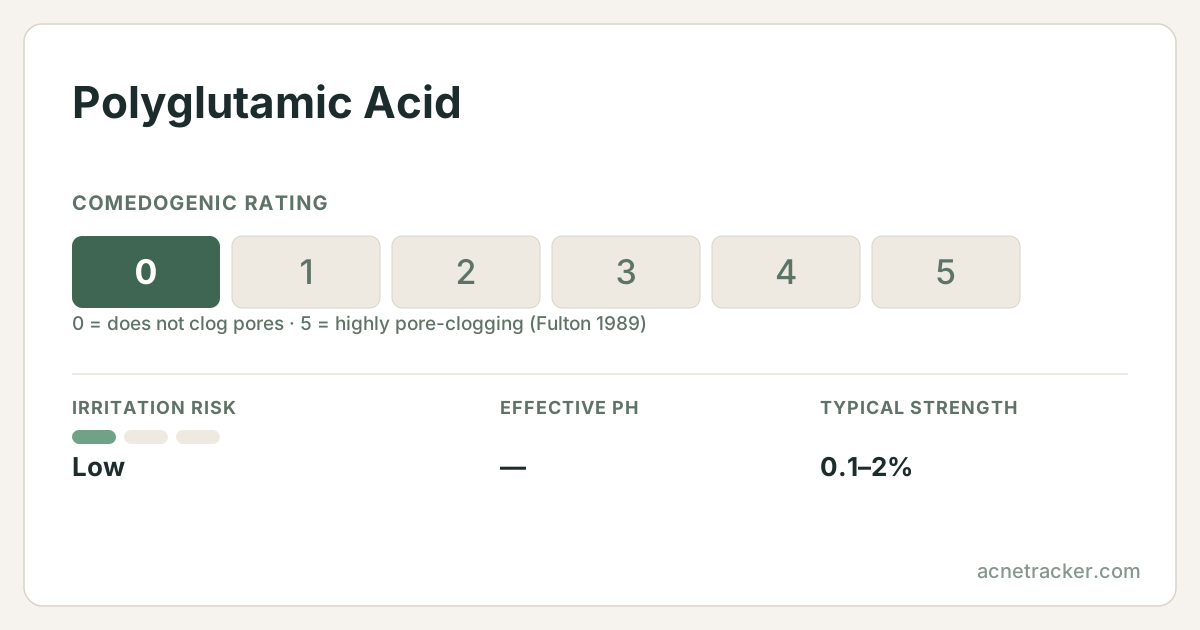
Polyglutamic acid, usually shortened to PGA, is a humectant produced by fermentation and increasingly paired with or promoted over hyaluronic acid. It is a large peptide-like molecule that holds an impressive amount of water and forms a light, breathable film on the skin surface. Where hyaluronic acid pulls water into the deeper layers, PGA specializes in holding moisture at the surface and slowing the rate at which it evaporates. That surface focus makes it a strong partner for hyaluronic acid rather than a straight replacement, and its rating of 0 with minimal irritation risk means it fits comfortably into oily, dry and sensitive routines alike.
Quick facts
- Comedogenic rating
- our estimate — not measured
- Irritation risk
- Low
- Effective pH
- —
- Typical strength
- 0.1–2%
- Pregnancy
- Considered safe
- Suits skin types
- oilydrycombinationsensitivenormalacne-pronemature
Where this number comes from
No one has published a comedogenic rating for this ingredient. Fulton's 1989 table tested about 250 raw materials and this was not among them, and we found no later study measuring it. The figure shown is our own reasoning from the ingredient's chemistry and how it is used — treat it as an estimate, not a measurement.
Fulton read his own scale as 0-1 not significant, 2-3 borderline, 4-5 positive. The assay is the rabbit ear at 10% dilution, which the paper itself calls extremely sensitive and not fully predictive of human skin. Ratings describe the raw ingredient; concentration and formulation change real-world behaviour.
Caution profile
The four published fields on this page, on one 0–5 scale. Further from the centre means more care is needed — never that the ingredient is worse.
Derived, not measured: pore-clogging is the published comedogenic rating; irritation maps low/moderate/high to 1/3/5; pregnancy maps safe/caution/avoid to 0/3/5; skin-type limits is how many of the seven skin types this entry does NOT list. Every input is printed in words in the quick-facts card above.
Show the numbers
| Metric | 0–5 | Published field |
|---|---|---|
| Pore-clogging | 0 | 0/5 |
| Irritation | 1 | Low |
| Skin-type limits | 0 | 7/7 |
| Pregnancy | 0 | Considered safe |
Working pH and typical strength
Where this ingredient is formulated to sit, and at what concentration.
Both bars come from the fields above: the pH window and the typical strength range published for this ingredient. The tinted column is healthy skin's surface pH (about 4.7–5.75).
Show the numbers
| Metric | 0–5 |
|---|---|
| Typical strength | 0.1–2% |
What is it?
Polyglutamic acid is a biopolymer built from repeating units of glutamic acid, an amino acid. It is produced industrially by fermenting Bacillus bacteria — the same process behind the sticky Japanese food natto — which makes it a naturally derived, vegan-friendly ingredient. Because the molecule is large, it stays mostly on the surface of the skin, where it binds water and creates a thin hydrating layer. Laboratory measurements suggest it can hold several times more water than an equivalent amount of hyaluronic acid, though real-world results depend heavily on the whole formula. It also appears to help slow the breakdown of the skin's own natural moisturizing factors, extending hydration between applications.
Benefits
Long-lasting surface hydration
PGA forms a moisture-binding film that reduces surface water loss, keeping skin hydrated for longer than a lightweight watery serum alone.
Complements hyaluronic acid
Used together, hyaluronic acid draws water into deeper layers while PGA holds it at the surface, so the pair hydrates more completely than either does alone.
Smooths and softens
The thin film it leaves behind gives skin an immediately smoother, more supple feel and a soft glow without any greasiness.
Gentle for reactive skin
With a rating of 0 and very low irritation potential, PGA hydrates sensitive and acne-prone skin that reacts to heavier oils and occlusives.
How to use
Apply PGA after cleansing to damp skin, either on its own as a serum or layered over a hyaluronic acid product for a fuller hydration effect. Seal it with a moisturizer to make the most of its film-forming action. It works morning and night and sits comfortably under sunscreen and makeup. Because it is purely hydrating and non-acidic, there is no adjustment period and no conflict with actives — you can use it on the same days as retinol, vitamin C or exfoliating acids to cushion their drying effects.
Side effects
PGA is very well tolerated and side effects are uncommon. Occasionally a heavier PGA layer can feel slightly tacky before it dries down or can pill under other products if too much is applied. As with any humectant, hydration is best when the layer is sealed with a moisturizer; used alone in dry air it may feel less effective. Genuine allergic reactions are rare.
Who should avoid it
No specific group needs to avoid polyglutamic acid. Those who dislike a tacky finish should use a small amount and follow with a cream to smooth the feel. Anyone reacting to a particular product should consider the other ingredients in the formula first, as PGA itself is a very unlikely culprit.
Frequently asked questions
Is polyglutamic acid better than hyaluronic acid?
They work differently rather than one being universally better. PGA holds moisture at the surface and slows evaporation, while hyaluronic acid draws water into deeper layers. Using both gives the most complete hydration.
Does polyglutamic acid clog pores?
No. It has a comedogenic rating of 0 and contains no oils, so it hydrates oily and acne-prone skin without contributing to breakouts.
Can I use PGA with hyaluronic acid?
Yes. PGA and hyaluronic acid hold water in different places, so the two together cover more ground than either alone. Apply hyaluronic acid first, then layer PGA on top and seal with a moisturizer for surface-to-depth hydration.
How often can I use polyglutamic acid?
Morning and night. It is non-irritating, non-acidic and compatible with every other active, so daily use is safe and gives the best hydration over time.
Is polyglutamic acid safe during pregnancy?
Yes. It is a fermentation-derived humectant with no systemic activity of concern and is generally considered safe during pregnancy and breastfeeding.
Where this ingredient shows up here
Counted across this database, not the web — these are the pages on this site that reason about this ingredient.
Combination guides 1
Sources & further reading
Medical disclaimer
Find your personal acne triggers
Our free Acne Tracker lets you log breakouts, sleep, stress and diet, and shows you which factors correlate with your flare-ups.