Magnesium: Comedogenic Rating & Ingredient Analysis
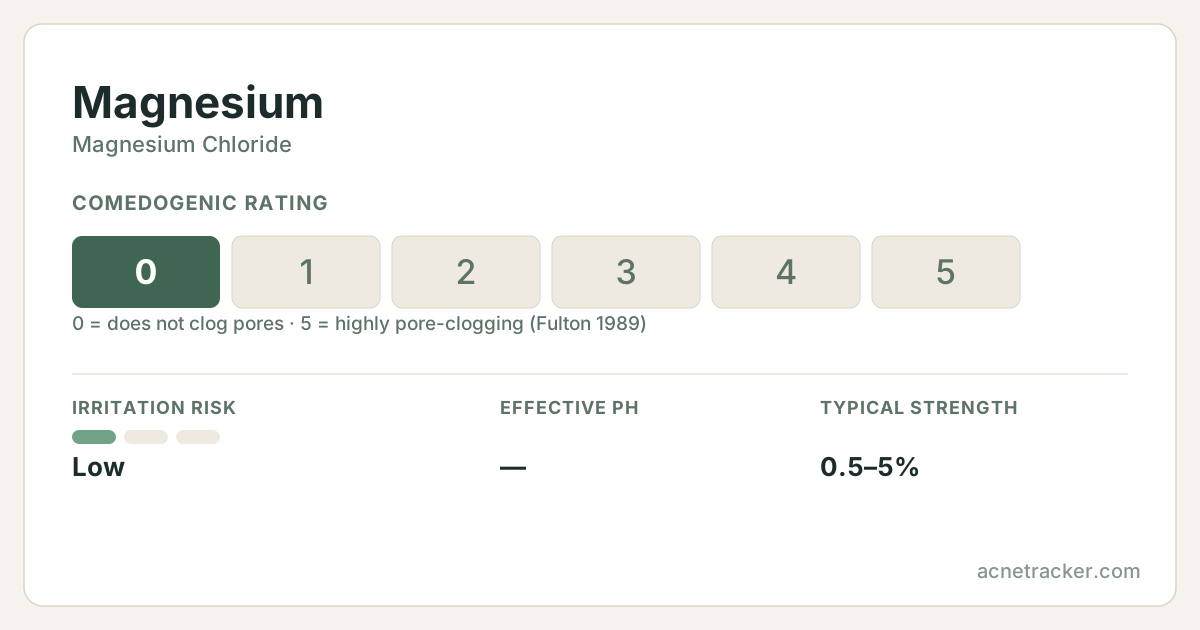
Magnesium is an essential mineral that appears in skincare mostly as magnesium salts, such as magnesium chloride, magnesium sulfate or magnesium PCA. It is included for its potential soothing and barrier-supporting properties, and it features in toners, creams, masks and mineral soaks. Magnesium is central to countless processes in the body, and research on magnesium-rich waters and salts has explored calming effects on irritated skin. In cosmetics its role is supportive and gentle rather than dramatic, and the strength of the evidence varies with the form and how it is delivered.
Quick facts
- Comedogenic rating
- our estimate — not measured
- Irritation risk
- Low
- Effective pH
- —
- Typical strength
- 0.5–5%
- Pregnancy
- Considered safe
- Suits skin types
- sensitivenormalcombinationdryacne-prone
Where this number comes from
No one has published a comedogenic rating for this ingredient. Fulton's 1989 table tested about 250 raw materials and this was not among them, and we found no later study measuring it. The figure shown is our own reasoning from the ingredient's chemistry and how it is used — treat it as an estimate, not a measurement.
Fulton read his own scale as 0-1 not significant, 2-3 borderline, 4-5 positive. The assay is the rabbit ear at 10% dilution, which the paper itself calls extremely sensitive and not fully predictive of human skin. Ratings describe the raw ingredient; concentration and formulation change real-world behaviour.
Caution profile
The four published fields on this page, on one 0–5 scale. Further from the centre means more care is needed — never that the ingredient is worse.
Derived, not measured: pore-clogging is the published comedogenic rating; irritation maps low/moderate/high to 1/3/5; pregnancy maps safe/caution/avoid to 0/3/5; skin-type limits is how many of the seven skin types this entry does NOT list. Every input is printed in words in the quick-facts card above.
Show the numbers
| Metric | 0–5 | Published field |
|---|---|---|
| Pore-clogging | 0 | 0/5 |
| Irritation | 1 | Low |
| Skin-type limits | 1.4 | 5/7 |
| Pregnancy | 0 | Considered safe |
Working pH and typical strength
Where this ingredient is formulated to sit, and at what concentration.
Both bars come from the fields above: the pH window and the typical strength range published for this ingredient. The tinted column is healthy skin's surface pH (about 4.7–5.75).
Show the numbers
| Metric | 0–5 |
|---|---|
| Typical strength | 0.5–5% |
What is it?
In the body, magnesium is a cofactor for hundreds of enzymes and plays a part in energy production, cell function and the barrier. In skincare it is used as water-soluble salts that dissolve to release magnesium ions. Studies on magnesium-rich mineral waters, including Dead Sea preparations, have reported improvements in skin hydration and reductions in redness and roughness in certain conditions, which is often cited as evidence for magnesium's soothing potential. Different forms serve different purposes: magnesium PCA doubles as a humectant, magnesium ascorbyl phosphate is a stable vitamin C derivative, and magnesium chloride or sulfate feature in soaks. As with many minerals applied topically, contact time and formulation strongly shape any benefit.
Benefits
Soothes irritation
Magnesium salts are valued for calming properties; research on magnesium-rich waters has reported reduced redness and roughness, supporting their use in products for reactive skin.
Supports the barrier
As a mineral involved in normal skin function, magnesium is included to help support a comfortable, well-functioning barrier, particularly in soothing and hydrating formulas.
Versatile mineral forms
Magnesium appears in useful forms such as magnesium PCA, a humectant, and magnesium ascorbyl phosphate, a gentle vitamin C derivative, broadening its role beyond simple soaks.
Gentle and well tolerated
Magnesium salts are generally mild and non-comedogenic, making them a low-risk addition to toners, creams and masks for a wide range of skin types.
How to use
You will meet magnesium in leave-on toners, creams and masks, or in mineral bath soaks. In leave-on products, apply as directed within your routine; magnesium-containing soothing formulas layer comfortably with hydrators and niacinamide. Mineral soaks are used occasionally for a relaxing, potentially calming effect. There is no need to introduce magnesium gradually the way you would an acid or retinoid. As always, patch test a new product if your skin is reactive.
Side effects
Magnesium salts are generally well tolerated and low in irritation potential. Some people find magnesium chloride sprays can sting slightly on freshly shaved or broken skin, which is a property of the concentrated salt rather than a sign of harm. Genuine reactions are uncommon. If a specific magnesium product stings or irritates, other ingredients or a high salt concentration are the likely cause.
Who should avoid it
There is little reason to avoid topical magnesium, which is chosen precisely for sensitive, easily irritated skin. Avoid concentrated magnesium sprays on broken or freshly shaved skin, where they can sting. If you react to a particular formula, review its other ingredients rather than assuming the magnesium is to blame.
Pairs well with
Frequently asked questions
What does magnesium do for the skin?
Applied as magnesium salts, it is valued for soothing and barrier-supporting properties. Research on magnesium-rich waters has reported reduced redness and roughness, so it is often used in calming formulas.
What forms of magnesium are in skincare?
Common forms include magnesium chloride and sulfate in soaks, magnesium PCA as a humectant, and magnesium ascorbyl phosphate as a gentle vitamin C derivative. Each serves a slightly different purpose.
Can magnesium help sensitive or irritated skin?
It may. Its soothing reputation and evidence from magnesium-rich waters make it a sensible ingredient in products aimed at reactive, red or rough skin, as a gentle supportive mineral.
Does magnesium spray sting?
Concentrated magnesium chloride sprays can tingle or sting slightly, especially on freshly shaved or broken skin. This reflects the salt concentration rather than damage, but dilute or avoid it if it is uncomfortable.
Is magnesium safe to use daily?
Yes. Magnesium salts are generally mild, non-comedogenic and well tolerated, so leave-on products containing them can typically be used as part of a daily routine.
Sources & further reading
Medical disclaimer
Find your personal acne triggers
Our free Acne Tracker lets you log breakouts, sleep, stress and diet, and shows you which factors correlate with your flare-ups.