Evening Primrose Oil: Comedogenic Rating & Ingredient Analysis
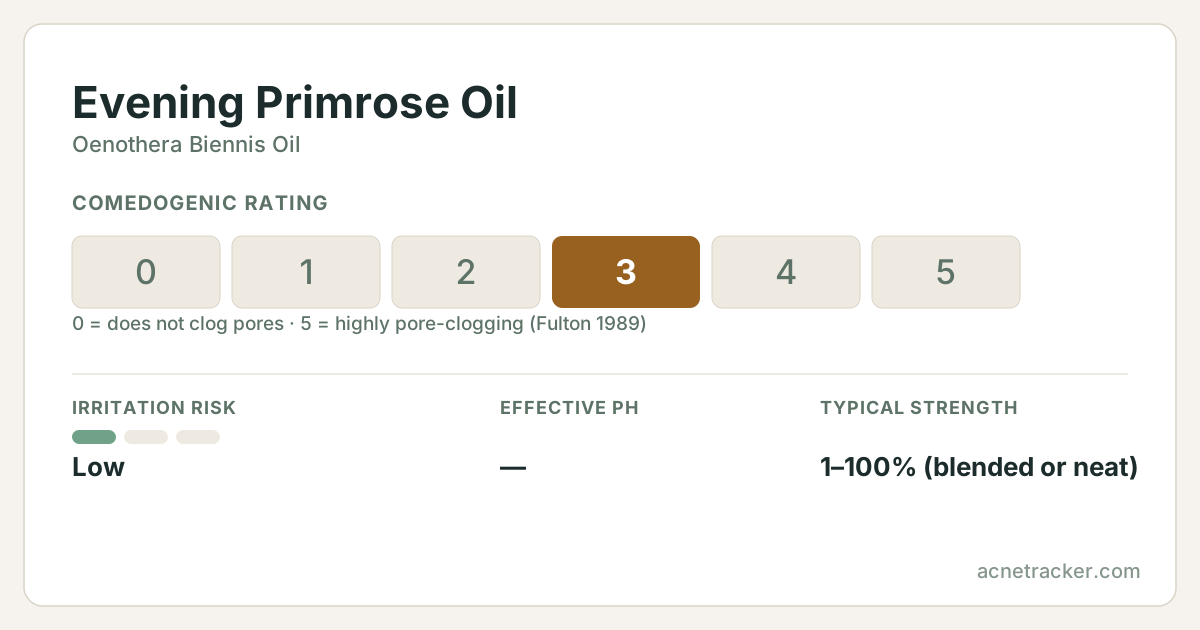
Evening primrose oil, often shortened to EPO, is a pale golden oil pressed from the tiny seeds of a wildflower native to North America. It is best known as an oral supplement, but this page covers its topical use in skincare, where it is valued as a light, gentle facial oil for dry, sensitive and mature skin. Its appeal comes from an unusually high content of gamma-linolenic acid (GLA), an omega-6 fatty acid that is uncommon in the plant world and that the skin uses to help maintain a calm, comfortable barrier.
Quick facts
- Comedogenic rating
- measured (Fulton 1989)
- Irritation risk
- Low
- Effective pH
- —
- Typical strength
- 1–100% (blended or neat)
- Pregnancy
- Considered safe
- Suits skin types
- drynormalsensitivematurecombination
Where this number comes from
Read directly from Table I of Fulton's 1989 paper — the primary source, not one of the copied tables that circulate online.
Fulton read his own scale as 0-1 not significant, 2-3 borderline, 4-5 positive. The assay is the rabbit ear at 10% dilution, which the paper itself calls extremely sensitive and not fully predictive of human skin. Ratings describe the raw ingredient; concentration and formulation change real-world behaviour.
Caution profile
The four published fields on this page, on one 0–5 scale. Further from the centre means more care is needed — never that the ingredient is worse.
Derived, not measured: pore-clogging is the published comedogenic rating; irritation maps low/moderate/high to 1/3/5; pregnancy maps safe/caution/avoid to 0/3/5; skin-type limits is how many of the seven skin types this entry does NOT list. Every input is printed in words in the quick-facts card above.
Show the numbers
| Metric | 0–5 | Published field |
|---|---|---|
| Pore-clogging | 3 | 3/5 |
| Irritation | 1 | Low |
| Skin-type limits | 1.4 | 5/7 |
| Pregnancy | 0 | Considered safe |
Working pH and typical strength
Where this ingredient is formulated to sit, and at what concentration.
Both bars come from the fields above: the pH window and the typical strength range published for this ingredient. The tinted column is healthy skin's surface pH (about 4.7–5.75).
Show the numbers
| Metric | 0–5 |
|---|---|
| Typical strength | 1–100% (blended or neat) |
What is it?
EPO is dominated by linoleic acid with a meaningful share of GLA, giving it a light, non-greasy feel that absorbs faster than richer oils like argan-oil. Linoleic-rich oils are generally friendlier to congestion-prone skin than oleic-rich ones, because linoleic acid is a component of healthy sebum that acne-prone skin is often short of. That said, EPO still carries some oleic acid and is prone to oxidation, and Fulton rated it 3 — borderline on his scale. It is often blended with more stable oils and antioxidants to extend its shelf life. Note that oral EPO and topical EPO are studied separately; the skin-feel and barrier benefits described here refer to topical use.
Benefits
Delivers hard-to-find GLA
Gamma-linolenic acid is rare in plant oils and helps the skin keep its barrier lipids in good order, which can make dry, easily irritated skin feel calmer and more comfortable.
Light, fast-absorbing feel
Being linoleic-rich, EPO sinks in quickly without a heavy residue, so it suits people who want the comfort of a facial oil without a greasy finish.
Soothes dry, reactive skin
Its fatty-acid profile supports a smoother, less tight-feeling surface, which is why it is a favourite for sensitive skin and dry patches that flare in winter.
Plays well with actives
As a gentle buffering oil it can be layered after a potentially drying active to restore comfort, pairing nicely with niacinamide or a hydrating serum.
How to use
Apply a few drops to cleansed, slightly damp skin at night, either neat on dry areas or blended into a moisturiser or another facial oil. Because it oxidises fairly easily, buy small bottles, keep it cool and dark, and use it within a few months of opening. It works well as a barrier-restoring step after an exfoliating acid or retinoid on the nights you use those, applied once the active has absorbed. Patch test first if your skin is very reactive, and discard the oil if it starts to smell rancid.
Side effects
Topical EPO is well tolerated by most people. The main practical issue is oxidation: an old, poorly stored bottle can smell off and is more likely to irritate. Rarely, a botanical oil can trigger contact sensitivity, so a patch test is wise for reactive skin. Its light-to-moderate richness means very oily skin should apply it thinly.
Who should avoid it
There are few hard restrictions on topical use. People with very oily, congestion-prone skin should use it sparingly and monitor how their skin responds. If you have reacted to seed oils before, patch test first. Topical EPO is generally regarded as acceptable in pregnancy, but oral supplementation is a separate question you should raise with your doctor rather than assuming the topical safety carries over.
Pairs well with
Avoid combining with
Frequently asked questions
Is topical evening primrose oil good for acne-prone skin?
Its linoleic-rich profile is friendlier to congestion-prone skin than heavy oleic oils, though Fulton rated it 3, borderline on his scale. Use it thinly and watch how your skin responds, as individual tolerance to any oil varies.
What is GLA and why does it matter?
Gamma-linolenic acid is an omega-6 fatty acid that is uncommon in plant oils. Topically it helps support the skin's barrier lipids, which can make dry, easily irritated skin feel calmer and more comfortable.
Does evening primrose oil go off quickly?
It oxidises more readily than stable oils like jojoba-oil, so buy small bottles, store them cool and dark, and replace the oil if it smells sharp or rancid. Blends with added vitamin E last a little longer.
Can I use evening primrose oil with retinol?
Yes, as a buffering step. Apply your retinol first, let it absorb, then press in a few drops of EPO to ease dryness. Do not mix them in the same drop; layer the oil afterwards to restore comfort.
Sources & further reading
Medical disclaimer
Find your personal acne triggers
Our free Acne Tracker lets you log breakouts, sleep, stress and diet, and shows you which factors correlate with your flare-ups.