Ceteareth-20: Comedogenic Rating & Ingredient Analysis
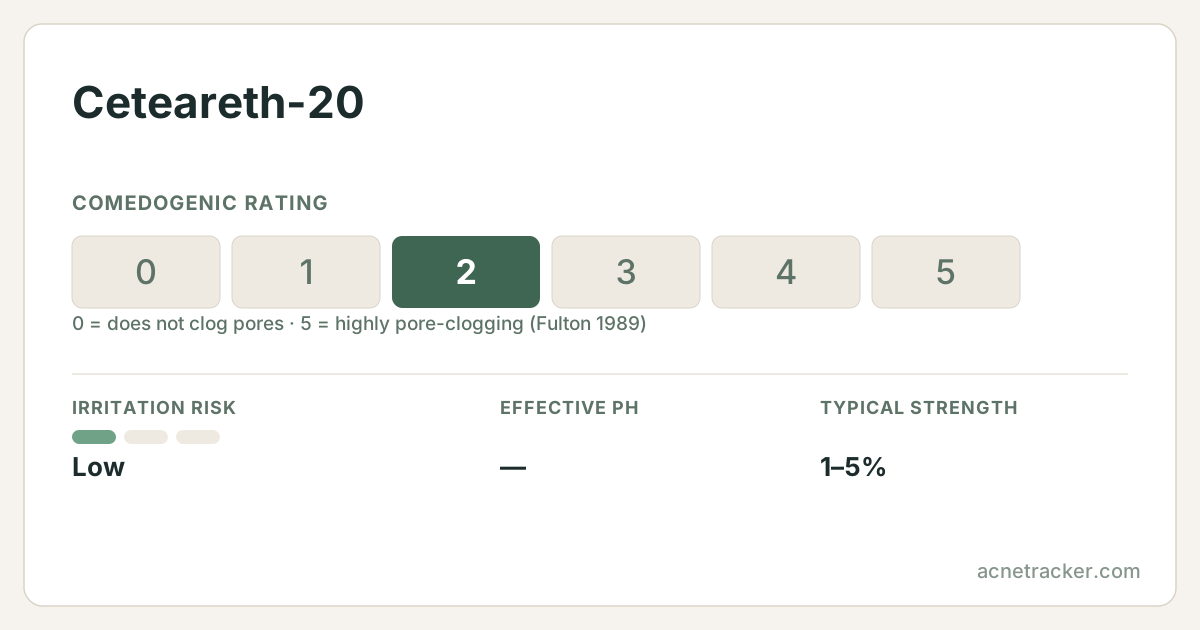
Ceteareth-20 is a classic emulsifier, the kind of behind-the-scenes ingredient that makes a cream a cream. Its job is to hold oil and water together in a stable, smooth lotion or cream so the product does not split into an oily layer and a watery one. It is a dependable, well-established emulsifier that has been used for decades in moisturizers, cleansers and lotions of every kind. You will rarely notice it, but without an emulsifier like this most creams simply could not exist as the uniform textures we expect.
Quick facts
- Comedogenic rating
- measured (Fulton 1989)
- Irritation risk
- Low
- Effective pH
- —
- Typical strength
- 1–5%
- Pregnancy
- Considered safe
- Suits skin types
- drynormalcombinationmature
Where this number comes from
Read directly from Table I of Fulton's 1989 paper — the primary source, not one of the copied tables that circulate online.
Fulton read his own scale as 0-1 not significant, 2-3 borderline, 4-5 positive. The assay is the rabbit ear at 10% dilution, which the paper itself calls extremely sensitive and not fully predictive of human skin. Ratings describe the raw ingredient; concentration and formulation change real-world behaviour.
Caution profile
The four published fields on this page, on one 0–5 scale. Further from the centre means more care is needed — never that the ingredient is worse.
Derived, not measured: pore-clogging is the published comedogenic rating; irritation maps low/moderate/high to 1/3/5; pregnancy maps safe/caution/avoid to 0/3/5; skin-type limits is how many of the seven skin types this entry does NOT list. Every input is printed in words in the quick-facts card above.
Show the numbers
| Metric | 0–5 | Published field |
|---|---|---|
| Pore-clogging | 2 | 2/5 |
| Irritation | 1 | Low |
| Skin-type limits | 2.1 | 4/7 |
| Pregnancy | 0 | Considered safe |
Working pH and typical strength
Where this ingredient is formulated to sit, and at what concentration.
Both bars come from the fields above: the pH window and the typical strength range published for this ingredient. The tinted column is healthy skin's surface pH (about 4.7–5.75).
Show the numbers
| Metric | 0–5 |
|---|---|
| Typical strength | 1–5% |
What is it?
Ceteareth-20 is a non-ionic emulsifier made by reacting cetearyl alcohol, a fatty alcohol from vegetable oils, with about 20 units of ethylene oxide. This gives it a fatty, oil-loving portion and a water-loving portion, exactly the split a molecule needs to bridge oil and water. When it sits at the boundary between the two, it lowers the tension between them so tiny oil droplets stay evenly dispersed throughout the water phase, forming a stable emulsion. The 20 in the name refers to the number of ethylene oxide units, which makes it more water-loving than lower-numbered ceteareths. It is often paired with cetearyl alcohol or other co-emulsifiers to build a rich, stable cream.
Benefits
Keeps creams stable
As an oil-in-water emulsifier it holds oil droplets suspended in the water phase, so lotions and creams stay smooth and do not separate on the shelf.
Creates a pleasant texture
It helps build the soft, uniform body of a lotion or cream, contributing to how easily a product spreads and absorbs.
Solubilizes ingredients
It can also help disperse small amounts of oils and oil-soluble ingredients into a formula, keeping everything evenly mixed.
Reliable and versatile
Compatible with a wide range of oils and actives, it is a flexible base emulsifier suited to everything from light lotions to richer creams.
How to use
Ceteareth-20 needs nothing from you; it is fully worked into the cream, lotion or cleanser during manufacturing. Apply the moisturizer or wash as usual. It is a functional ingredient rather than an active, so there are no layering rules or adjustment periods tied to it. Its presence simply signals a standard emulsified cream or lotion.
Side effects
Ceteareth-20 is regarded as low-irritation, and Fulton rated it 2 — borderline — so it is unlikely to clog pores for most people. Because it is a surfactant-type emulsifier, a small number of people with very reactive or compromised skin may find high-emulsifier formulas slightly more prone to feeling irritating, but this is uncommon at normal use levels. It does not typically sensitize the skin.
Who should avoid it
Most people can use it without concern. The exception worth naming is a damaged barrier or highly reactive skin: an emulsifier is a surfactant by nature, and a cream carrying a lot of one can feel irritating to skin in that state, so a simpler formula may sit better. That is a question of how much emulsifier a cream needs, not of ceteareth-20 being a common trigger, and it remains a safe choice to keep using during pregnancy and breastfeeding.
Pairs well with
Frequently asked questions
Is ceteareth-20 safe for skin?
Yes. It is a long-established emulsifier with low irritation potential and a comedogenic rating of 2 in Fulton's table, considered safe in cosmetic products at normal use levels.
What does ceteareth-20 do?
It is an emulsifier that keeps oil and water blended in a stable cream or lotion, preventing the product from separating and giving it a smooth, uniform texture.
Does ceteareth-20 clog pores?
Rarely — Fulton rated it 2, borderline on his scale, and it is present as an emulsifier at a few percent rather than as an oil. What decides whether a cream congests you is usually the oil phase it is holding together, so judge the formula as a whole.
Is ceteareth-20 the same as cetearyl alcohol?
No. Ceteareth-20 is made from cetearyl alcohol but modified with ethylene oxide to become an emulsifier. Cetearyl alcohol itself is a thickening fatty alcohol, and the two are often used together.
Why is ceteareth-20 in my moisturizer?
It holds the oil and water phases of the cream together so it stays a smooth, uniform lotion rather than splitting into greasy and watery layers.
Sources & further reading
Medical disclaimer
Find your personal acne triggers
Our free Acne Tracker lets you log breakouts, sleep, stress and diet, and shows you which factors correlate with your flare-ups.