PEG-100 Stearate: Comedogenic Rating & Ingredient Analysis
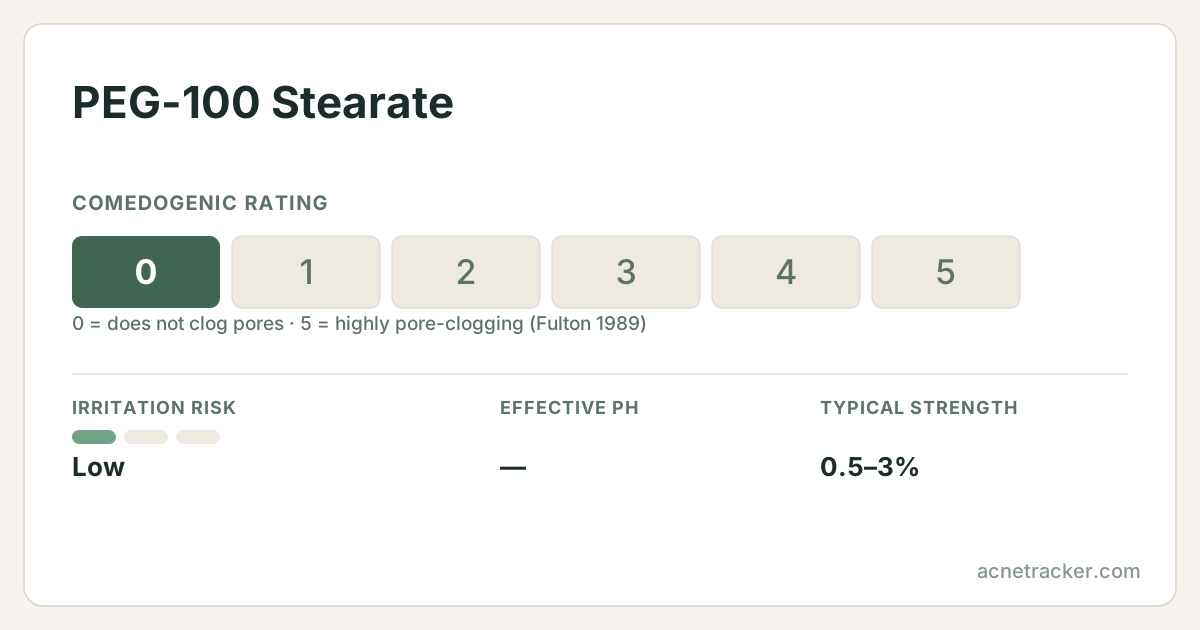
PEG-100 stearate is one of the most familiar co-emulsifiers in skincare, so common that it is almost always listed right after glyceryl stearate on an ingredient label. The two form a classic partnership: glyceryl stearate provides an oil-loving emulsifier and PEG-100 stearate adds a strongly water-loving one, and together they build especially smooth, stable creams and lotions. On its own, PEG-100 stearate is a lightweight, water-dispersible emulsifier that helps keep oil evenly blended into the water phase without adding heaviness.
Quick facts
- Comedogenic rating
- measured (Fulton 1989)
- Irritation risk
- Low
- Effective pH
- —
- Typical strength
- 0.5–3%
- Pregnancy
- Considered safe
- Suits skin types
- drynormalcombinationsensitivemature
Where this number comes from
Read directly from Table I of Fulton's 1989 paper — the primary source, not one of the copied tables that circulate online.
Fulton read his own scale as 0-1 not significant, 2-3 borderline, 4-5 positive. The assay is the rabbit ear at 10% dilution, which the paper itself calls extremely sensitive and not fully predictive of human skin. Ratings describe the raw ingredient; concentration and formulation change real-world behaviour.
Caution profile
The four published fields on this page, on one 0–5 scale. Further from the centre means more care is needed — never that the ingredient is worse.
Derived, not measured: pore-clogging is the published comedogenic rating; irritation maps low/moderate/high to 1/3/5; pregnancy maps safe/caution/avoid to 0/3/5; skin-type limits is how many of the seven skin types this entry does NOT list. Every input is printed in words in the quick-facts card above.
Show the numbers
| Metric | 0–5 | Published field |
|---|---|---|
| Pore-clogging | 0 | 0/5 |
| Irritation | 1 | Low |
| Skin-type limits | 1.4 | 5/7 |
| Pregnancy | 0 | Considered safe |
Working pH and typical strength
Where this ingredient is formulated to sit, and at what concentration.
Both bars come from the fields above: the pH window and the typical strength range published for this ingredient. The tinted column is healthy skin's surface pH (about 4.7–5.75).
Show the numbers
| Metric | 0–5 |
|---|---|
| Typical strength | 0.5–3% |
What is it?
PEG-100 stearate is made by attaching about 100 units of polyethylene glycol (PEG) to stearic acid, a common fatty acid. The long PEG chain makes the molecule very water-loving, while the stearic acid end is oil-loving, giving it strong emulsifying ability with a light feel. Because it is so water-friendly, it complements more oil-friendly emulsifiers, which is why it is paired with glyceryl stearate to balance an emulsion. PEG ingredients are sometimes questioned online, but cosmetic-grade PEG-100 stearate is well studied, used at low levels and considered safe by cosmetic review bodies.
Benefits
Balances the emulsion
Its strongly water-loving nature complements oil-loving emulsifiers like glyceryl stearate, letting the pair build a smooth, well-balanced cream.
Light, non-greasy feel
It emulsifies effectively without adding waxiness or heaviness, helping keep lotions feeling light on the skin.
Stabilizes lotions and creams
By holding oil dispersed in water it prevents separation and keeps the product uniform throughout its shelf life.
Compatible and versatile
It works with a wide range of oils and actives, making it a dependable co-emulsifier across many types of moisturizers.
How to use
PEG-100 stearate is already built into the cream or lotion, so simply use the product as directed. It is a functional emulsifier rather than an active, so there is nothing to introduce gradually and no layering rules attached to it. Seeing it next to glyceryl stearate on a label simply indicates a standard, well-formulated emulsified moisturizer.
Side effects
PEG-100 stearate is regarded as low-irritation and non-comedogenic, with a rating of 0. Concerns sometimes raised about PEGs mostly relate to manufacturing impurities in poorly purified grades; cosmetic-grade material is purified and considered safe. On intact skin it is well tolerated and does not typically sting or sensitize.
Who should avoid it
There is no skin type that specifically needs to avoid PEG-100 stearate. The caution people raise is about PEGs as a class rather than this particular molecule, and it centres on a severely compromised barrier, where some prefer to limit PEG-based ingredients as a personal precaution. On healthy skin the evidence supports its safety, including through pregnancy and breastfeeding. What it is doing in the jar is holding your moisturizer's oil phase in place at a low percentage, working opposite glyceryl stearate.
Pairs well with
Frequently asked questions
Is PEG-100 stearate safe?
Yes. It is a well-studied co-emulsifier with a comedogenic rating of 0 and low irritation potential. Cosmetic-grade material is purified and considered safe by review bodies.
What does PEG-100 stearate do?
It is a water-loving emulsifier that keeps oil dispersed in the water phase of a cream, usually partnering with glyceryl stearate to make smooth, stable lotions.
Does PEG-100 stearate clog pores?
No. It has a comedogenic rating of 0 and is water-dispersible, so it is suitable for acne-prone skin.
Are PEGs bad for your skin?
Concerns usually stem from impurities in poorly purified industrial grades. Cosmetic-grade PEG-100 stearate is refined, used at low levels and considered safe on intact skin.
Why is it always next to glyceryl stearate?
The two form a classic self-emulsifying pair: one is oil-loving, the other water-loving, and together they create particularly smooth, stable creams.
Sources & further reading
Medical disclaimer
Find your personal acne triggers
Our free Acne Tracker lets you log breakouts, sleep, stress and diet, and shows you which factors correlate with your flare-ups.