Sodium Polyacrylate: Comedogenic Rating & Ingredient Analysis
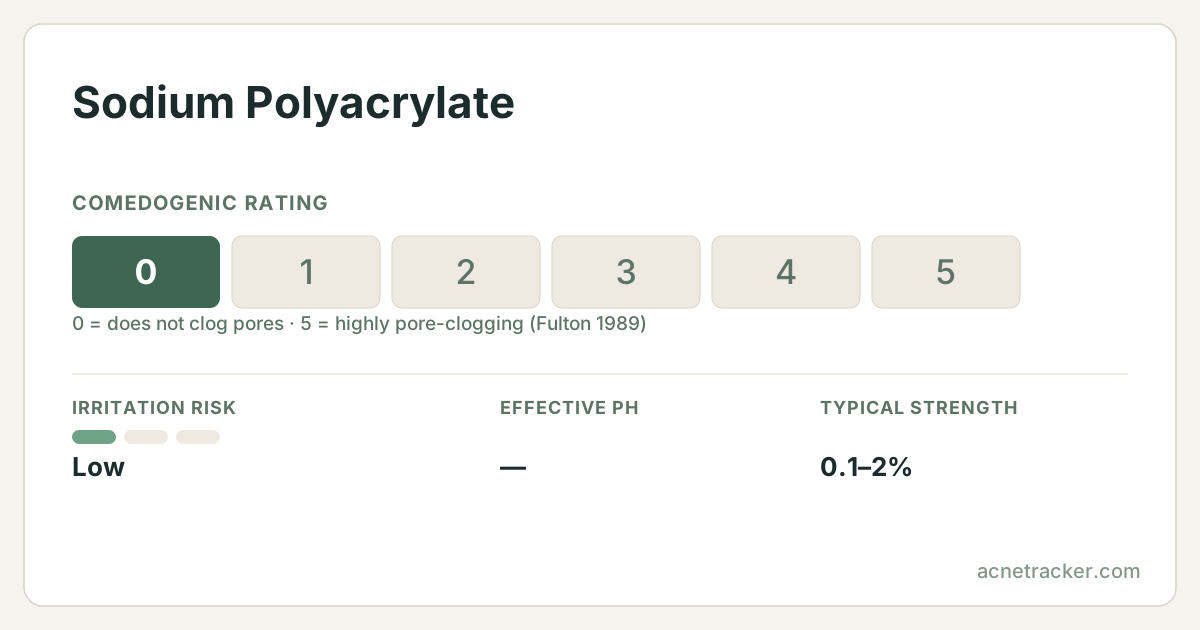
Sodium polyacrylate is a modern texturizing polymer that shows up in serums, gel-creams and sheet-mask essences when a brand wants a fresh, silky, fast-absorbing feel. It is best known outside cosmetics as the superabsorbent material inside diapers, where it can soak up many times its weight in water. In skincare it is used at far lower levels for a different reason: even a small amount thickens the water phase, stabilizes lightweight emulsions and leaves a smooth, powdery-slip finish that makes gel textures feel elegant rather than sticky.
Quick facts
- Comedogenic rating
- our estimate — not measured
- Irritation risk
- Low
- Effective pH
- —
- Typical strength
- 0.1–2%
- Pregnancy
- Considered safe
- Suits skin types
- oilydrycombinationsensitivenormalacne-pronemature
Where this number comes from
No one has published a comedogenic rating for this ingredient. Fulton's 1989 table tested about 250 raw materials and this was not among them, and we found no later study measuring it. The figure shown is our own reasoning from the ingredient's chemistry and how it is used — treat it as an estimate, not a measurement.
Fulton read his own scale as 0-1 not significant, 2-3 borderline, 4-5 positive. The assay is the rabbit ear at 10% dilution, which the paper itself calls extremely sensitive and not fully predictive of human skin. Ratings describe the raw ingredient; concentration and formulation change real-world behaviour.
Caution profile
The four published fields on this page, on one 0–5 scale. Further from the centre means more care is needed — never that the ingredient is worse.
Derived, not measured: pore-clogging is the published comedogenic rating; irritation maps low/moderate/high to 1/3/5; pregnancy maps safe/caution/avoid to 0/3/5; skin-type limits is how many of the seven skin types this entry does NOT list. Every input is printed in words in the quick-facts card above.
Show the numbers
| Metric | 0–5 | Published field |
|---|---|---|
| Pore-clogging | 0 | 0/5 |
| Irritation | 1 | Low |
| Skin-type limits | 0 | 7/7 |
| Pregnancy | 0 | Considered safe |
Working pH and typical strength
Where this ingredient is formulated to sit, and at what concentration.
Both bars come from the fields above: the pH window and the typical strength range published for this ingredient. The tinted column is healthy skin's surface pH (about 4.7–5.75).
Show the numbers
| Metric | 0–5 |
|---|---|
| Typical strength | 0.1–2% |
What is it?
Sodium polyacrylate is the sodium salt of polyacrylic acid, a long chain of acrylate units. Unlike carbomer it does not usually need a separate pH adjuster, because it comes pre-neutralized and thickens water directly. Its standout property is water absorption: the polymer grabs and holds large amounts of water, which is what builds viscosity at low use levels. It also forms a very thin, flexible film as a product dries, giving the characteristic cushiony-then-silky feel. The molecule is far too large to penetrate the skin and has no active or biological role; its job is purely sensory and structural.
Benefits
Thickens with a light feel
It builds viscosity while keeping a formula feeling fresh and weightless, which is why it is popular in gel-creams and watery essences rather than rich balms.
Delivers a silky slip
As it dries it leaves a soft, almost powdery glide that makes serums feel refined and helps them layer smoothly under makeup.
Stabilizes lightweight emulsions
By thickening the water phase it holds small oil droplets in suspension, keeping fluid lotions and gel-creams from separating.
Boosts a hydrated finish
Its water-holding structure keeps moisture at the surface a little longer, enhancing the fresh, dewy feel of hydrating products.
How to use
As with other thickeners, there is nothing special to do; sodium polyacrylate is already blended into the finished product, usually a gel, essence or lightweight cream. If you notice faint white pilling when layering several gel products, that is a sign of stacking too many film-forming textures rather than a problem with this ingredient. Spacing out layers, letting each absorb, and applying to slightly damp skin keeps everything smooth.
Side effects
Sodium polyacrylate is regarded as non-irritating and non-comedogenic, with a rating of 0. Because it is a large surface-level polymer, it does not penetrate or provoke the skin. The only common complaint is cosmetic pilling when it is layered heavily with other film formers or silicones. Genuine allergic reactions are extremely rare.
Who should avoid it
No skin type needs to avoid sodium polyacrylate. It suits sensitive, oily and acne-prone skin and is considered safe during pregnancy and breastfeeding. People prone to pilling from layered gels may simply prefer fewer film-forming products at once.
Pairs well with
Frequently asked questions
Is sodium polyacrylate safe in skincare?
Yes. In finished products it is inert, non-irritating and has a comedogenic rating of 0. It stays on the surface as a thin film and is not absorbed into the skin.
Is this the same stuff used in diapers?
It is the same family of superabsorbent polymer, but used at far lower concentrations and for texture rather than absorbing liquid. Cosmetic grades are purified for skin use.
Does sodium polyacrylate clog pores?
No. It has a comedogenic rating of 0 and does not penetrate the follicle, so it is suitable for acne-prone and oily skin.
Why does my gel feel silky then slightly tacky?
That is the thin film sodium polyacrylate forms as it dries. The silky slip comes first; if it feels tacky, the formula uses a little too much or you have layered several film formers.
Can I use it with hyaluronic acid?
Yes. It pairs well with humectants like hyaluronic acid and glycerin, thickening the water they are dissolved in and enhancing a fresh, hydrated finish.
Sources & further reading
Medical disclaimer
Find your personal acne triggers
Our free Acne Tracker lets you log breakouts, sleep, stress and diet, and shows you which factors correlate with your flare-ups.