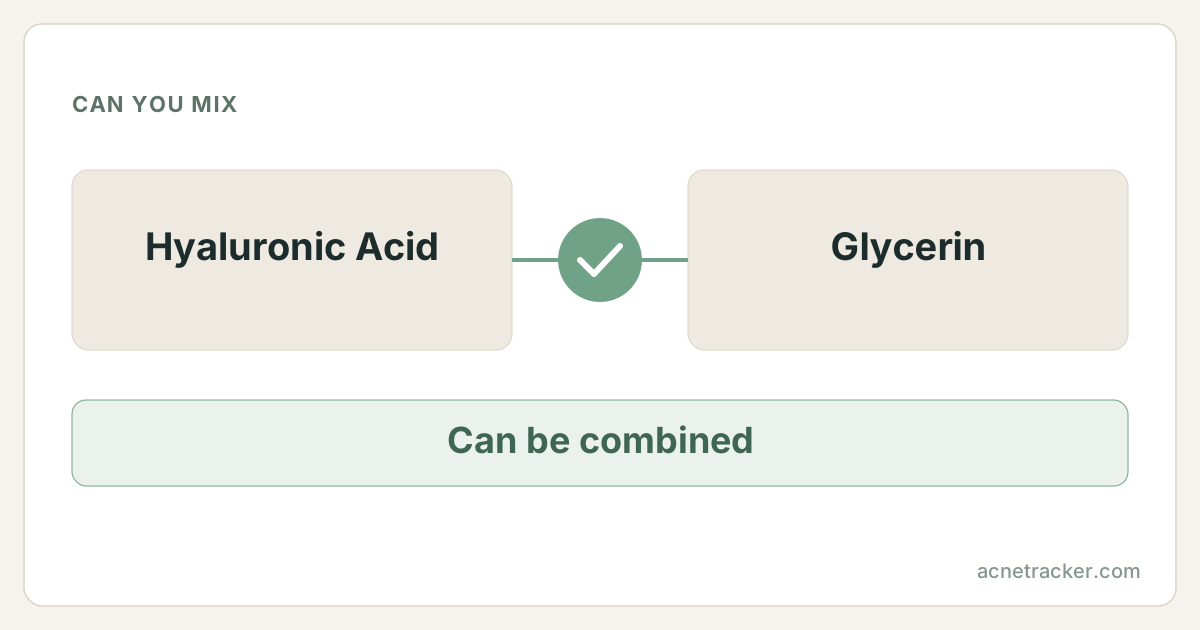
Can You Mix Hyaluronic Acid and Glycerin?
Yes — and you are almost certainly already doing it. Glycerin sits in the great majority of hyaluronic acid serums, usually higher up the ingredient list than the hyaluronic acid itself. They are both humectants, but they are not redundant: glycerin is small enough to move into the stratum corneum, while hyaluronic acid is a large polymer that works mostly at the surface. That difference is the whole point of the pair.
How this pairing resolves
The two ingredients, their published numbers, and where they land together.
The numbers beside each ingredient are its published comedogenic rating and effective pH window, taken from its own profile page.
Show the numbers
| Ingredients | Metric | 0–5 |
|---|---|---|
| Hyaluronic Acid | Comedogenic rating | 0/5 |
| Hyaluronic Acid | Effective pH | no published pH |
| Glycerin | Comedogenic rating | 0/5 |
| Glycerin | Effective pH | no published pH |
Why
Size explains nearly everything here. Glycerin is a tiny three-carbon molecule of about 92 daltons — small enough to diffuse into the stratum corneum and distribute among the corneocytes, where it behaves much like the skin's own natural moisturising factor. Cosmetic hyaluronic acid runs from a few thousand daltons to over a million; even the fragmented grades are orders of magnitude larger, and the high-weight ones cannot cross an intact stratum corneum at all. They therefore occupy different territory: glycerin hydrates within the tissue, hyaluronic acid draws and holds water in a film at the top of it. Glycerin also has the deeper evidence base by a wide margin — it is one of the most studied humectants in dermatology, with work linking it to aquaporin-3 water channels and to normalising desquamation in dry skin. Hyaluronic acid's popularity owes as much to the name, and to injectable filler's halo, as to any demonstrated superiority over glycerin on the surface of the skin. The uncomfortable summary is that the cheap ingredient is the better-supported one, and the expensive one is the better story.
How to combine them
Nothing needs orchestrating: one product containing both, applied to damp skin and sealed with a moisturiser, is the complete answer. If you are choosing rather than layering, read the position on the list. Glycerin high in the ingredients — the first four or five names — is doing real work; hyaluronic acid appearing after the preservative is present at a fraction of a percent and there mainly for the label. Where the pair genuinely earns its keep is dry air. In a heated flat in February, at indoor humidity well below the skin's own water content, a humectant film has little atmospheric moisture to draw from and will take what it needs from the tissue underneath, then let it evaporate. Glycerin is less prone to this than large hyaluronic acid, but neither is a moisturiser on its own. The occlusive or emollient step on top is not optional in dry conditions — it is the step that makes the humectants work in the first place.
Example routine
| When | Steps |
|---|---|
| Morning | Cleanser → Glycerin/hyaluronic serum on damp skin → Moisturiser → SPF 30+ |
| Evening | Cleanser → Humectant serum on damp skin → Moisturiser |
| Dry indoor air (winter) | Never leave humectants unsealed — always a cream on top |
| Reading the label | Glycerin in the top 5 = active dose; HA after the preservative = label copy |
Warning signs
Frequently asked questions
Is glycerin just a cheap filler compared to hyaluronic acid?
No, and the reverse case is easier to argue. Glycerin is cheap because it is abundant, not because it is weak, and it has a longer and stronger evidence record in dermatology than cosmetic hyaluronic acid does.
Do I need both, or will one do?
One good humectant plus a proper moisturiser will serve most people. Both together is a sensible belt-and-braces because they work at different depths, but the moisturiser matters more than the choice between them.
Which is better for very dry skin in winter?
Glycerin has the edge, because it penetrates and depends less on humidity in the air. But in genuinely dry indoor air the decisive factor is what you seal it with, not which humectant you pick.
Can glycerin make my skin sticky?
Yes, above roughly 10% in a leave-on product it gets tacky, especially in humid weather. Lower-percentage formulas or a lighter application solve it; the stickiness is cosmetic, not a sign of a problem.
Does glycerin clog pores?
No. It is water-soluble, does not sit in the follicle as an oil would, and is used freely in products aimed at acne-prone skin. The same applies to hyaluronic acid.
Sources & further reading
There is no single study of this exact question. The guidance here is reasoned from the ingredient profiles below, each of which carries its own references:
- Hyaluronic Acid3 refs
- Glycerin3 refs
Show every reference behind this page (4)
- PubChem — Hyaluronic acid compound summarycited by Hyaluronic Acid
- European Commission CosIng database — Hyaluronic Acidcited by Hyaluronic Acid, Glycerin
- DermNet — Moisturisers and humectantscited by Hyaluronic Acid, Glycerin
- PubChem — Glycerol compound summarycited by Glycerin
Medical disclaimer
Ingredients mentioned on this page
Find your personal acne triggers
Our free Acne Tracker lets you log breakouts, sleep, stress and diet, and shows you which factors correlate with your flare-ups.