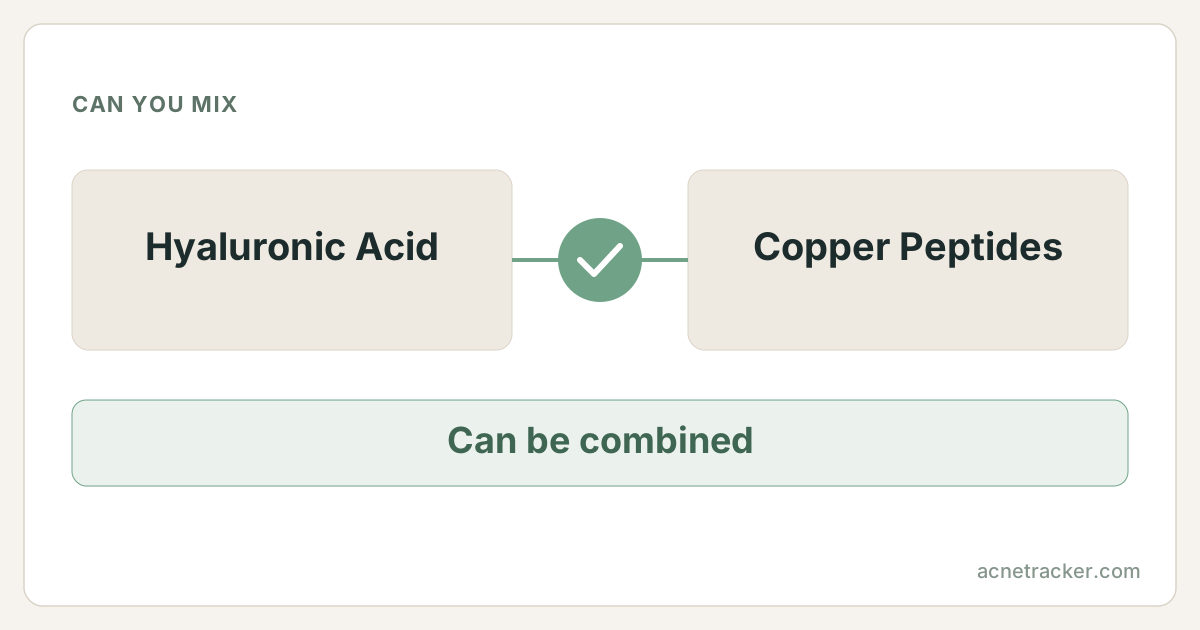
Can You Mix Hyaluronic Acid and Copper Peptides?
Yes, layered as separate steps with a moment between them. This is the one hyaluronic acid pairing with actual chemistry to respect: GHK-Cu carries a positive charge, hyaluronate carries a negative one, and oppositely charged polymers and complexes can associate with each other. In a bottle that is a formulator's problem to solve. In your palm, mixing the two is the version worth avoiding.
How this pairing resolves
The two ingredients, their published numbers, and where they land together.
The numbers beside each ingredient are its published comedogenic rating and effective pH window, taken from its own profile page.
Show the numbers
| Ingredients | Metric | 0–5 |
|---|---|---|
| Hyaluronic Acid | Comedogenic rating | 0/5 |
| Hyaluronic Acid | Effective pH | no published pH |
| Copper Peptides | Comedogenic rating | 0/5 |
| Copper Peptides | Effective pH | no published pH |
Why
GHK-Cu is a tripeptide — glycyl-L-histidyl-L-lysine — bound to a copper ion. The copper is not a passenger; the complex is the active entity, and the peptide's job includes ferrying that ion. It was identified in human plasma and has a genuine research history in wound healing, with work reporting effects on collagen synthesis and fibroblast activity, though cosmetic evidence for wrinkles is thinner than the price of these serums suggests. The relevant fact here is electrostatic. The copper complex is cationic. Hyaluronan is a polyanion — every repeating unit carries a carboxyl group that is deprotonated at the pH of a formula, giving a long chain of negative charges. Oppositely charged species in solution attract, and a polyanion can associate with cationic species, potentially forming complexes that come out of solution or lose activity. This is well known to formulators, which is why copper peptide products are often built without anionic thickeners and why a well-made serum with both in it has been engineered around the issue rather than stumbling into it. What it means for you is narrower than the internet suggests: this is a mixing-in-the-palm concern and a same-bottle concern, not a layering concern. Applied as separate steps, each product absorbs into skin whose own chemistry — salts, proteins, a pH near 5 — is already vastly more complicated than a hyaluronate gel. Nothing dramatic happens on your face.
How to combine them
Keep them as two distinct steps and do not blend them in your hand. Hyaluronic acid on damp skin first, wait until it is no longer wet, then the copper peptide serum, then moisturiser. Alternatively give them separate slots entirely — copper peptides in the morning, hyaluronic acid at night — which sidesteps the question and is what many people do anyway. Copper peptides have their own famous incompatibility, and it is not hyaluronic acid: direct vitamin C, which is a reducing agent, can interfere with the copper complex, and strong acids are also better kept to a different part of the day. So the practical routine is usually copper peptides in one session and the acids or L-ascorbic acid in the other, with hyaluronic acid free to appear in both because it conflicts with nothing. Give peptides months rather than weeks before judging.
Example routine
| When | Steps |
|---|---|
| Morning | Cleanser → Hyaluronic acid on damp skin → wait → Copper peptides → Moisturiser → SPF 30+ |
| Evening | Cleanser → Vitamin C or acids → Hyaluronic acid → Moisturiser (no copper peptides) |
| Do not | Mix a hyaluronate gel and a copper peptide serum in your palm before applying |
| Timeline | Judge peptides at 3 months, not 3 weeks |
Warning signs
Frequently asked questions
Does hyaluronic acid deactivate copper peptides?
Not in the way the internet claims. The real concern is electrostatic association between a cationic copper complex and an anionic polymer, and it belongs to mixing in one solution — a formulator's problem. Applied as separate layers with a moment between, your skin's own chemistry dwarfs the issue.
Can I mix the two serums in my hand to save a step?
That is the one version worth avoiding. Combining a polyanionic gel and a cationic peptide complex in a drop on your palm is exactly the condition where association and clumping can occur. Layer them instead and let the first settle.
What should I not use with copper peptides?
Direct vitamin C is the well-known one — L-ascorbic acid is a reducing agent and can interfere with the copper complex — and strong acids are usually given a separate slot. Hyaluronic acid is not on that list; it is the ingredient that fits anywhere.
Is the evidence for copper peptides in skincare strong?
It is stronger in wound healing than in cosmetics. GHK-Cu has real literature on collagen synthesis and fibroblast activity, much of it in healing contexts; the leap to visible wrinkle improvement from a serum is where the evidence thins considerably.
Morning or evening for copper peptides?
Either — they are not photosensitising. Most people put them in whichever session does not contain vitamin C or acids, which usually means morning. Hyaluronic acid can go in both sessions without any scheduling thought.
Sources & further reading
There is no single study of this exact question. The guidance here is reasoned from the ingredient profiles below, each of which carries its own references:
- Hyaluronic Acid3 refs
- Copper Peptides2 refs
Show every reference behind this page (4)
- PubChem — Hyaluronic acid compound summarycited by Hyaluronic Acid
- European Commission CosIng database — Hyaluronic Acidcited by Hyaluronic Acid, Copper Peptides
- DermNet — Moisturisers and humectantscited by Hyaluronic Acid
- PubMed — The human tri-peptide GHK and tissue remodeling (J Biomater Sci Polym Ed, 2008)cited by Copper Peptides
Medical disclaimer
Ingredients mentioned on this page
Find your personal acne triggers
Our free Acne Tracker lets you log breakouts, sleep, stress and diet, and shows you which factors correlate with your flare-ups.