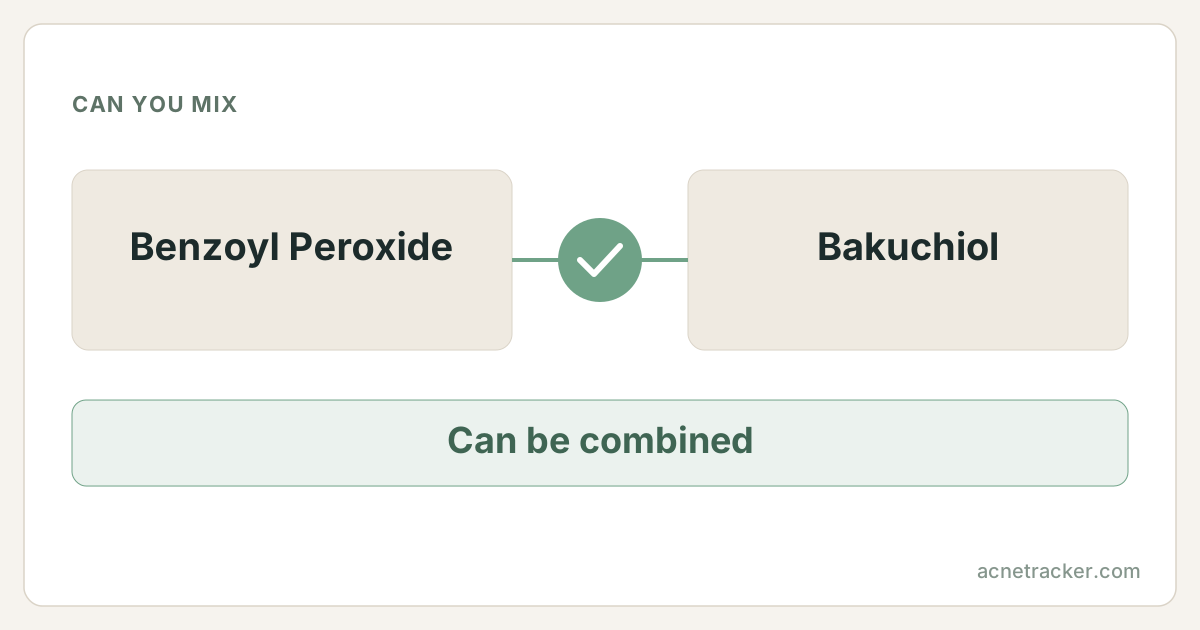
Can You Mix Benzoyl Peroxide and Bakuchiol?
Yes, for most people. Bakuchiol is not a retinoid at all — it is a plant-derived meroterpene phenol that happens to switch on some of the same genes — so the rule about benzoyl peroxide degrading retinoids does not transfer to it. It is also far better tolerated than retinol, which makes it a sensible partner for a drying treatment. The honest caveat: nobody has published a stability study on this specific pair.
How this pairing resolves
The two ingredients, their published numbers, and where they land together.
The numbers beside each ingredient are its published comedogenic rating and effective pH window, taken from its own profile page.
Show the numbers
| Ingredients | Metric | 0–5 |
|---|---|---|
| Benzoyl Peroxide | Comedogenic rating | 0/5 |
| Benzoyl Peroxide | Effective pH | no published pH |
| Bakuchiol | Comedogenic rating | 0/5 |
| Bakuchiol | Effective pH | no published pH |
Why
Bakuchiol comes from the seeds of Psoralea corylifolia and looks nothing like vitamin A on paper. What earned it the retinol comparison is gene expression work showing it upregulates similar collagen-related pathways, plus a 2019 randomised trial in the British Journal of Dermatology that compared bakuchiol 0.5% with retinol 0.5% over twelve weeks and found comparable improvement in photoageing measures, with the bakuchiol group reporting significantly less stinging and scaling. That tolerance gap is the reason it belongs in a benzoyl peroxide routine at all: the limiting factor when treating acne is almost never the active's power, it is how much irritation a face will accept before the user quits. Where honesty is required: bakuchiol is a phenol, and phenols are oxidisable in principle, so a chemist could reasonably ask what an oxidiser does to it on skin. No one has measured it. What we can say is that bakuchiol's stability profile is well ahead of retinol's — it tolerates light and heat that would destroy retinol — and that it lacks the conjugated polyene chain that makes tretinoin so vulnerable to benzoyl peroxide in the first place.
How to combine them
The uncomplicated route: benzoyl peroxide on spots in the morning, bakuchiol across the whole face at night, moisturiser after both. That respects the theoretical stability question at zero cost. If you want them in one evening routine, apply benzoyl peroxide to the lesions first, let it dry down completely — not partially — then apply bakuchiol over the wider area and moisturise. Bakuchiol needs no adjustment period in the way retinol does, so you can use it nightly from the start; the ramp-up belongs to the benzoyl peroxide side. Typical concentrations are 0.5–2%, and bakuchiol is usually delivered in an oil or oil-in-water base, which is worth noting if you are acne-prone and sensitive to heavier textures. Unlike retinol, bakuchiol has not been shown to increase photosensitivity, but sunscreen stays in the routine because benzoyl peroxide leaves skin thinner and the ageing work bakuchiol is doing is undone by UV anyway.
Example routine
| When | Steps |
|---|---|
| Morning | Cleanser → Benzoyl peroxide 2.5% on spots → Moisturiser → SPF 30+ |
| Evening | Cleanser → Bakuchiol 0.5–1% → Moisturiser |
| Same-routine option | Benzoyl peroxide on lesions → dry down fully → Bakuchiol → Moisturiser |
| Frequency | Bakuchiol nightly from day one; benzoyl peroxide built up gradually |
Warning signs
Frequently asked questions
Does benzoyl peroxide deactivate bakuchiol like it does retinol?
There is no published stability study on the pair. What is known is that bakuchiol lacks the polyene chain that makes tretinoin vulnerable and is markedly more stable to light and heat than retinol, so the same concern does not obviously apply.
Is bakuchiol actually as good as retinol?
A 2019 randomised trial found bakuchiol 0.5% comparable to retinol 0.5% on photoageing measures at twelve weeks, with less irritation. That is one trial on ageing, not acne — the evidence base is much smaller than retinol's.
Can I use bakuchiol every night alongside benzoyl peroxide?
Yes, bakuchiol needs no adjustment period. Benzoyl peroxide is the ingredient to introduce gradually — start at 2.5% on spots a few times weekly and build up from there.
Should I use bakuchiol instead of retinol if I'm on benzoyl peroxide?
It is a reasonable choice if retinol irritates you too much to continue, since the combined dryness is the usual failure point. If you tolerate retinol well, the simpler fix is to use it at night and benzoyl peroxide in the morning.
Sources & further reading
There is no single study of this exact question. The guidance here is reasoned from the ingredient profiles below, each of which carries its own references:
- Benzoyl Peroxide3 refs
- Bakuchiol3 refs
Show every reference behind this page (6)
- PubChem — Benzoyl peroxide compound summarycited by Benzoyl Peroxide
- DermNet — Benzoyl peroxidecited by Benzoyl Peroxide
- FDA — Drugs (OTC acne products)cited by Benzoyl Peroxide
- PubChem — Bakuchiol compound summarycited by Bakuchiol
- Bakuchiol: a retinol-like functional compound (PubMed)cited by Bakuchiol
- DermNet — Cosmeceuticalscited by Bakuchiol
Medical disclaimer
Ingredients mentioned on this page
Find your personal acne triggers
Our free Acne Tracker lets you log breakouts, sleep, stress and diet, and shows you which factors correlate with your flare-ups.