Can You Mix Azelaic Acid and Bakuchiol?
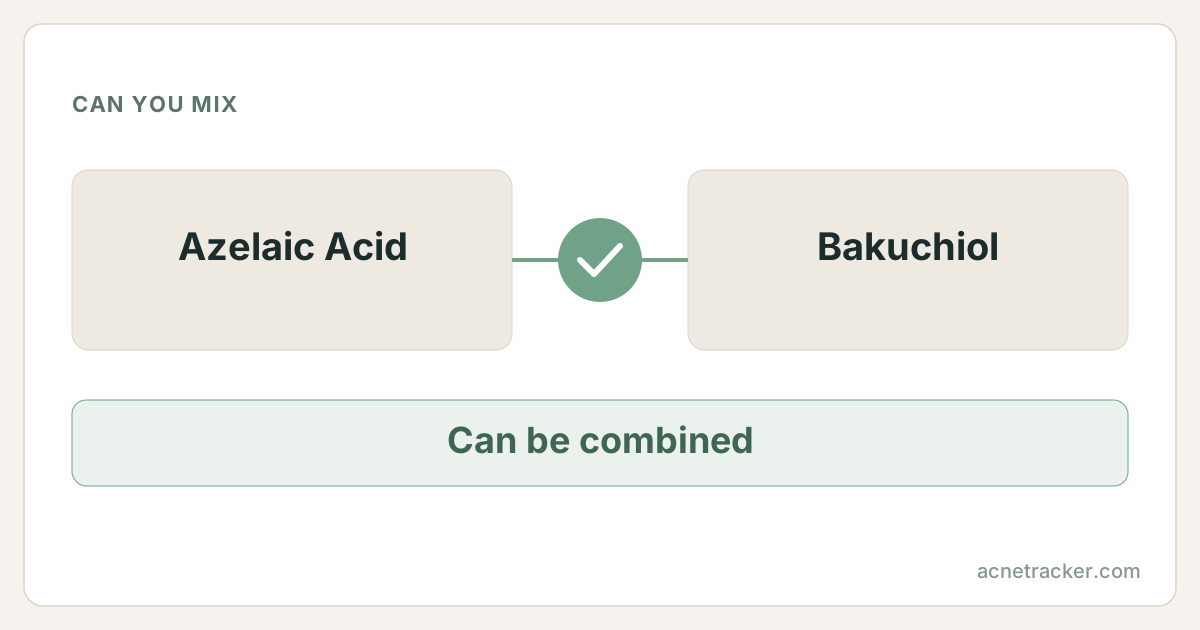
Yes. Bakuchiol is not a retinoid, is not pH-sensitive and does not cause the retinisation phase, so it layers with azelaic acid without ceremony. One caution worth stating plainly, because it is the reason many people search this pair: azelaic acid's pregnancy-compatible reputation does not transfer to bakuchiol, which has not been established as safe in pregnancy.
How this pairing resolves
The two ingredients, their published numbers, and where they land together.
The numbers beside each ingredient are its published comedogenic rating and effective pH window, taken from its own profile page.
Show the numbers
| Ingredients | Metric | 0–5 |
|---|---|---|
| Azelaic Acid | Comedogenic rating | 0/5 |
| Azelaic Acid | Effective pH | 4.0–5.0 |
| Bakuchiol | Comedogenic rating | 0/5 |
| Bakuchiol | Effective pH | no published pH |
Why
Bakuchiol is a meroterpene phenol from the seeds of Psoralea corylifolia, and structurally it looks nothing like vitamin A — no beta-ionone ring, no polyene chain, none of the features that define a retinoid. What made it interesting is functional: gene expression work reported that bakuchiol upregulates several of the same collagen-related genes retinol does, and a much-cited randomised twelve-week comparison (Dhaliwal et al., British Journal of Dermatology, 2019) found bakuchiol 0.5% comparable to retinol 0.5% for photoageing measures, with less scaling and stinging. That is a real study, but it was small, and 'behaves like retinol on these endpoints' is a narrower claim than 'is a natural retinol'. Alongside azelaic acid the interaction question is easy: bakuchiol has no oxidisable retinoid backbone to protect, no pH window to defend, and azelaic acid is neither an oxidiser nor a strong acid at use strength. Nothing degrades. The reason to combine them is division of labour — bakuchiol on texture and fine lines, azelaic acid on redness, pigment and the follicle. The pregnancy point deserves its own sentence: bakuchiol is a plant extract, and 'plant' has no bearing on reproductive safety. Its close botanical relative psoralen is a known photosensitiser, which is a reminder that this genus is not inert.
How to combine them
Bakuchiol is usually suspended in an oil or a lightweight emulsion at 0.5–2%, so texture rather than chemistry decides the order: azelaic acid on clean dry skin first, bakuchiol over it, moisturiser last. If your bakuchiol is a thin serum and your azelaic acid a heavy cream, keep azelaic acid last instead — thin to thick beats any rule about which is 'more active'. Unlike retinol, bakuchiol tolerates morning use because it does not degrade in daylight and does not increase photosensitivity, so you can genuinely run both twice a day if your skin is content. Most people do not need to: azelaic acid every morning and bakuchiol every evening spreads the load and makes any reaction traceable. There is no adjustment period to schedule and no need to alternate nights. Sunscreen still applies, not because either ingredient demands it but because it is what protects the pigment progress azelaic acid is slowly making.
Example routine
| When | Steps |
|---|---|
| Morning | Cleanser → Azelaic acid 10% → Moisturiser → SPF 30+ |
| Evening | Cleanser → Bakuchiol 0.5–2% → Moisturiser |
| Same-routine option | Azelaic acid → absorb → Bakuchiol → Moisturiser |
| Pregnancy | Not a bakuchiol routine — ask your doctor before assuming either is fine |
Warning signs
Frequently asked questions
Is bakuchiol safe to use in pregnancy because it's natural?
No. Natural has no bearing on reproductive safety, and bakuchiol has not been established as safe in pregnancy. Azelaic acid's better-known compatibility does not extend to it. Ask your doctor rather than reasoning from the word 'plant'.
Does azelaic acid deactivate bakuchiol?
No. Bakuchiol has no oxidisable retinoid structure and no pH window to protect, and azelaic acid is neither an oxidiser nor strongly acidic at use concentration. There is no known degradation between them.
Can I put both on in the morning?
Yes. Unlike retinol, bakuchiol is stable in daylight and does not increase sun sensitivity, and neither does azelaic acid. Splitting them across morning and evening is a comfort choice, not a chemical necessity.
Is bakuchiol a good retinol replacement in this routine?
It is a gentler alternative with real but limited evidence — the well-known 2019 comparison against retinol was a small twelve-week trial. If you tolerate a retinoid, it likely does more; if you do not, bakuchiol is a reasonable option.
Which one treats acne here?
Azelaic acid, primarily. It is mildly comedolytic, antibacterial and anti-inflammatory. Bakuchiol's evidence sits mostly in photoageing; treat any acne benefit from it as unproven rather than assumed.
Sources & further reading
There is no single study of this exact question. The guidance here is reasoned from the ingredient profiles below, each of which carries its own references:
- Azelaic Acid3 refs
- Bakuchiol3 refs
Show every reference behind this page (6)
- PubChem — Azelaic acid compound summarycited by Azelaic Acid
- DermNet — Azelaic acidcited by Azelaic Acid
- European Commission CosIng database — Azelaic Acidcited by Azelaic Acid
- PubChem — Bakuchiol compound summarycited by Bakuchiol
- Bakuchiol: a retinol-like functional compound (PubMed)cited by Bakuchiol
- DermNet — Cosmeceuticalscited by Bakuchiol
Medical disclaimer
Ingredients mentioned on this page
Find your personal acne triggers
Our free Acne Tracker lets you log breakouts, sleep, stress and diet, and shows you which factors correlate with your flare-ups.