Folliculitis on the Arms
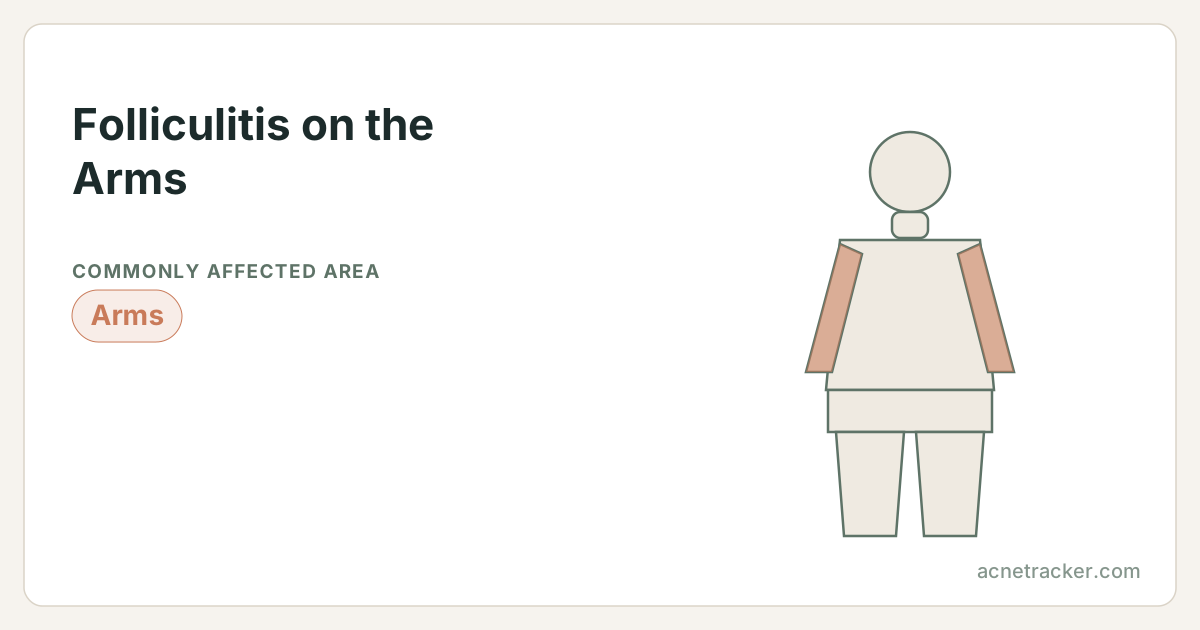
Arms are a slightly odd place for folliculitis, and the oddity is informative. Unlike legs, most people do not shave their arms, so the usual leading cause is off the table. What remains is mechanical and environmental: straps, sleeves, damp fabric and friction. That is why arm folliculitis tends to appear in shapes rather than scattered evenly — a band where a backpack sits, a patch under a rash guard, a crop on the forearm after a day in a wet wetsuit sleeve. Because keratosis pilaris also lives on the upper arm and looks vaguely similar, a lot of arm folliculitis gets treated with keratolytics for months without improving, which is a shame, since it is one of the more treatable things on this site.
How to recognize it
Folliculitis is a lifecycle, and that is what separates it from everything else on the arm. A bump appears over a day, reddens, may raise a small pustule at the follicle mouth, and settles within a week. Look for a hair emerging from the centre of each one. It is sore or itchy rather than rough, and running a hand over the area you feel individual raised bumps with normal skin between them, not a uniform sandpaper field. Distribution is a strong clue: if the crop traces the outline of a strap, a sleeve hem or a compression band, that is not a coincidence and it is not keratosis pilaris, which never respects clothing edges.
What causes it
Straps, sleeves and occlusion
Backpack and bag straps, tight sleeve cuffs, rash guards and compression sleeves all press fabric against arm follicles for hours. That combination of pressure and trapped moisture is enough on its own to inflame a follicle, which is why crops so often map exactly onto where the fabric sits.
Sweat that stays on the skin
Arm skin under a damp long sleeve stays warm and wet, and the ordinary skin flora that lives there quite happily overgrows in those conditions. The follicle opening is the entry point. Sitting in a sweaty training top through a commute is a reliable way to reproduce this.
Friction from equipment and surfaces
Gym bars, climbing walls, work gloves that end mid-forearm, desk edges under the forearm — repeated mechanical rubbing at a follicle opening inflames it without any infection needed at all, and then makes infection easier if bacteria do get in.
Occlusive products under fabric
Rich body butters and heavy oils applied to arms that then spend the day covered can contribute. Fulton's 1989 table rates several common emollient esters highly — isopropyl myristate at 5 and isopropyl palmitate at 4 — so switching to a lighter lotion is a reasonable experiment if crops follow moisturising.
Shaving or waxing the arms
A minority do remove arm hair, and when they do the mechanics become the same as on legs: micro-openings straight into follicles, crops appearing a day or two later. If you epilate or wax your arms, that timing link is worth checking before blaming anything else.
Ingredients with evidence
| Ingredient | Role |
|---|---|
| Benzoyl peroxide (wash) | The standard over-the-counter option for the bacterial form, used as a short-contact wash. Worth a pharmacist conversation about strength and format rather than guessing; it bleaches fabric. |
| Salicylic acid (BHA) | Keeps follicular openings clear between crops. Preventive rather than a treatment for a bump that has already formed, and useful when keratosis pilaris coexists. |
| Azelaic acid | Anti-inflammatory and antibacterial, with the useful side benefit of working on the brown marks each settled bump tends to leave on the arm. |
| Niacinamide | Barrier support for skin under constant mechanical load, plus help with residual redness while crops heal. Broadly tolerated alongside the actives above. |
| Panthenol | Soothing and hydrating without occluding, which suits an arm that needs comfort but must not be sealed under a sleeve in a heavy layer. |
Building the routine
Start with the fabric, because on arms the fabric is usually the cause. Loosen or pad strap contact points, get out of damp sleeves promptly rather than at the end of the day, and wash training tops properly. Then add a benzoyl peroxide wash two or three times a week, given a minute of contact before rinsing, followed by a light moisturiser. Give it three to four weeks. Do not squeeze — an arm folliculitis bump yields almost nothing and leaves a mark that lasts far longer than the bump. If crops keep arriving despite dry sleeves and a benzoyl peroxide wash, stop escalating antibacterials and consider Malassezia folliculitis, which looks nearly identical, itches more, and does not respond to antibacterials at all.
When to see a doctor
Frequently asked questions
How do I tell folliculitis on my arms from keratosis pilaris?
By lifecycle and feel. Folliculitis bumps arrive, hurt or itch, sometimes pustulate and leave within a week. Keratosis pilaris is a rough, unchanging, symmetrical field that has been there for years and does nothing. If the bumps follow a strap line, it is folliculitis.
Can my backpack really cause bumps on my arms?
Yes, and the shape usually proves it. Straps supply pressure, friction and trapped moisture at once, which is the full recipe for inflaming a follicle. A crop that traces the strap path and clears on weeks you do not carry the bag is about as clear as evidence gets.
Is folliculitis on the arms contagious?
The common form comes from your own resident skin bacteria and is not passed on through ordinary contact. Sharing towels, razors or untreated warm water can transmit the organisms involved, so those remain worth avoiding regardless.
Why does my arm folliculitis keep coming back?
Almost always because the cause is still in place. Products treat the current crop; they do not remove the strap, the damp sleeve or the friction that produced it. The other common reason is that it is Malassezia rather than bacteria, in which case antibacterial washes were never going to work.
Sources & further reading
What this page cites about the condition itself:
There is no single study of this exact question. The guidance here is reasoned from the ingredient profiles below, each of which carries its own references:
- Benzoyl Peroxide3 refs
- Salicylic Acid2 refs
- Azelaic Acid3 refs
- Niacinamide2 refs
- Panthenol3 refs
Show every reference behind this page (10)
- PubChem — Benzoyl peroxide compound summarycited by Benzoyl Peroxide
- DermNet — Benzoyl peroxidecited by Benzoyl Peroxide
- FDA — Drugs (OTC acne products)cited by Benzoyl Peroxide, Salicylic Acid
- Salicylic acid as a peeling agent: a comprehensive review (PubMed)cited by Salicylic Acid
- PubChem — Azelaic acid compound summarycited by Azelaic Acid
- DermNet — Azelaic acidcited by Azelaic Acid
- European Commission CosIng database — Azelaic Acidcited by Azelaic Acid, Niacinamide, Panthenol
- Niacinamide: mechanisms of action and its topical use in dermatology (PubMed)cited by Niacinamide
- PubChem — Panthenol compound summarycited by Panthenol
- Safety Assessment of Panthenol, Pantothenic Acid, and Derivatives as Used in Cosmetics (PubMed)cited by Panthenol
Medical disclaimer
Ingredients mentioned on this page
Find your personal acne triggers
Our free Acne Tracker lets you log breakouts, sleep, stress and diet, and shows you which factors correlate with your flare-ups.