Sodium Lactate: Comedogenic Rating & Ingredient Analysis
Sodium lactate is the sodium salt of lactic acid, and it is one of the skin's own natural moisturising factors (NMFs) — the water-attracting substances your skin uses to stay hydrated. In skincare it plays a quiet but valuable role as a humectant that draws and holds water in the skin, and it doubles as a formulation helper that buffers pH. Unlike lactic acid, which is an exfoliating alpha hydroxy acid, sodium lactate at typical use levels is mainly a moisturiser, though it retains a very mild affinity for gentle surface renewal. It is a gentle, dependable ingredient that supports soft, well-hydrated skin.
Quick facts
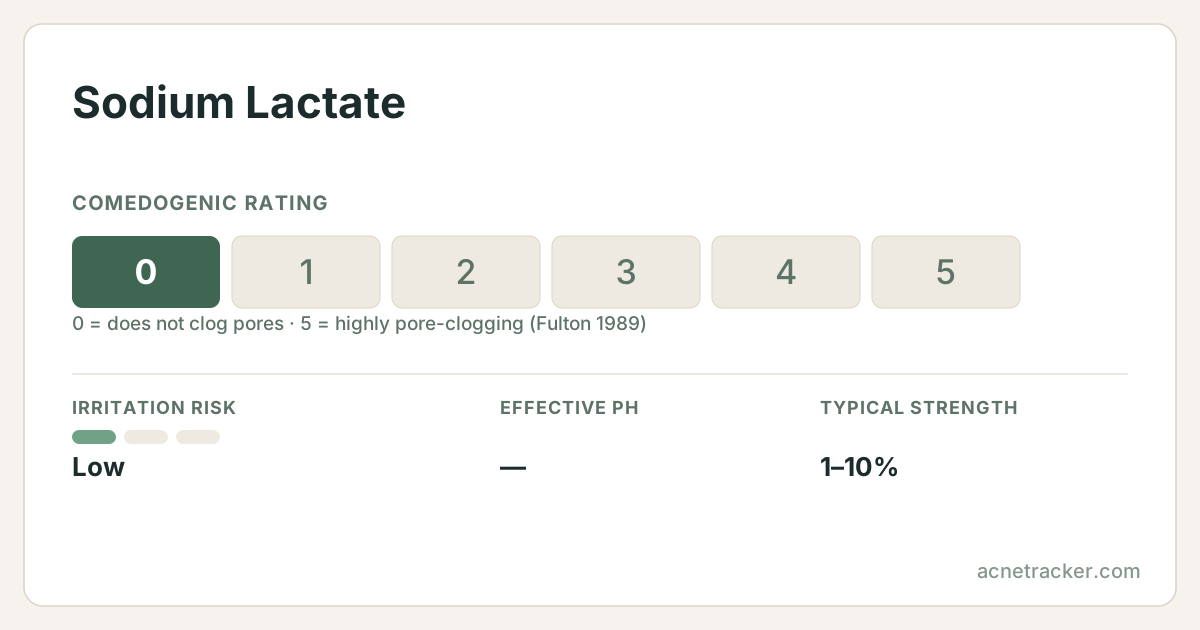
- Comedogenic rating
- our estimate — not measured
- Irritation risk
- Low
- Effective pH
- —
- Typical strength
- 1–10%
- Pregnancy
- Considered safe
- Suits skin types
- drynormalcombinationsensitiveoily
Where this number comes from
No one has published a comedogenic rating for this ingredient. Fulton's 1989 table tested about 250 raw materials and this was not among them, and we found no later study measuring it. The figure shown is our own reasoning from the ingredient's chemistry and how it is used — treat it as an estimate, not a measurement.
Fulton read his own scale as 0-1 not significant, 2-3 borderline, 4-5 positive. The assay is the rabbit ear at 10% dilution, which the paper itself calls extremely sensitive and not fully predictive of human skin. Ratings describe the raw ingredient; concentration and formulation change real-world behaviour.
Caution profile
The four published fields on this page, on one 0–5 scale. Further from the centre means more care is needed — never that the ingredient is worse.
Derived, not measured: pore-clogging is the published comedogenic rating; irritation maps low/moderate/high to 1/3/5; pregnancy maps safe/caution/avoid to 0/3/5; skin-type limits is how many of the seven skin types this entry does NOT list. Every input is printed in words in the quick-facts card above.
Show the numbers
| Metric | 0–5 | Published field |
|---|---|---|
| Pore-clogging | 0 | 0/5 |
| Irritation | 1 | Low |
| Skin-type limits | 1.4 | 5/7 |
| Pregnancy | 0 | Considered safe |
Working pH and typical strength
Where this ingredient is formulated to sit, and at what concentration.
Both bars come from the fields above: the pH window and the typical strength range published for this ingredient. The tinted column is healthy skin's surface pH (about 4.7–5.75).
Show the numbers
| Metric | 0–5 |
|---|---|
| Typical strength | 1–10% |
What is it?
Sodium lactate is produced by neutralising lactic acid, and because it is a component of the skin's natural moisturising factor, it works in harmony with the skin's own hydration system. As a humectant, it attracts water from the environment and deeper skin layers to the surface, helping keep the stratum corneum supple. It is often described as one of the more effective NMF humectants after glycerin. In formulas, it also acts as a buffer, helping to stabilise pH, and it can boost the water-holding capacity of a product. At higher concentrations it has mild keratolytic (surface-smoothing) qualities, but at the levels used in most moisturisers, its main job is hydration rather than exfoliation.
Benefits
Effective humectant
As a natural moisturising factor, sodium lactate draws and holds water in the skin, helping keep it soft, supple and comfortably hydrated over the day.
Works with the skin's own system
Because it is part of the skin's natural moisturising factor, sodium lactate complements the skin's built-in hydration mechanisms, supporting healthy moisture balance.
Buffers and stabilises formulas
Beyond hydration, sodium lactate helps buffer and stabilise a product's pH, contributing to well-balanced, gentle formulations.
Mild surface smoothing
At higher concentrations it has gentle keratolytic qualities that can support smoother-feeling skin, though hydration remains its primary role at typical levels.
How to use
Sodium lactate is easy and gentle to use, appearing in moisturisers, lotions and hydrating serums. Apply products containing it once or twice daily to clean skin; there is no adjustment period. It layers well with other humectants like glycerin and sodium PCA, and with barrier-supporting actives such as niacinamide, to build lasting hydration. One practical note: because it is a humectant, applying it to slightly damp skin and sealing it with a moisturiser or occlusive helps lock in the water it attracts, especially in dry climates. As a hydrating support ingredient, it fits comfortably into virtually any routine, day or night.
Side effects
Sodium lactate is gentle and very well tolerated, and irritation is uncommon at typical concentrations. At high levels its mild acidity and keratolytic action could, in theory, cause slight sensitivity or increase sun sensitivity a little, as with other alpha hydroxy-related ingredients, but the amounts in most moisturisers are low and primarily hydrating. As always, patch testing a new product for a few days is a reasonable way to confirm your skin agrees with the full formula.
Who should avoid it
There is little reason for most people to avoid sodium lactate; it suits dry, normal, combination and even sensitive skin as a hydrating ingredient. Those using it in a high-strength, exfoliation-focused product should apply daily sunscreen and watch for sensitivity, as with any AHA-related ingredient. It is also considered safe to use while pregnant or breastfeeding. Very few people react to it, given it mirrors a component the skin makes itself.
Pairs well with
Frequently asked questions
What does sodium lactate do for skin?
Sodium lactate is a humectant and natural moisturising factor that draws and holds water in the skin, keeping it soft and hydrated, while also helping buffer a product's pH.
Is sodium lactate the same as lactic acid?
No. Sodium lactate is the salt of lactic acid. Lactic acid is an exfoliating AHA, while sodium lactate at typical levels mainly hydrates, with only mild surface-smoothing at higher concentrations.
Is sodium lactate good for dry skin?
Yes. As one of the more effective NMF humectants, it is excellent for dry skin, especially when layered with other hydrators and sealed in with a moisturiser.
Can I use sodium lactate every day?
Yes. It is gentle and hydrating, so daily use is fine and beneficial. In exfoliation-focused high-strength products, pair it with daily sunscreen and monitor for sensitivity.
Is sodium lactate safe in pregnancy?
Sodium lactate is generally considered safe during pregnancy and breastfeeding, especially as a hydrating ingredient. As always, confirm with your healthcare provider about your full routine.
Sources & further reading
Sodium lactate is a component of the skin's own natural moisturising factor, and its water-binding and pH-buffering behaviour follow from that. The mild-exfoliation description reflects lactate's chemical relationship to lactic acid; at the near-neutral pH where sodium lactate is used as a humectant, that exfoliating action is minimal.
Medical disclaimer
Find your personal acne triggers
Our free Acne Tracker lets you log breakouts, sleep, stress and diet, and shows you which factors correlate with your flare-ups.