Sodium Benzoate: Comedogenic Rating & Ingredient Analysis
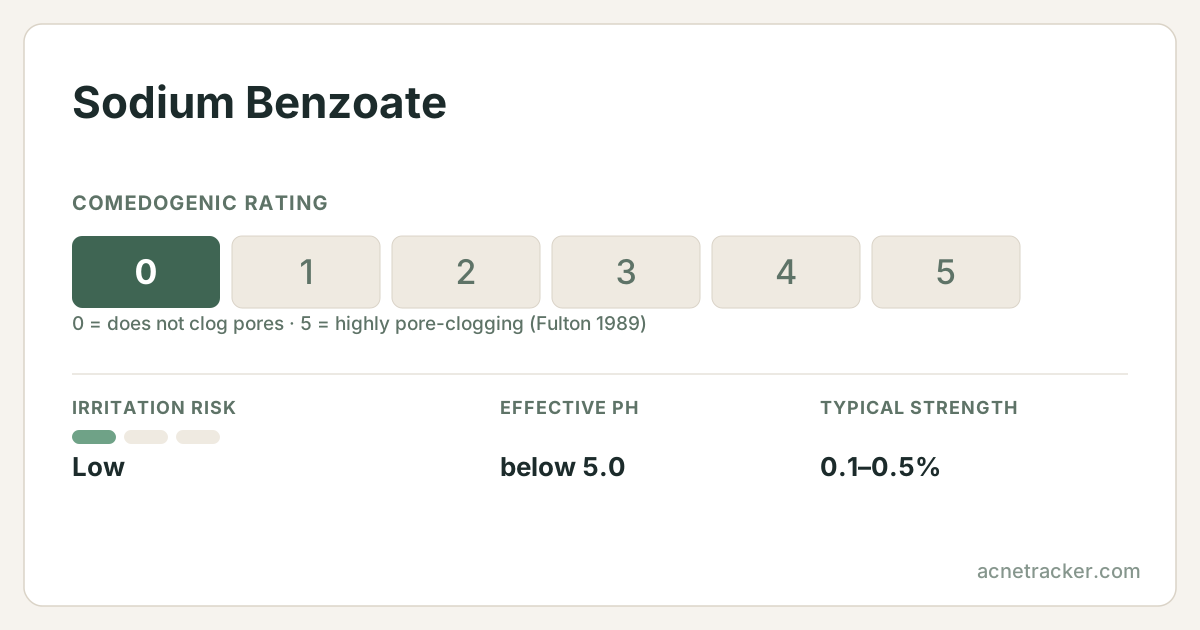
Sodium benzoate is a mild, widely used preservative that also appears as a food additive (E211) in soft drinks and sauces. In cosmetics it is valued as a gentle, nature-derived option that fits into "clean" and organic-friendly formulations, often paired with potassium sorbate to broaden its protection. It is the sodium salt of benzoic acid and works best in slightly acidic products. For most people it is one of the least troublesome preservatives, with a low irritation and allergy profile, which makes it a common choice for sensitive-skin and baby-care ranges.
Quick facts
- Comedogenic rating
- our estimate — not measured
- Irritation risk
- Low
- Effective pH
- below 5.0
- Typical strength
- 0.1–0.5%
- Pregnancy
- Considered safe
- Suits skin types
- oilydrycombinationsensitivenormalacne-prone
Where this number comes from
No one has published a comedogenic rating for this ingredient. Fulton's 1989 table tested about 250 raw materials and this was not among them, and we found no later study measuring it. The figure shown is our own reasoning from the ingredient's chemistry and how it is used — treat it as an estimate, not a measurement.
Fulton read his own scale as 0-1 not significant, 2-3 borderline, 4-5 positive. The assay is the rabbit ear at 10% dilution, which the paper itself calls extremely sensitive and not fully predictive of human skin. Ratings describe the raw ingredient; concentration and formulation change real-world behaviour.
Caution profile
The four published fields on this page, on one 0–5 scale. Further from the centre means more care is needed — never that the ingredient is worse.
Derived, not measured: pore-clogging is the published comedogenic rating; irritation maps low/moderate/high to 1/3/5; pregnancy maps safe/caution/avoid to 0/3/5; skin-type limits is how many of the seven skin types this entry does NOT list. Every input is printed in words in the quick-facts card above.
Show the numbers
| Metric | 0–5 | Published field |
|---|---|---|
| Pore-clogging | 0 | 0/5 |
| Irritation | 1 | Low |
| Skin-type limits | 0.7 | 6/7 |
| Pregnancy | 0 | Considered safe |
Working pH and typical strength
Where this ingredient is formulated to sit, and at what concentration.
Both bars come from the fields above: the pH window and the typical strength range published for this ingredient. The tinted column is healthy skin's surface pH (about 4.7–5.75).
Show the numbers
| Metric | 0–5 |
|---|---|
| Working pH | below 5.0 |
| Typical strength | 0.1–0.5% |
What is it?
Sodium benzoate is an organic-acid preservative: in the product it exists in equilibrium with benzoic acid, and it is the acid form that actually kills microbes. This is why it only works well at lower pH, typically below 5, where more of it is present as the active acid. It is particularly effective against yeast and mould and is usually combined with a partner preservative to cover bacteria fully. It has no skincare treatment function — it neither hydrates nor exfoliates — and its comedogenic rating is zero. Regulators including the EU SCCS permit it within set limits, and it is regarded as a well-tolerated, food-grade preservative.
Benefits
Gentle, food-grade preservation
Sodium benzoate has a long safety record as both a food and cosmetic preservative, with a low irritation and allergy profile suited to sensitive skin.
Effective against yeast and mould
It is particularly good at controlling fungal contamination, which is why it is frequently paired with potassium sorbate for broader coverage.
Accepted by natural standards
As a nature-identical organic acid salt, it is permitted by many organic and eco certifications, making it popular in clean-beauty formulas.
Non-comedogenic
At the low levels used it does not clog pores and does not contribute to breakouts, so it suits acne-prone skin.
How to use
Sodium benzoate is a formulation preservative, so there is nothing to apply or layer — it simply keeps a product safe. It performs only in acidic formulas, so you will most often see it in products with a low pH, sometimes alongside actives such as niacinamide or hyaluronic-acid and partner preservative potassium-sorbate. There is no special handling required and no need to avoid it unless you have a specific sensitivity. It is a good example of a preservative chosen for its gentleness in sensitive-skin products.
Side effects
Sodium benzoate is well tolerated by the vast majority of people, and true allergic reactions are uncommon. Some individuals may notice mild transient tingling in very acidic formulas, and a small number can experience contact urticaria. Overall it sits among the gentlest preservatives available. As with any ingredient, patch testing is sensible if you have a history of preservative reactions.
Who should avoid it
Only people with a confirmed sensitivity to benzoates need to avoid sodium benzoate, which is uncommon. There is no general reason for sensitive or acne-prone skin to reject it — indeed, it is often chosen for those very categories. If you have reacted to benzoates in food or cosmetics before, check labels and choose an alternative preservative.
Pairs well with
Frequently asked questions
Is sodium benzoate safe in skincare?
Yes. It is a well-tolerated, food-grade preservative permitted by regulators within set limits, with a low irritation and allergy profile. It is often chosen for sensitive-skin and baby-care products.
Why is sodium benzoate paired with potassium sorbate?
Sodium benzoate is strong against yeast and mould but weaker against some bacteria, so it is combined with potassium sorbate to give broader, more complete microbial protection.
Does sodium benzoate need a low pH to work?
Yes. It is only fully active in acidic formulas, generally below pH 5, because it must convert to benzoic acid to kill microbes. In higher-pH products it is far less effective.
Does sodium benzoate cause acne?
No. It has a comedogenic rating of zero, is used at low concentration, and does not clog pores, so it does not cause breakouts and is suitable for acne-prone skin.
Sources & further reading
Medical disclaimer
Find your personal acne triggers
Our free Acne Tracker lets you log breakouts, sleep, stress and diet, and shows you which factors correlate with your flare-ups.