Isopropyl Myristate: Comedogenic Rating & Ingredient Analysis
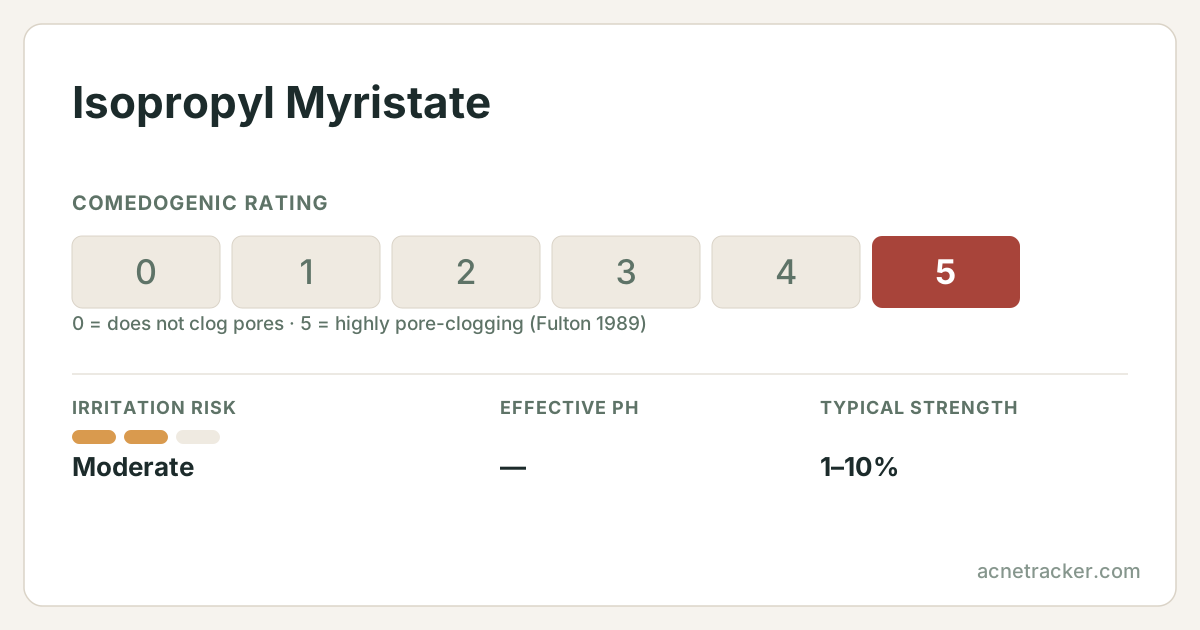
Isopropyl myristate is a synthetic emollient and texture agent used to make creams, lotions and makeup feel light, silky and fast-absorbing rather than greasy. It is a genuinely useful formulation ingredient, giving products a dry, elegant slip and helping other ingredients spread and penetrate. But for anyone with acne-prone skin it comes with a serious warning: in Fulton's classic comedogenicity testing, isopropyl myristate scored the maximum rating, making it one of the single most pore-clogging ingredients commonly found in cosmetics. Its lightweight feel can be deceptive, so it is an ingredient acne-prone users learn to scan labels for and avoid.
Quick facts
- Comedogenic rating
- measured (Fulton 1989)
- Irritation risk
- Moderate
- Effective pH
- —
- Typical strength
- 1–10%
- Pregnancy
- Considered safe
- Suits skin types
- drynormal
Where this number comes from
Read directly from Table I of Fulton's 1989 paper — the primary source, not one of the copied tables that circulate online.
Fulton read his own scale as 0-1 not significant, 2-3 borderline, 4-5 positive. The assay is the rabbit ear at 10% dilution, which the paper itself calls extremely sensitive and not fully predictive of human skin. Ratings describe the raw ingredient; concentration and formulation change real-world behaviour.
Caution profile
The four published fields on this page, on one 0–5 scale. Further from the centre means more care is needed — never that the ingredient is worse.
Derived, not measured: pore-clogging is the published comedogenic rating; irritation maps low/moderate/high to 1/3/5; pregnancy maps safe/caution/avoid to 0/3/5; skin-type limits is how many of the seven skin types this entry does NOT list. Every input is printed in words in the quick-facts card above.
Show the numbers
| Metric | 0–5 | Published field |
|---|---|---|
| Pore-clogging | 5 | 5/5 |
| Irritation | 3 | Moderate |
| Skin-type limits | 3.6 | 2/7 |
| Pregnancy | 0 | Considered safe |
Working pH and typical strength
Where this ingredient is formulated to sit, and at what concentration.
Both bars come from the fields above: the pH window and the typical strength range published for this ingredient. The tinted column is healthy skin's surface pH (about 4.7–5.75).
Show the numbers
| Metric | 0–5 |
|---|---|
| Typical strength | 1–10% |
What is it?
Isopropyl myristate is the ester of isopropyl alcohol and myristic acid, a fatty acid. In formulations it works as an emollient that reduces greasiness, a solvent, and a penetration enhancer that helps active ingredients and other components pass into the skin more readily. That penetration-enhancing quality, combined with its fatty-acid structure, is part of why it is so comedogenic: it was rated 5 out of 5 in Fulton's 1989 study, the top of the scale. It gives a pleasant, non-oily finish, which is why formulators like it, but that cosmetic benefit is exactly why it appears in so many products that acne-prone skin then reacts to.
Benefits
Lightweight, non-greasy feel
Isopropyl myristate gives creams and lotions a silky, dry-touch finish, reducing the heavy, greasy feel of richer emollients and making products more pleasant to apply.
Helps ingredients spread
As a spreading agent and solvent it helps other ingredients distribute evenly across the skin, improving the texture and application of the finished product.
Enhances penetration
It can help certain active ingredients pass into the skin more readily, a formulating advantage when better delivery of an active is the goal.
Improves product texture
It is widely used to fine-tune the feel of makeup, moisturisers and bath products, giving them the elegant, fast-absorbing quality consumers expect.
How to use
Isopropyl myristate is a formulation ingredient rather than something you apply on its own, so managing it is really about reading labels. If your skin is acne-prone, treat its presence high on an ingredient list as a reason to be cautious, since its top comedogenic rating means it can trigger clogged pores and breakouts. It is more of a concern in leave-on products than in wash-off ones that have limited contact time. For non-acne-prone skin it is generally unproblematic and simply contributes to a lighter product feel.
Side effects
The headline issue with isopropyl myristate is comedogenicity: with the maximum rating it is strongly associated with clogged pores and breakouts on acne-prone skin. It can also be mildly irritating or drying for some, partly due to its solvent and penetration-enhancing action. For people who are not acne-prone, it is usually well tolerated and mainly valued for the light texture it provides.
Who should avoid it
Acne-prone and congestion-prone skin should avoid leave-on products where isopropyl myristate features prominently, given its top-of-scale comedogenic rating. Those with sensitive or easily irritated skin may also prefer to avoid it. It is not a safety concern in pregnancy, but the pore-clogging caveat applies to acne-prone skin regardless.
Pairs well with
Frequently asked questions
Is isopropyl myristate comedogenic?
Very. It scored the maximum 5 out of 5 in Fulton's comedogenicity testing, making it one of the most pore-clogging ingredients in cosmetics, so acne-prone skin should avoid leave-on products where it features prominently.
Why is isopropyl myristate used in skincare?
It gives products a light, silky, non-greasy feel, helps ingredients spread evenly and can enhance penetration of actives. These formulating benefits are why it is common despite its comedogenicity.
Can isopropyl myristate cause breakouts?
Yes, on acne-prone skin. Its top comedogenic rating means it can clog pores and trigger breakouts, especially in leave-on products, so scanning labels for it is worthwhile if you break out easily.
Is isopropyl myristate safe?
It is not a toxicity or pregnancy concern and is well tolerated by many people, but its high comedogenic rating makes it a poor choice for acne-prone skin in leave-on formulas.
Where this ingredient shows up here
Counted across this database, not the web — these are the pages on this site that reason about this ingredient.
Condition pages 1
Sources & further reading
Medical disclaimer
Find your personal acne triggers
Our free Acne Tracker lets you log breakouts, sleep, stress and diet, and shows you which factors correlate with your flare-ups.