Hexylene Glycol: Comedogenic Rating & Ingredient Analysis
Hexylene glycol is a texture-and-solubility ingredient more than a skincare active. Formulators reach for it to keep a product from separating, to thin out a formula that would otherwise be too thick to spread, and to help dissolve ingredients that resist water. Along the way it lends a little humectancy, drawing a small amount of moisture into the surface of the skin. You will find it in lightweight lotions, cleansers, sunscreens and serums, usually at low percentages. It is one of many quiet helpers that make a formula feel pleasant and stay stable on the shelf, rather than something you would choose a product for on its own.
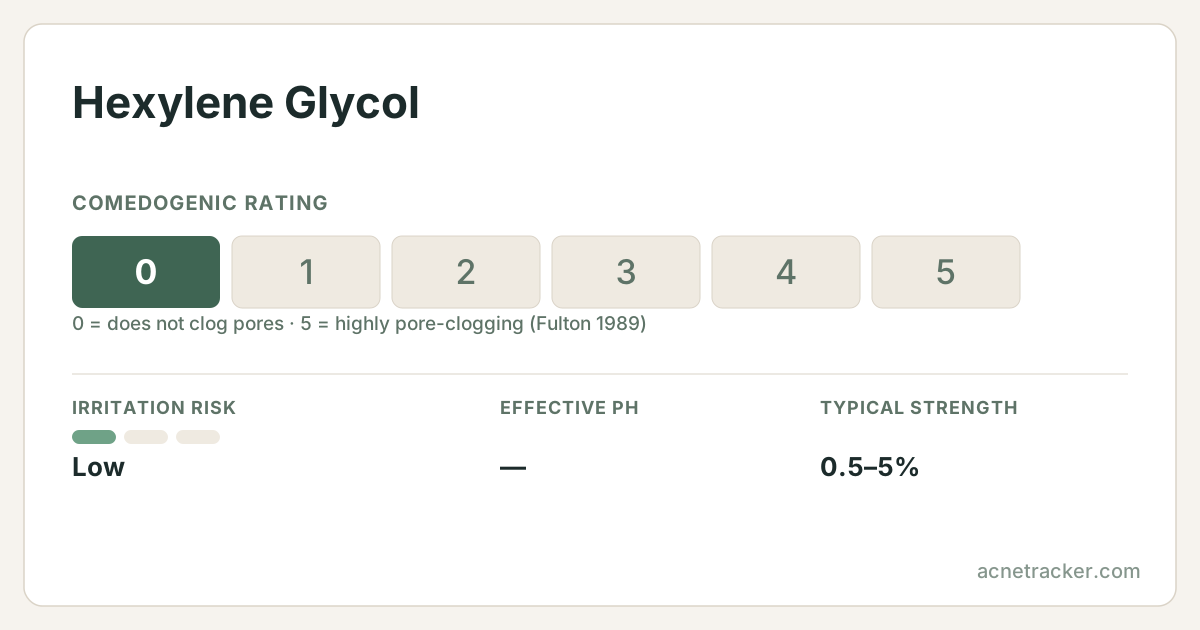
Quick facts
- Comedogenic rating
- measured (Fulton 1989)
- Irritation risk
- Low
- Effective pH
- —
- Typical strength
- 0.5–5%
- Pregnancy
- Considered safe
- Suits skin types
- oilycombinationnormalacne-pronedry
Where this number comes from
Read directly from Table I of Fulton's 1989 paper — the primary source, not one of the copied tables that circulate online.
Fulton read his own scale as 0-1 not significant, 2-3 borderline, 4-5 positive. The assay is the rabbit ear at 10% dilution, which the paper itself calls extremely sensitive and not fully predictive of human skin. Ratings describe the raw ingredient; concentration and formulation change real-world behaviour.
Caution profile
The four published fields on this page, on one 0–5 scale. Further from the centre means more care is needed — never that the ingredient is worse.
Derived, not measured: pore-clogging is the published comedogenic rating; irritation maps low/moderate/high to 1/3/5; pregnancy maps safe/caution/avoid to 0/3/5; skin-type limits is how many of the seven skin types this entry does NOT list. Every input is printed in words in the quick-facts card above.
Show the numbers
| Metric | 0–5 | Published field |
|---|---|---|
| Pore-clogging | 0 | 0/5 |
| Irritation | 1 | Low |
| Skin-type limits | 1.4 | 5/7 |
| Pregnancy | 0 | Considered safe |
Working pH and typical strength
Where this ingredient is formulated to sit, and at what concentration.
Both bars come from the fields above: the pH window and the typical strength range published for this ingredient. The tinted column is healthy skin's surface pH (about 4.7–5.75).
Show the numbers
| Metric | 0–5 |
|---|---|
| Typical strength | 0.5–5% |
What is it?
Hexylene glycol is a six-carbon diol (2-methyl-2,4-pentanediol) that behaves as a solvent, a viscosity reducer and a mild humectant. Its dual water- and oil-friendly nature lets it act as a coupling agent, keeping the water and oil phases of an emulsion evenly blended so a cream does not split. It also lowers the thickness of a formula, which is how a rich base becomes a fluid that glides. As a humectant its water-binding is modest compared with glycerin, so its main role stays on the formulation side. It has a comedogenic rating of 0 and, at the low concentrations used in cosmetics, a low irritation profile, though it is slightly more likely to tingle on very reactive skin than the gentler caprylyl glycol.
Benefits
Keeps formulas stable
It couples the water and oil phases of an emulsion, preventing separation so a cream or lotion stays uniform through its shelf life.
Creates lighter textures
By reducing viscosity it turns heavy bases into fluids that spread easily — helpful for gel-creams aimed at oily and combination skin.
Dissolves stubborn ingredients
As a solvent it helps disperse actives and preservatives that do not mix readily with water, keeping them evenly distributed.
Adds light hydration
Its mild humectant action draws a little water to the skin surface, contributing to a smooth, conditioned feel.
How to use
Hexylene glycol needs no special handling — use any product it appears in as directed. It works morning or night and layers with sunscreen, makeup and other actives without conflict. Because it is a support ingredient at low levels, evaluate the finished product rather than the glycol itself. If you have very sensitive skin and are building a minimalist routine, you may prefer formulas that use caprylyl glycol or propanediol instead, as these tend to be marginally gentler, but for most people hexylene glycol causes no trouble at all.
Side effects
At the low levels used in leave-on skincare, hexylene glycol is well tolerated. Concentrated exposure can be mildly irritating, which is why cosmetic use stays at small percentages. It does not exfoliate, does not raise sun sensitivity and has a comedogenic rating of 0. People with highly reactive or compromised skin are the most likely to notice any transient tingling.
Who should avoid it
There is no group that must avoid hexylene glycol outright. If your skin is very sensitive or you have reacted to glycols before, patch test first and favour products where it sits low on the ingredient list. Otherwise it is fine for all skin types.
Pairs well with
Frequently asked questions
Is hexylene glycol bad for skin?
No. At the low levels used in cosmetics it is a well-tolerated solvent and mild humectant with a comedogenic rating of 0. Irritation is uncommon and usually tied to other ingredients.
What does hexylene glycol do in a product?
It mainly keeps emulsions from separating, thins thick textures so they spread easily, and helps dissolve ingredients that do not mix well with water. It also adds a little hydration.
Does hexylene glycol cause breakouts?
It has a comedogenic rating of 0 and is water-compatible rather than oily, so it is not a likely cause of breakouts even on acne-prone skin.
Is hexylene glycol safe in skincare?
Yes, at the concentrations used in finished products it is regarded as safe. Only concentrated raw material is irritating, which is why formulas use small amounts.
Sources & further reading
Medical disclaimer
Find your personal acne triggers
Our free Acne Tracker lets you log breakouts, sleep, stress and diet, and shows you which factors correlate with your flare-ups.