Glycine: Comedogenic Rating & Ingredient Analysis
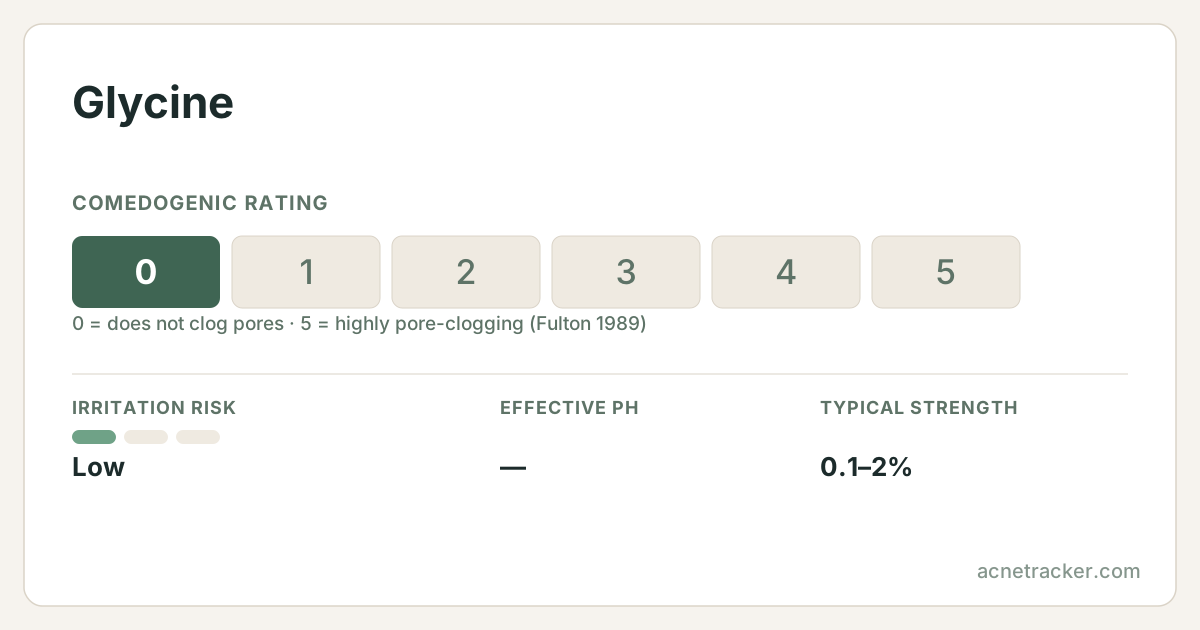
Glycine is the smallest and simplest amino acid, and it is far from a minor player in the skin. It is the single most abundant amino acid in collagen, the protein that gives skin its firmness and structure, so it is a genuine building block for the framework that keeps skin looking plump. In skincare it also serves as a humectant, part of the natural moisturising factor, and a gentle buffering agent that helps stabilise a formula's pH. Non-irritating and non-comedogenic, glycine is a quietly useful conditioning ingredient that supports both hydration and the skin's structural proteins.
Quick facts
- Comedogenic rating
- our estimate — not measured
- Irritation risk
- Low
- Effective pH
- —
- Typical strength
- 0.1–2%
- Pregnancy
- Considered safe
- Suits skin types
- drysensitivenormalcombinationmatureacne-prone
Where this number comes from
No one has published a comedogenic rating for this ingredient. Fulton's 1989 table tested about 250 raw materials and this was not among them, and we found no later study measuring it. The figure shown is our own reasoning from the ingredient's chemistry and how it is used — treat it as an estimate, not a measurement.
Fulton read his own scale as 0-1 not significant, 2-3 borderline, 4-5 positive. The assay is the rabbit ear at 10% dilution, which the paper itself calls extremely sensitive and not fully predictive of human skin. Ratings describe the raw ingredient; concentration and formulation change real-world behaviour.
Caution profile
The four published fields on this page, on one 0–5 scale. Further from the centre means more care is needed — never that the ingredient is worse.
Derived, not measured: pore-clogging is the published comedogenic rating; irritation maps low/moderate/high to 1/3/5; pregnancy maps safe/caution/avoid to 0/3/5; skin-type limits is how many of the seven skin types this entry does NOT list. Every input is printed in words in the quick-facts card above.
Show the numbers
| Metric | 0–5 | Published field |
|---|---|---|
| Pore-clogging | 0 | 0/5 |
| Irritation | 1 | Low |
| Skin-type limits | 0.7 | 6/7 |
| Pregnancy | 0 | Considered safe |
Working pH and typical strength
Where this ingredient is formulated to sit, and at what concentration.
Both bars come from the fields above: the pH window and the typical strength range published for this ingredient. The tinted column is healthy skin's surface pH (about 4.7–5.75).
Show the numbers
| Metric | 0–5 |
|---|---|
| Typical strength | 0.1–2% |
What is it?
Glycine is the smallest amino acid, with the simplest side chain of any of the twenty that build human proteins. Its abundance in collagen is striking: roughly every third amino acid in a collagen strand is glycine, and its small size is what allows collagen's triple-helix to coil tightly. In the skin, glycine is part of the natural moisturising factor, so it binds water at the surface and supports softness. As a cosmetic ingredient it also acts as a buffer, helping keep a product at a stable, skin-friendly pH. While applying glycine to the skin does not directly rebuild deep collagen the way it contributes internally, it conditions the surface and is frequently paired with other amino acids like proline in structure-supporting formulas. Its comedogenic rating is 0, which is what you would expect of the smallest and most water-soluble of the twenty: there is no oily fraction to lodge in a follicle, and reactions to it are uncommon.
Benefits
A collagen building block
Glycine is the most abundant amino acid in collagen, the structural protein behind firm, resilient skin, which is why it features in structure-focused formulas.
Hydrates as part of NMF
As a natural moisturising factor component, glycine binds water in the surface layers for a softer, smoother feel.
Conditions and smooths
It leaves the skin surface conditioned and comfortable, complementing humectants and barrier ingredients.
Stabilises formulas
Its buffering capacity helps keep products at a comfortable pH, contributing to gentleness and stability.
How to use
Use products containing glycine as directed, at any time of day. It is a gentle conditioning amino acid that fits into hydrating, soothing and anti-aging routines, and it layers naturally with other amino acids such as proline, with humectants like hyaluronic acid, and with actives like niacinamide. There is no adjustment period, no photosensitivity and no incompatibility with common ingredients, so you can include glycine-containing products freely morning and night.
Side effects
Glycine is very well tolerated on the skin, with irritation and allergy being rare. As part of the skin's own moisturising factor, it is inherently skin-compatible. The simplest side chain of the twenty amino acids leaves it with very little to react with: it carries a comedogenic rating of 0 and no photosensitising activity. For essentially all users, glycine is a comfortable, low-risk conditioning ingredient.
Who should avoid it
No skin type needs to avoid topical glycine. People with very reactive skin can patch test a new product first, though reactions are uncommon. There are no specific groups for whom it is contraindicated.
Pairs well with
Frequently asked questions
What does glycine do for skin?
It hydrates as part of the natural moisturising factor, conditions the surface and is the most abundant amino-acid building block of collagen, so it features in structure-supporting formulas.
Does topical glycine boost collagen?
Glycine is a major building block of collagen internally, but applying it topically mainly conditions and hydrates the surface rather than directly rebuilding deep collagen. It supports the skin as part of a broader routine.
Is glycine safe for sensitive skin?
Yes. Glycine is part of the skin's own moisturising factor, is non-comedogenic and has a low irritation profile, making it well suited to sensitive skin.
Does glycine clog pores?
No. Glycine has a comedogenic rating of 0 and is a small water-soluble amino acid, so it does not clog pores.
Sources & further reading
Glycine is genuinely one of the main amino acids in collagen, and its water-binding behaviour is well understood — both are compositional facts. That is not the same as evidence that applying glycine to skin builds collagen, and we found no topical trial establishing it.
Medical disclaimer
Find your personal acne triggers
Our free Acne Tracker lets you log breakouts, sleep, stress and diet, and shows you which factors correlate with your flare-ups.