Fragrance (Parfum): Comedogenic Rating & Ingredient Analysis
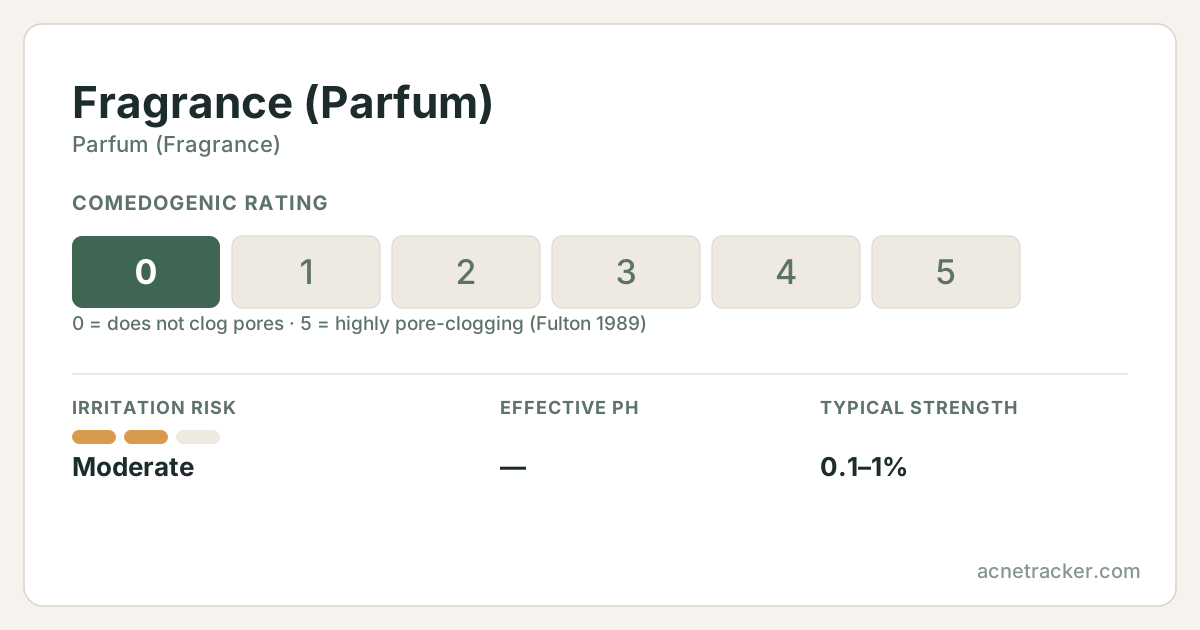
Fragrance, listed on ingredient labels as "Parfum" in Europe and "Fragrance" in the United States, is one of the most common additions to skincare and one of the most debated. The word does not name a single molecule: it is an umbrella term for a blend that can contain anywhere from a handful to several hundred individual scent compounds, natural or synthetic. Formulators add it to make a product pleasant to use and to mask the raw, sometimes unappealing smell of the base ingredients. For most people fragrance causes no problem at all, but for those with sensitive, reactive or eczema-prone skin it is the ingredient most likely to trigger irritation, which is why fragrance-free lines exist for exactly this group.
Quick facts
- Comedogenic rating
- our estimate — not measured
- Irritation risk
- Moderate
- Effective pH
- —
- Typical strength
- 0.1–1%
- Pregnancy
- Ask your doctor
- Suits skin types
- oilydrycombinationnormal
Where this number comes from
No one has published a comedogenic rating for this ingredient. Fulton's 1989 table tested about 250 raw materials and this was not among them, and we found no later study measuring it. The figure shown is our own reasoning from the ingredient's chemistry and how it is used — treat it as an estimate, not a measurement.
Fulton read his own scale as 0-1 not significant, 2-3 borderline, 4-5 positive. The assay is the rabbit ear at 10% dilution, which the paper itself calls extremely sensitive and not fully predictive of human skin. Ratings describe the raw ingredient; concentration and formulation change real-world behaviour.
Caution profile
The four published fields on this page, on one 0–5 scale. Further from the centre means more care is needed — never that the ingredient is worse.
Derived, not measured: pore-clogging is the published comedogenic rating; irritation maps low/moderate/high to 1/3/5; pregnancy maps safe/caution/avoid to 0/3/5; skin-type limits is how many of the seven skin types this entry does NOT list. Every input is printed in words in the quick-facts card above.
Show the numbers
| Metric | 0–5 | Published field |
|---|---|---|
| Pore-clogging | 0 | 0/5 |
| Irritation | 3 | Moderate |
| Skin-type limits | 2.1 | 4/7 |
| Pregnancy | 3 | Ask your doctor |
Working pH and typical strength
Where this ingredient is formulated to sit, and at what concentration.
Both bars come from the fields above: the pH window and the typical strength range published for this ingredient. The tinted column is healthy skin's surface pH (about 4.7–5.75).
Show the numbers
| Metric | 0–5 |
|---|---|
| Typical strength | 0.1–1% |
What is it?
"Parfum" is a legal catch-all that lets a manufacturer protect a proprietary scent recipe without listing every component. Under EU cosmetic law the blend itself can stay generic, but 26 specific fragrance molecules known to cause allergic reactions must be declared separately on the label once they exceed set thresholds — molecules such as linalool, limonene, citronellol, geraniol and eugenol. Fragrance does not treat any skin condition; it has no active benefit for acne, barrier repair or ageing. Its comedogenic rating is effectively zero because it is used at very low concentration, so the real question with fragrance is never whether it clogs pores but whether it irritates or sensitises the skin over time.
Benefits
Improves the sensory experience
A pleasant scent is the main reason fragrance is added; it makes daily routines more enjoyable, which can help people stay consistent with their skincare.
Masks base-ingredient odour
Many raw materials — plant oils, surfactants, actives — have an unpleasant smell. Even fragrance-free products often use a masking fragrance to neutralise it.
Signals product identity
Scent is central to how a brand is recognised and remembered; it is a marketing and formulation choice rather than a skin-care function.
No pore-clogging load
Because fragrance is used at fractions of a percent, it does not add meaningful comedogenic weight to a formula, so acne concerns centre on irritation, not clogging.
How to use
There is nothing to "use" about fragrance directly — the choice is whether to accept it in a formula. If your skin is calm and tolerant, a fragranced moisturiser or cleanser is generally fine. If you have sensitive, rosacea-prone or eczema-prone skin, or you are already using strong actives such as retinol, salicylic-acid or glycolic-acid that can sensitise the barrier, prefer fragrance-free versions to reduce the total irritation load. Fragrance-free pairs better with actives because it removes one variable when your skin is already being challenged. When trying a new fragranced product, patch test on the inner forearm for a few days before applying to the face.
Side effects
The most common issue is irritant contact dermatitis — stinging, redness or a rough, tight feeling that is not a true allergy but a reaction to the concentration or the specific blend. A smaller group develops genuine allergic contact dermatitis to particular fragrance molecules, which can appear as itchy, sometimes delayed rashes and tends to worsen with repeated exposure. Fragrance sensitisation is cumulative, so a product tolerated for months can eventually provoke a reaction. Leave-on products carry more risk than rinse-off ones because contact time is longer.
Who should avoid it
People with eczema, rosacea, known fragrance allergy or a compromised skin barrier should choose fragrance-free products. The same applies to anyone whose routine already includes several potent actives, since stacking irritants raises the odds of a flare. "Unscented" is not the same as "fragrance-free" — unscented products may still contain masking fragrance — so check the full ingredient list rather than front-of-pack claims.
Avoid combining with
Frequently asked questions
Does fragrance cause acne?
Fragrance does not directly clog pores, so it rarely causes true acne. It can, however, cause irritation and redness that resemble or worsen breakouts, especially on sensitive skin using strong actives at the same time.
Is fragrance-free better for acne-prone skin?
Often, yes. Acne routines frequently include exfoliants and retinoids that can sensitise the barrier, and removing fragrance lowers the total irritation load, making fragrance-free the safer default for reactive, breakout-prone skin.
What is the difference between unscented and fragrance-free?
Fragrance-free means no fragrance ingredients are added. Unscented usually means masking fragrance has been used to cancel out a product's natural smell, so an unscented product can still contain fragrance compounds.
Why are some fragrance ingredients listed separately?
EU law requires 26 known allergenic fragrance molecules, such as linalool and limonene, to be named on the label once they pass certain thresholds, so consumers who react to them can identify and avoid them.
Is fragrance safe during pregnancy?
Cosmetic fragrance at normal use levels is generally considered low risk, but sensitivity often increases in pregnancy. Many people choose fragrance-free products during this time out of caution; ask your doctor if unsure.
Sources & further reading
Medical disclaimer
Find your personal acne triggers
Our free Acne Tracker lets you log breakouts, sleep, stress and diet, and shows you which factors correlate with your flare-ups.