Capric Acid: Comedogenic Rating & Ingredient Analysis
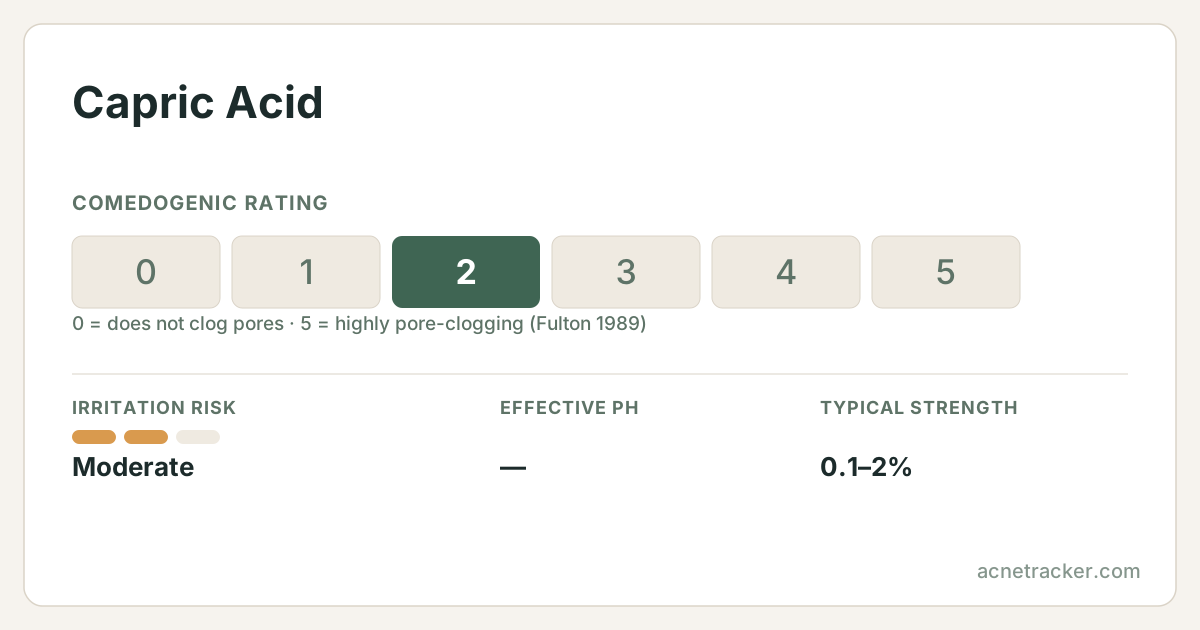
Capric acid is the close partner of caprylic acid, and the two almost always travel together. On ingredient lists you rarely see capric acid by itself; instead you see caprylic/capric triglyceride, the smooth, lightweight emollient that these two medium-chain fatty acids form when joined to glycerin. That ingredient is a favourite for giving serums and moisturisers a soft, fast-absorbing slip without a greasy afterfeel. Capric acid on its own is lightly antimicrobial and a building block for gentle surfactants. Like its shorter sibling, it is low on the comedogenic scale, so the emollients built from it are friendly to oily and acne-prone skin.
Quick facts
- Comedogenic rating
- measured (Fulton 1989)
- Irritation risk
- Moderate
- Effective pH
- —
- Typical strength
- 0.1–2%
- Pregnancy
- Considered safe
- Suits skin types
- oilycombinationnormalacne-prone
Where this number comes from
Read directly from Table I of Fulton's 1989 paper — the primary source, not one of the copied tables that circulate online.
Fulton read his own scale as 0-1 not significant, 2-3 borderline, 4-5 positive. The assay is the rabbit ear at 10% dilution, which the paper itself calls extremely sensitive and not fully predictive of human skin. Ratings describe the raw ingredient; concentration and formulation change real-world behaviour.
Caution profile
The four published fields on this page, on one 0–5 scale. Further from the centre means more care is needed — never that the ingredient is worse.
Derived, not measured: pore-clogging is the published comedogenic rating; irritation maps low/moderate/high to 1/3/5; pregnancy maps safe/caution/avoid to 0/3/5; skin-type limits is how many of the seven skin types this entry does NOT list. Every input is printed in words in the quick-facts card above.
Show the numbers
| Metric | 0–5 | Published field |
|---|---|---|
| Pore-clogging | 2 | 2/5 |
| Irritation | 3 | Moderate |
| Skin-type limits | 2.1 | 4/7 |
| Pregnancy | 0 | Considered safe |
Working pH and typical strength
Where this ingredient is formulated to sit, and at what concentration.
Both bars come from the fields above: the pH window and the typical strength range published for this ingredient. The tinted column is healthy skin's surface pH (about 4.7–5.75).
Show the numbers
| Metric | 0–5 |
|---|---|
| Typical strength | 0.1–2% |
What is it?
Capric acid is a saturated medium-chain fatty acid with ten carbons, one longer than caprylic acid and one shorter than lauric acid. It is found in coconut and palm kernel oils and in milk fat. Because it is small and fluid, it is used mainly to make lightweight emollient esters and surfactants rather than as a leave-on lipid in its own right. Its most important role in modern skincare is as half of caprylic/capric triglyceride, a workhorse emollient prized for being stable, silky and non-comedogenic. Capric acid also contributes mild antimicrobial activity, which can support a formula's freshness.
Benefits
Creates lightweight emollients
Combined with caprylic acid and glycerin, capric acid forms caprylic/capric triglyceride, a fast-absorbing emollient that softens skin without heaviness or shine.
Low pore-clogging risk
Capric acid sits near the bottom of the comedogenic scale, so the emollients derived from it are comfortable choices for oily and breakout-prone skin.
Mild antimicrobial activity
Like other medium-chain fatty acids, capric acid is reported to have some activity against microbes, which can help support the overall stability of a formula.
Improves texture and spreadability
Its ester derivatives give products an elegant, even glide, helping actives and sunscreens spread smoothly and feel pleasant rather than tacky.
How to use
You will not use capric acid directly; you use products formulated with it or, far more commonly, with caprylic/capric triglyceride. Those show up in lightweight lotions, serums, sunscreens and cleansing oils, and they suit almost every skin type, including oily and acne-prone. Simply pick products with a texture you like and follow their directions; there are no special layering or timing rules, and these emollients are compatible with essentially all actives. If you are targeting congestion, favour formulas where the emollient is light rather than deeply occlusive.
Side effects
Capric acid and its derivatives are well tolerated at cosmetic levels. Pure capric acid can be mildly irritating in concentrated form, which is why it is used sparingly and usually in ester form. The caprylic/capric triglyceride that most products contain is exceptionally gentle and rarely a source of problems, even on sensitive skin. As always, individual responses vary, so patch test a new product if your skin is reactive.
Who should avoid it
There is no group that specifically needs to avoid capric acid or its common derivatives. People with very sensitive skin who react to a specific formula should identify the actual trigger, which is rarely the capric-based emollient itself. This ingredient family is generally a safe bet across oily, dry, combination and acne-prone skin.
Pairs well with
Frequently asked questions
Does capric acid clog pores?
Fulton rated it 2 — borderline on his scale — and its main derivative, caprylic/capric triglyceride, is considered non-comedogenic, so it is a friendly choice for oily and acne-prone skin.
What is the difference between capric and caprylic acid?
They are both light medium-chain fatty acids that differ by two carbons; capric acid has ten, caprylic has eight. They are usually combined into caprylic/capric triglyceride, a smooth emollient.
Is capric acid good for the skin?
Yes, mainly through its derivatives. Caprylic/capric triglyceride softens skin with a light, non-greasy feel and a low pore-clogging risk, making it useful across most skin types.
Where does capric acid come from?
Nature puts it in milk fat and in the kernel oils of coconut and palm. The cosmetic supply is drawn from those vegetable oils, and most of it goes on to be built into emollient esters.
Is capric acid antibacterial?
It has some mild antimicrobial activity, like other medium-chain fatty acids, which can support a formula's freshness. It is not used as a stand-alone acne treatment, though.
Sources & further reading
Medical disclaimer
Find your personal acne triggers
Our free Acne Tracker lets you log breakouts, sleep, stress and diet, and shows you which factors correlate with your flare-ups.