Octisalate: Comedogenic Rating & Ingredient Analysis
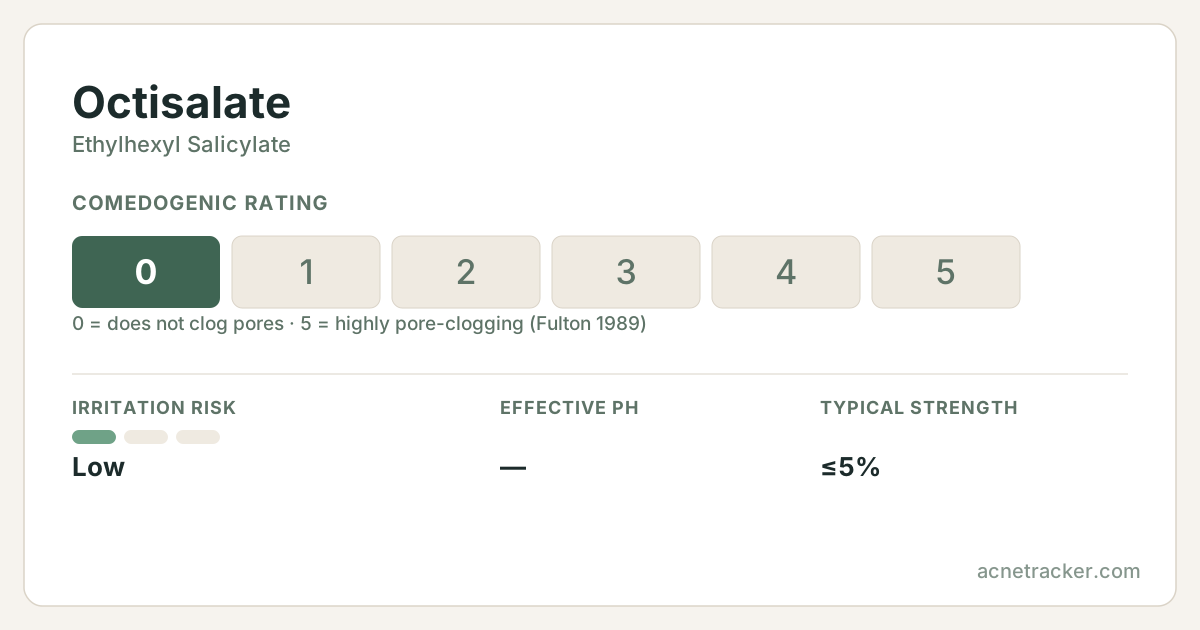
Octisalate, or ethylhexyl salicylate, is a gentle and reliable UVB chemical sunscreen filter that appears in a huge number of everyday sunscreens. Like its salicylate cousin homosalate, it is a weak absorber used mainly as a supporting filter and solvent rather than as the main source of SPF. Its strengths are a very low irritation profile, good water resistance and the ability to help stabilize avobenzone. Because it is so mild, it is a common choice in facial sunscreens and cosmetics aimed at sensitive and acne-prone skin. It is approved in both the US and the EU.
Quick facts
- Comedogenic rating
- measured (Fulton 1989)
- Irritation risk
- Low
- Effective pH
- —
- Typical strength
- ≤5%
- Pregnancy
- Considered safe
- Suits skin types
- oilydrycombinationsensitivenormalacne-prone
Where this number comes from
Read directly from Table I of Fulton's 1989 paper — the primary source, not one of the copied tables that circulate online.
Fulton read his own scale as 0-1 not significant, 2-3 borderline, 4-5 positive. The assay is the rabbit ear at 10% dilution, which the paper itself calls extremely sensitive and not fully predictive of human skin. Ratings describe the raw ingredient; concentration and formulation change real-world behaviour.
Caution profile
The four published fields on this page, on one 0–5 scale. Further from the centre means more care is needed — never that the ingredient is worse.
Derived, not measured: pore-clogging is the published comedogenic rating; irritation maps low/moderate/high to 1/3/5; pregnancy maps safe/caution/avoid to 0/3/5; skin-type limits is how many of the seven skin types this entry does NOT list. Every input is printed in words in the quick-facts card above.
Show the numbers
| Metric | 0–5 | Published field |
|---|---|---|
| Pore-clogging | 0 | 0/5 |
| Irritation | 1 | Low |
| Skin-type limits | 0.7 | 6/7 |
| Pregnancy | 0 | Considered safe |
Working pH and typical strength
Where this ingredient is formulated to sit, and at what concentration.
Both bars come from the fields above: the pH window and the typical strength range published for this ingredient. The tinted column is healthy skin's surface pH (about 4.7–5.75).
Show the numbers
| Metric | 0–5 |
|---|---|
| Typical strength | ≤5% |
What is it?
Octisalate is an ester of salicylic acid that absorbs UVB with a peak around 307 nanometres. Its absorbance is modest, so it contributes only a little to SPF on its own, but it earns its place by dissolving oil-insoluble UV filters, adding water resistance, and helping protect avobenzone from breaking down in light. Chemically it is quite stable and has one of the lowest rates of contact allergy among organic filters, which is why it shows up in so many products meant for daily wear. It provides essentially no UVA protection, so it is always combined with UVA filters.
Benefits
Very gentle
Octisalate has one of the lowest irritation and allergy rates among chemical filters, making it suitable for sensitive and acne-prone skin in daily sunscreens.
Stabilizes avobenzone
It helps keep the fragile UVA filter avobenzone from degrading in sunlight, supporting reliable broad-spectrum protection through the day.
Adds water resistance
As an oily filter it improves how well sunscreen resists sweat and water, useful in both facial and body formulas.
Dissolves other filters
It acts as a solvent for powdery UV filters, giving formulators flexibility to build light textures that layer under vitamin-c serums and makeup.
How to use
Octisalate is only found blended into finished sunscreens, used as your morning SPF and reapplied every two hours in sun. Because it is a supporting UVB filter with no UVA coverage, always choose a broad-spectrum product where UVA is handled by partners such as avobenzone or minerals like titanium-dioxide. Its gentleness makes it a good pick for facial sunscreen if your skin reacts to stronger filters. It layers cleanly under antioxidant serums and makeup without pilling in most formulas.
Side effects
Octisalate is one of the best-tolerated UV filters, with only rare reports of contact allergy or irritation. It was not among the filters that raised systemic-absorption concerns in the same way as oxybenzone. As with any sunscreen, getting it in the eyes can sting, and a very small number of people with salicylate sensitivity may react. Overall its safety profile is reassuring for everyday use.
Who should avoid it
There is no group that clearly needs to avoid octisalate. People with a known salicylate allergy should patch test or choose a mineral sunscreen with zinc-oxide. It is considered acceptable in pregnancy. For nearly everyone else it is a mild, dependable filter that suits sensitive skin well.
Pairs well with
Frequently asked questions
Is octisalate good for sensitive skin?
Yes. It is one of the gentlest chemical UV filters, with a very low allergy rate, which is why it is common in facial sunscreens for sensitive and acne-prone skin.
Does octisalate protect against UVA?
No. It only covers UVB and must be paired with UVA filters like avobenzone or minerals such as titanium-dioxide for broad-spectrum protection.
What is the difference between octisalate and homosalate?
Both are salicylate UVB filters and solvents. Octisalate is milder and better at water resistance; homosalate is a slightly stronger absorber. They are often used together.
Is octisalate safe during pregnancy?
Yes, it is generally considered safe in pregnancy and did not raise the absorption concerns seen with oxybenzone. Confirm with your doctor for your situation.
Sources & further reading
Medical disclaimer
Find your personal acne triggers
Our free Acne Tracker lets you log breakouts, sleep, stress and diet, and shows you which factors correlate with your flare-ups.