Avobenzone: Comedogenic Rating & Ingredient Analysis
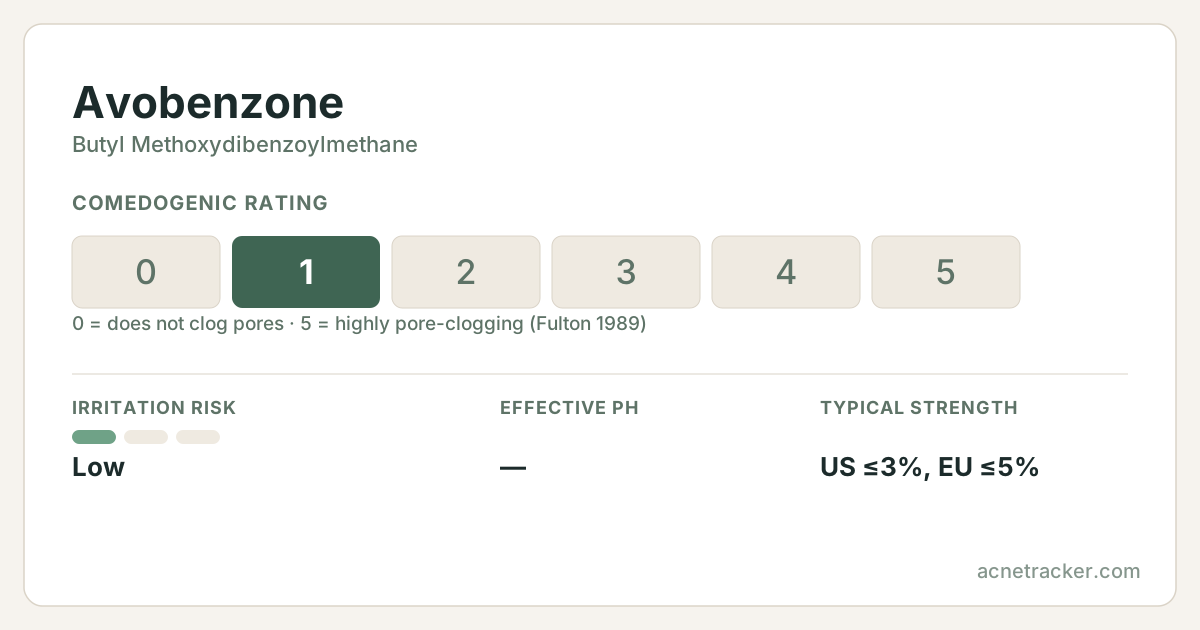
Avobenzone is the most widely used chemical UVA filter in the world, and for many years it was the only broad UVA absorber approved for over-the-counter sunscreens in the United States. Its job is to soak up the long-wave ultraviolet light (UVA) that penetrates deep into the skin, drives photoaging and contributes to pigmentation and some skin cancers. Almost every American broad-spectrum sunscreen relies on it, and it appears throughout European formulas as well. Its great weakness is instability: on its own, avobenzone breaks down within minutes of sun exposure, so formulators must pair it with stabilizing partners to keep it working through the day.
Quick facts
- Comedogenic rating
- our estimate — not measured
- Irritation risk
- Low
- Effective pH
- —
- Typical strength
- US ≤3%, EU ≤5%
- Pregnancy
- Considered safe
- Suits skin types
- oilydrycombinationnormalacne-pronemature
Where this number comes from
No one has published a comedogenic rating for this ingredient. Fulton's 1989 table tested about 250 raw materials and this was not among them, and we found no later study measuring it. The figure shown is our own reasoning from the ingredient's chemistry and how it is used — treat it as an estimate, not a measurement.
Fulton read his own scale as 0-1 not significant, 2-3 borderline, 4-5 positive. The assay is the rabbit ear at 10% dilution, which the paper itself calls extremely sensitive and not fully predictive of human skin. Ratings describe the raw ingredient; concentration and formulation change real-world behaviour.
Caution profile
The four published fields on this page, on one 0–5 scale. Further from the centre means more care is needed — never that the ingredient is worse.
Derived, not measured: pore-clogging is the published comedogenic rating; irritation maps low/moderate/high to 1/3/5; pregnancy maps safe/caution/avoid to 0/3/5; skin-type limits is how many of the seven skin types this entry does NOT list. Every input is printed in words in the quick-facts card above.
Show the numbers
| Metric | 0–5 | Published field |
|---|---|---|
| Pore-clogging | 1 | 1/5 |
| Irritation | 1 | Low |
| Skin-type limits | 0.7 | 6/7 |
| Pregnancy | 0 | Considered safe |
Working pH and typical strength
Where this ingredient is formulated to sit, and at what concentration.
Both bars come from the fields above: the pH window and the typical strength range published for this ingredient. The tinted column is healthy skin's surface pH (about 4.7–5.75).
Show the numbers
| Metric | 0–5 |
|---|---|
| Typical strength | US ≤3%, EU ≤5% |
What is it?
Avobenzone, known by the INCI name Butyl Methoxydibenzoylmethane, is a dibenzoylmethane derivative that absorbs UVA light with a peak around 357 nanometres. Chemically it exists in two forms that interconvert; when it absorbs a photon it can shift into an unstable state and degrade, a process called photodegradation. This is why raw avobenzone loses a large share of its protective power after an hour in the sun. Manufacturers solve this by combining it with photostabilizers such as octocrylene, octisalate or Tinosorb S, which absorb the excess energy and keep the molecule intact. Avobenzone does not protect well against UVB on its own, so it is always blended with UVB filters to reach a labelled SPF and true broad-spectrum coverage.
Benefits
Strong UVA coverage
Avobenzone absorbs across the UVA range, the deep-penetrating wavelengths most linked to wrinkles, loss of firmness and long-term pigmentation, which shorter-range UVB filters miss.
Cosmetically elegant
As a soluble chemical filter it disappears into lotions and fluids without the white cast that high levels of zinc-oxide or titanium-dioxide can leave, making high SPF easier to wear daily.
Widely available and studied
It has decades of use and a large safety record, and is approved for sunscreens in the United States, the European Union, and most other markets.
Flexible in formulation
It blends with most other chemical filters and with antioxidants like vitamin-c and vitamin-e, letting brands build lightweight broad-spectrum products for oily and acne-prone skin.
How to use
Use any avobenzone sunscreen the way you would any daily SPF: apply about a quarter teaspoon to the face as the last step of your morning routine, over serums and moisturizer, and reapply every two hours of sun exposure. Because avobenzone degrades in light, reapplication matters more than with mineral filters. Choose a product that also lists a stabilizer such as octocrylene or octisalate, which most modern formulas include automatically. It layers fine over antioxidant serums, which complement UV filters by mopping up the free radicals that slip through.
Side effects
Avobenzone is generally well tolerated, with a low rate of irritation and contact allergy compared with older filters like oxybenzone. Some people notice mild stinging if it gets into the eyes. In the 2019 FDA maximal-use study, avobenzone was among the filters detected in blood above the agency's testing threshold, which prompted a request for more safety data; the FDA has been clear that this finding does not mean the ingredient is unsafe, and continues to recommend sunscreen use.
Who should avoid it
There is no group that must categorically avoid avobenzone. People with a known allergy to it should switch to a mineral sunscreen based on zinc-oxide or titanium-dioxide. Those who want to minimize systemic absorption on principle, including some during pregnancy, may also prefer mineral filters, though avobenzone is widely considered acceptable in pregnancy.
Pairs well with
Frequently asked questions
Why does avobenzone need octocrylene?
Avobenzone breaks down quickly in sunlight on its own. Octocrylene and similar filters absorb the excess energy and keep avobenzone stable, so the sunscreen keeps protecting you for longer.
Does avobenzone protect against UVA or UVB?
Mainly UVA — the deep, aging wavelengths. It gives little UVB protection alone, so it is always combined with UVB filters to reach the SPF on the label.
Is avobenzone reef-safe?
Avobenzone is not on the ingredient lists banned by Hawaii or Key West, which target oxybenzone and octinoxate. Its environmental profile is considered less concerning, though data remain limited.
Can I use avobenzone if I have acne-prone skin?
Yes. It has a low comedogenic rating and is common in lightweight fluid sunscreens that suit oily and breakout-prone skin better than heavy mineral creams.
Where this ingredient shows up here
Counted across this database, not the web — these are the pages on this site that reason about this ingredient.
Buying guides 1
Sources & further reading
Medical disclaimer
Find your personal acne triggers
Our free Acne Tracker lets you log breakouts, sleep, stress and diet, and shows you which factors correlate with your flare-ups.