Tinosorb M: Comedogenic Rating & Ingredient Analysis
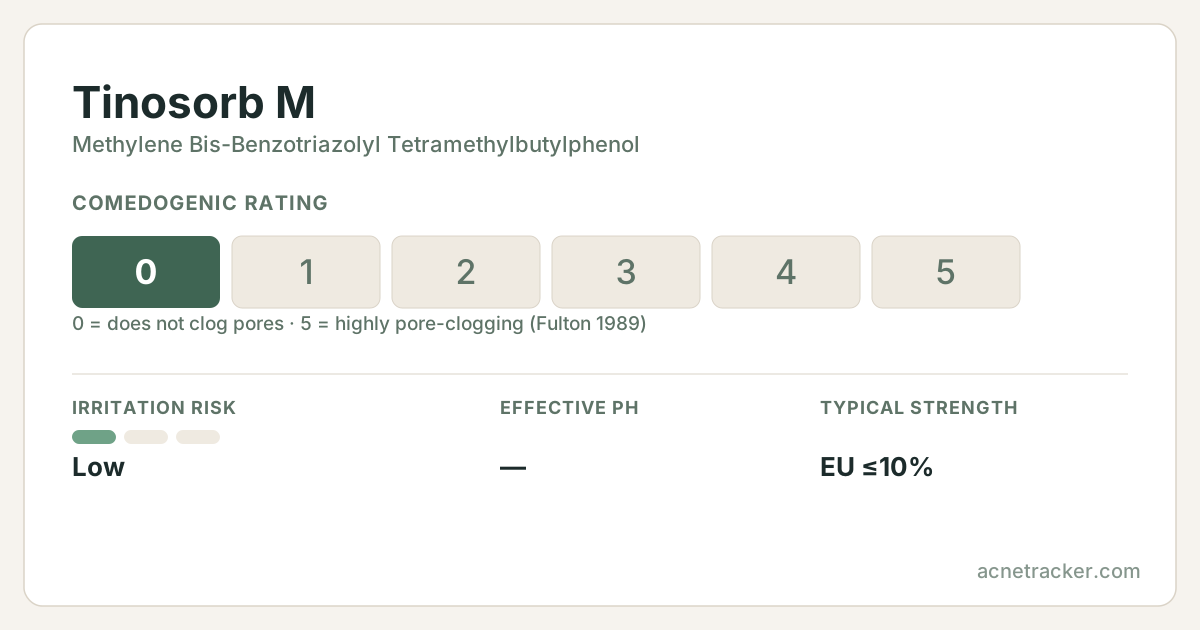
Tinosorb M, chemically bisoctrizole, is an unusual sunscreen filter because it works in two ways at once. Like a chemical filter it absorbs UV light, but it is also a microfine organic particle that scatters and reflects UV like a mineral filter. This hybrid behaviour gives it broad UVA and UVB coverage and excellent photostability. It is usually paired with its sibling Tinosorb S to build robust, elegant broad-spectrum sunscreens. Like Tinosorb S, it is approved across the EU, UK, Australia and Asia, but is not approved by the US FDA, so American consumers will not find it at home.
Quick facts
- Comedogenic rating
- our estimate — not measured
- Irritation risk
- Low
- Effective pH
- —
- Typical strength
- EU ≤10%
- Pregnancy
- Considered safe
- Suits skin types
- oilydrycombinationsensitivenormalacne-pronemature
Where this number comes from
No one has published a comedogenic rating for this ingredient. Fulton's 1989 table tested about 250 raw materials and this was not among them, and we found no later study measuring it. The figure shown is our own reasoning from the ingredient's chemistry and how it is used — treat it as an estimate, not a measurement.
Fulton read his own scale as 0-1 not significant, 2-3 borderline, 4-5 positive. The assay is the rabbit ear at 10% dilution, which the paper itself calls extremely sensitive and not fully predictive of human skin. Ratings describe the raw ingredient; concentration and formulation change real-world behaviour.
Caution profile
The four published fields on this page, on one 0–5 scale. Further from the centre means more care is needed — never that the ingredient is worse.
Derived, not measured: pore-clogging is the published comedogenic rating; irritation maps low/moderate/high to 1/3/5; pregnancy maps safe/caution/avoid to 0/3/5; skin-type limits is how many of the seven skin types this entry does NOT list. Every input is printed in words in the quick-facts card above.
Show the numbers
| Metric | 0–5 | Published field |
|---|---|---|
| Pore-clogging | 0 | 0/5 |
| Irritation | 1 | Low |
| Skin-type limits | 0 | 7/7 |
| Pregnancy | 0 | Considered safe |
Working pH and typical strength
Where this ingredient is formulated to sit, and at what concentration.
Both bars come from the fields above: the pH window and the typical strength range published for this ingredient. The tinted column is healthy skin's surface pH (about 4.7–5.75).
Show the numbers
| Metric | 0–5 |
|---|---|
| Typical strength | EU ≤10% |
What is it?
Tinosorb M is supplied as an aqueous dispersion of microfine organic particles. The molecule absorbs UVA and UVB, while the particulate form adds a physical scattering effect, so it bridges the gap between chemical and mineral filters. It is highly photostable and helps stabilize partner filters, and because it exists as suspended particles rather than a dissolved oil, it is water-based and can be built into fresh, light textures. Its large particle size means negligible skin penetration, contributing to a very clean safety profile. Formulators value it for delivering strong UVA protection without relying on avobenzone alone.
Benefits
Absorbs and scatters UV
Its hybrid organic-particulate nature both absorbs and physically deflects UVA and UVB, giving broad, robust protection in one ingredient.
Very photostable
It resists breakdown in sunlight and helps stabilize other filters, so a formula's protection stays reliable across a day of exposure.
Water-based and light
Because it is a particle dispersion rather than an oil, it enables fresh, lightweight textures that suit oily and acne-prone skin.
Low penetration, gentle
Its large particle size means it barely enters the skin, giving a low irritation profile that pairs well with vitamin-e and other antioxidants.
How to use
Tinosorb M appears in finished sunscreens sold outside the US; use those products as your daily broad-spectrum SPF, applying generously and reapplying every two hours in sun. It is frequently combined with Tinosorb S and avobenzone to cover the full UV spectrum with excellent stability. Because it is a particle-based filter, some formulas can leave a very slight cast at high loads, though far less than heavy mineral sunscreens using zinc-oxide. It layers cleanly under makeup and over antioxidant serums.
Side effects
Tinosorb M is very well tolerated, with low irritation and allergy rates and negligible skin absorption thanks to its large particle size. It is not linked to the systemic or hormonal concerns raised for older filters. As with any sunscreen, avoid contact with the eyes. High-load formulas may feel slightly heavier or leave a faint cast, but this is a cosmetic trait rather than a safety issue.
Who should avoid it
There is no group that clearly needs to avoid Tinosorb M; it is gentle and considered acceptable in pregnancy. US residents cannot buy it domestically because of FDA status. Anyone with a rare specific allergy should choose a mineral sunscreen with titanium-dioxide instead. Its excellent tolerance makes it suitable for sensitive skin.
Pairs well with
Frequently asked questions
How is Tinosorb M different from mineral sunscreen?
It both absorbs and scatters UV, so it acts partly like a mineral and partly like a chemical filter, but with far less white cast than zinc-oxide or titanium-dioxide at similar protection.
Is Tinosorb M available in the US?
No. Like Tinosorb S it is approved in the EU, UK, Australia and Asia but has not been approved by the FDA, so it is not in US sunscreens.
Does Tinosorb M leave a white cast?
Much less than mineral filters. At high concentrations a faint cast is possible, but it is generally far more cosmetically elegant than heavy zinc-oxide formulas.
Is Tinosorb M safe for daily use?
Yes. It is highly photostable, barely penetrates the skin and has a very low irritation rate, making it well suited to daily broad-spectrum sunscreens.
Sources & further reading
Medical disclaimer
Find your personal acne triggers
Our free Acne Tracker lets you log breakouts, sleep, stress and diet, and shows you which factors correlate with your flare-ups.