Sodium Lauryl Sulfate: Comedogenic Rating & Ingredient Analysis
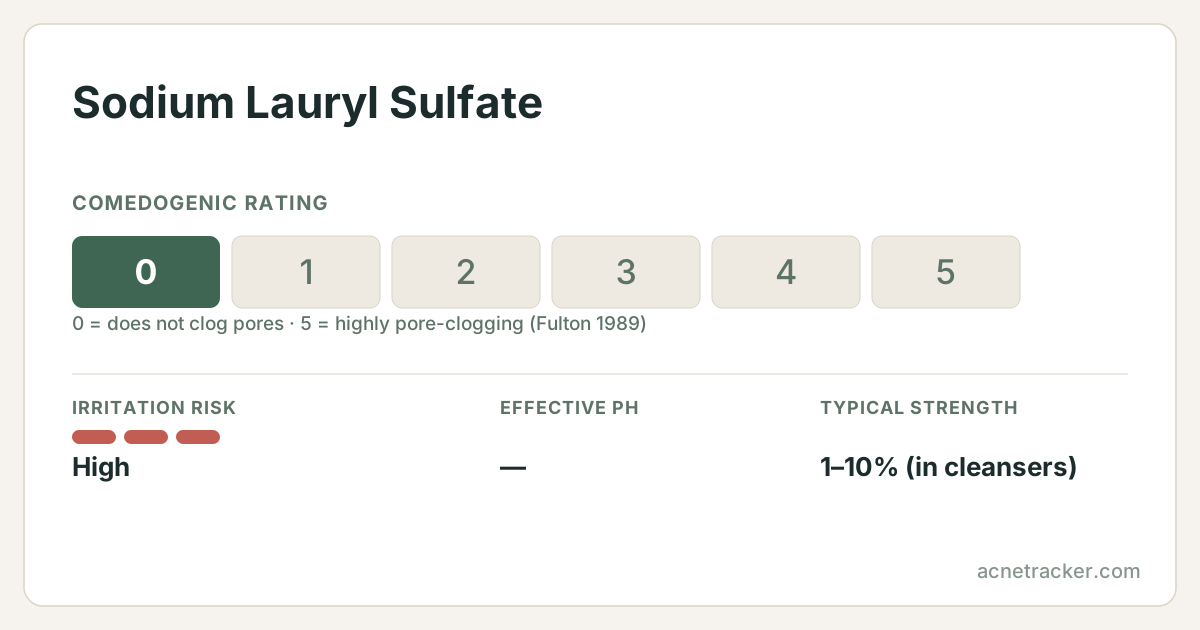
Sodium lauryl sulfate, universally known as SLS, is a powerful cleansing surfactant and one of the most talked-about ingredients on the internet, usually for the wrong reasons. It is an effective foaming detergent used in shampoos, body washes, toothpastes and some face cleansers, and it is so good at cleaning that scientists actually use it as a standard irritant in patch testing. That last fact drives much of the fear around it, but the reality is more measured: SLS is a strong cleanser that can dry and irritate skin with heavy use, not a toxin, and the toxicity and cancer rumours attached to it are unfounded.
Quick facts
- Comedogenic rating
- studies disagree
- Irritation risk
- High
- Effective pH
- —
- Typical strength
- 1–10% (in cleansers)
- Pregnancy
- Considered safe
- Suits skin types
- oily
Where this number comes from
Published studies disagree about this ingredient. Both are linked below.
Published studies disagree. Fulton's 1976 rabbit-ear work listed sodium lauryl sulfate among comedogenic emulsifiers, and that is the origin of the '5' still circulating in copied pore-clogging tables. A 2007 re-assay of fourteen cosmetic materials by Maibach's group found the first nine positive and SLS not among them. We publish 0 because the later, more specific re-assay found no comedogenic effect and because SLS is a rinse-off surfactant — in a cleanser the realistic concern is irritation, not clogged pores. The disagreement is real, and you should know it exists rather than trust either number blindly.
- Fulton JE et al. Non-comedogenic cosmetics. Cutis 17:344-351 (1976) — the rabbit-ear study that listed SLS among comedogenic emulsifiers (PubMed)
- Nguyen SH, Dang TP, Maibach HI. Comedogenicity in rabbit: some cosmetic ingredients/vehicles. Cutan Ocul Toxicol 26:287-92 (2007) — re-assay in which SLS was NOT among the positives (PubMed)
Fulton read his own scale as 0-1 not significant, 2-3 borderline, 4-5 positive. The assay is the rabbit ear at 10% dilution, which the paper itself calls extremely sensitive and not fully predictive of human skin. Ratings describe the raw ingredient; concentration and formulation change real-world behaviour.
Caution profile
The four published fields on this page, on one 0–5 scale. Further from the centre means more care is needed — never that the ingredient is worse.
Derived, not measured: pore-clogging is the published comedogenic rating; irritation maps low/moderate/high to 1/3/5; pregnancy maps safe/caution/avoid to 0/3/5; skin-type limits is how many of the seven skin types this entry does NOT list. Every input is printed in words in the quick-facts card above.
Show the numbers
| Metric | 0–5 | Published field |
|---|---|---|
| Pore-clogging | 0 | 0/5 |
| Irritation | 5 | High |
| Skin-type limits | 4.3 | 1/7 |
| Pregnancy | 0 | Considered safe |
Working pH and typical strength
Where this ingredient is formulated to sit, and at what concentration.
Both bars come from the fields above: the pH window and the typical strength range published for this ingredient. The tinted column is healthy skin's surface pH (about 4.7–5.75).
Show the numbers
| Metric | 0–5 |
|---|---|
| Typical strength | 1–10% (in cleansers) |
What is it?
SLS is an anionic surfactant made from lauryl alcohol. Unlike SLES, it is not ethoxylated, which makes it a stronger, more stripping cleanser. In products it lifts away oil and dirt and produces abundant foam, but it can also remove more of the skin's own protective oils than gentler surfactants, which is why it can leave skin feeling tight. This same defatting strength is why laboratories use SLS as a reference irritant. It is best suited to rinse-off products with short contact time, and to oily or resilient skin; it is increasingly replaced by SLES or sugar-based surfactants in products aimed at sensitive skin.
Benefits
Very effective cleansing
SLS removes oil, grime and buildup thoroughly, giving a deep-clean feel that suits oily skin and heavy product or styling residue.
Abundant, dense foam
It generates a rich, stable lather that spreads product easily and delivers the sudsy sensory experience many people expect.
Inexpensive and widely available
It is a low-cost, well-understood surfactant, which is why it remains common in mass-market cleansing products and toothpastes.
Not toxic despite its reputation
Regulators and safety panels regard SLS as safe in rinse-off use; its real limitation is potential dryness and irritation, not the cancer risk rumoured online.
How to use
Use SLS-containing products as rinse-off cleansers and rinse well; it is not meant to stay on the skin. If you have oily, robust skin it is generally fine, ideally in a formula buffered with milder co-surfactants like cocamidopropyl-betaine and humectants such as glycerin. If washing leaves your skin tight, dry or flaky, switch to an SLES or sulfate-free cleanser. As always, moisturise afterward and avoid over-cleansing, which amplifies any stripping effect.
Side effects
SLS is the strongest of the common surfactants and the most likely to cause dryness, tightness and irritant contact dermatitis with frequent or prolonged contact. It is not a sensitiser in the allergic sense and it is not carcinogenic; the online claims to that effect are myths. In toothpaste, SLS has been linked in some people to more frequent mouth ulcers, which is why SLS-free toothpastes exist. For skin, the practical concern is simply that it can be too harsh for delicate skin types.
Who should avoid it
People with dry, sensitive, eczema-prone, rosacea-prone or barrier-damaged skin should generally avoid SLS cleansers in favour of gentler SLES or sugar-based surfactants. Anyone who gets recurrent mouth ulcers may prefer SLS-free toothpaste. Oily, resilient skin usually tolerates SLS in well-formulated rinse-off products.
Pairs well with
Frequently asked questions
Is sodium lauryl sulfate dangerous?
No. SLS is not toxic or carcinogenic; those are internet myths. It is a strong cleanser that can dry and irritate skin with heavy use, which is its only real, well-documented drawback.
Why is SLS used as a standard irritant in research?
Because it reliably produces mild irritation, scientists use SLS as a consistent reference in skin tests. This lab role fuels its scary reputation, but it reflects its cleansing strength, not toxicity.
Is SLS worse than SLES?
It is harsher. SLS is not ethoxylated, so it strips more of the skin's oils than the milder SLES. For sensitive or dry skin, SLES or sulfate-free cleansers are usually the better choice.
Does SLS cause acne?
No. SLS is a rinse-off detergent with a comedogenic rating of zero — it leaves with the water rather than settling in a pore. Its relevance to acne is indirect: because SLS is the most defatting of the common surfactants, over-washing with it can compromise the barrier, and a stressed barrier may worsen breakouts in some people.
Sources & further reading
Medical disclaimer
Find your personal acne triggers
Our free Acne Tracker lets you log breakouts, sleep, stress and diet, and shows you which factors correlate with your flare-ups.