Oxybenzone: Comedogenic Rating & Ingredient Analysis
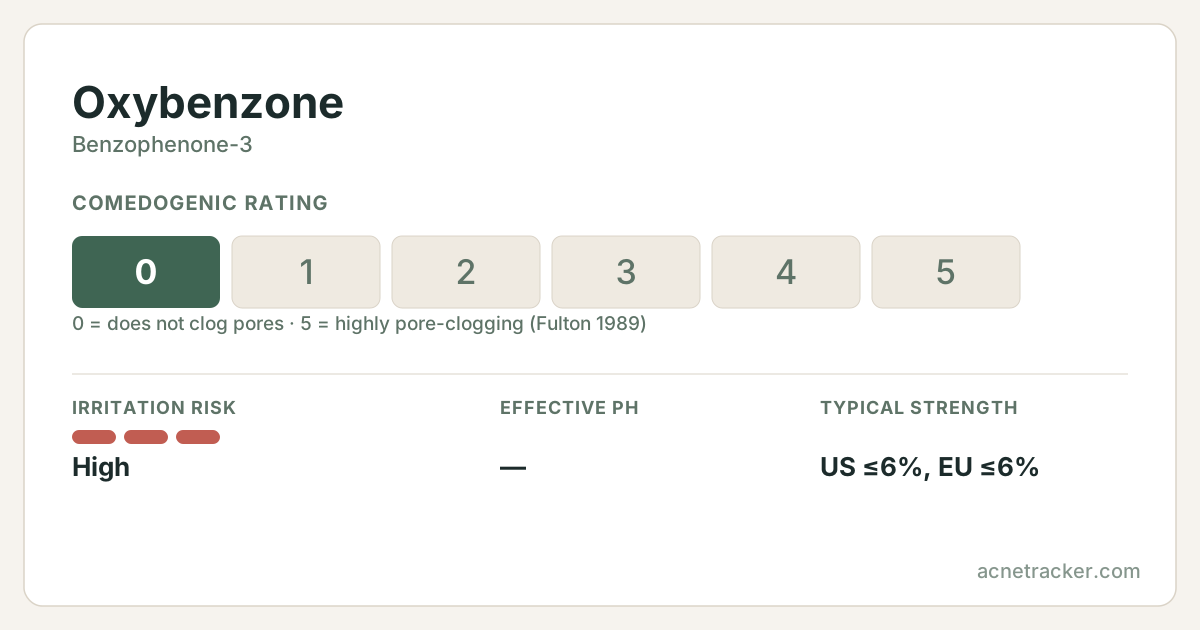
Oxybenzone, listed as Benzophenone-3, is the single most debated sunscreen ingredient of the last decade. It is a chemical filter that absorbs both UVB and short-wavelength UVA and helps stabilize other filters, which made it a formulation favourite for years. It is now the poster child for concerns about sunscreen: it showed the highest blood levels in the FDA's absorption studies, it is a comparatively common cause of contact and photoallergic reactions, and it is one of the two ingredients banned in Hawaii over coral-reef damage. Regulators have not declared it unsafe, but its use has fallen sharply as brands reformulate.
Quick facts
- Comedogenic rating
- measured (Fulton 1989)
- Irritation risk
- High
- Effective pH
- —
- Typical strength
- US ≤6%, EU ≤6%
- Pregnancy
- Ask your doctor
- Suits skin types
- oilycombinationnormal
Where this number comes from
Read directly from Table I of Fulton's 1989 paper — the primary source, not one of the copied tables that circulate online.
Fulton read his own scale as 0-1 not significant, 2-3 borderline, 4-5 positive. The assay is the rabbit ear at 10% dilution, which the paper itself calls extremely sensitive and not fully predictive of human skin. Ratings describe the raw ingredient; concentration and formulation change real-world behaviour.
Caution profile
The four published fields on this page, on one 0–5 scale. Further from the centre means more care is needed — never that the ingredient is worse.
Derived, not measured: pore-clogging is the published comedogenic rating; irritation maps low/moderate/high to 1/3/5; pregnancy maps safe/caution/avoid to 0/3/5; skin-type limits is how many of the seven skin types this entry does NOT list. Every input is printed in words in the quick-facts card above.
Show the numbers
| Metric | 0–5 | Published field |
|---|---|---|
| Pore-clogging | 0 | 0/5 |
| Irritation | 5 | High |
| Skin-type limits | 2.9 | 3/7 |
| Pregnancy | 3 | Ask your doctor |
Working pH and typical strength
Where this ingredient is formulated to sit, and at what concentration.
Both bars come from the fields above: the pH window and the typical strength range published for this ingredient. The tinted column is healthy skin's surface pH (about 4.7–5.75).
Show the numbers
| Metric | 0–5 |
|---|---|
| Typical strength | US ≤6%, EU ≤6% |
What is it?
Oxybenzone is a benzophenone derivative that absorbs UV light across UVB and into short UVA, with useful broad coverage for a single molecule, plus a stabilizing effect on partners like avobenzone. Its controversy comes from how readily it is absorbed through skin. In the FDA's 2019 maximal-use trial it reached plasma concentrations far above those of other filters, and it can be detected in urine and breast milk in population studies. Laboratory work suggests weak estrogen-like activity, though a direct human health effect at cosmetic exposure has not been demonstrated. The EU reduced its permitted concentration to 6% and requires warning labelling, reflecting a precautionary stance.
Benefits
Broad single-molecule coverage
Unusually for a chemical filter, oxybenzone absorbs both UVB and short UVA, so it contributes to broad-spectrum protection while also stabilizing avobenzone.
Boosts SPF efficiently
It is a strong absorber that raises SPF at modest use levels, which is why it was long a cost-effective backbone of many sunscreens.
Photostable partner
It helps hold other filters together in sunlight, improving the durability of a formula's protection through the day.
Cosmetically light
As an oil-soluble filter it blends clear into lotions without the cast of high-load mineral formulas using zinc-oxide or titanium-dioxide.
How to use
If you use a sunscreen containing oxybenzone, apply and reapply it like any SPF product. However, given the absorption data, allergy rate and reef concerns, many dermatologists now suggest choosing a formula without it — either other chemical filters like avobenzone with octocrylene, or a mineral sunscreen with zinc-oxide. If you do use oxybenzone, avoid getting it in the eyes and do a patch test if your skin is reactive. Reserve it for land use rather than ocean swimming near reefs.
Side effects
Oxybenzone has one of the higher rates of contact and photoallergic dermatitis among UV filters, causing itching, rash or reactions triggered by sun. Its defining issue is systemic absorption: it appears in blood, urine and breast milk, and shows weak hormonal activity in lab tests, prompting the FDA to request more safety data — the agency stresses this does not mean it is unsafe, only that data are incomplete. It is also linked to coral bleaching, the basis for several regional bans.
Who should avoid it
People prone to sunscreen allergies, children, and those who prefer to minimize hormone-active exposures often avoid oxybenzone; mineral sunscreens are the simplest substitute. Because of the strong absorption data, avoiding it during pregnancy and breastfeeding is a reasonable precaution, though not a proven necessity. Anyone swimming near coral reefs should choose reef-conscious alternatives.
Pairs well with
Frequently asked questions
Is oxybenzone dangerous?
Regulators have not found it unsafe at approved levels, but it is absorbed into the body more than other filters and causes more allergies, so many people and brands now avoid it out of caution.
Why do reefs matter for oxybenzone?
Studies link oxybenzone to coral bleaching, which led Hawaii, Key West and others to ban it in over-the-counter sunscreens for ocean use.
What can I use instead of oxybenzone?
Mineral sunscreens with zinc-oxide or titanium-dioxide, or chemical formulas built on avobenzone and octocrylene, all give broad-spectrum protection without oxybenzone.
Is oxybenzone still legal?
Yes. It remains approved in the US and EU, though the EU capped it at 6% with warning labelling and the FDA has asked for more safety data.
Sources & further reading
Medical disclaimer
Find your personal acne triggers
Our free Acne Tracker lets you log breakouts, sleep, stress and diet, and shows you which factors correlate with your flare-ups.