Ensulizole: Comedogenic Rating & Ingredient Analysis
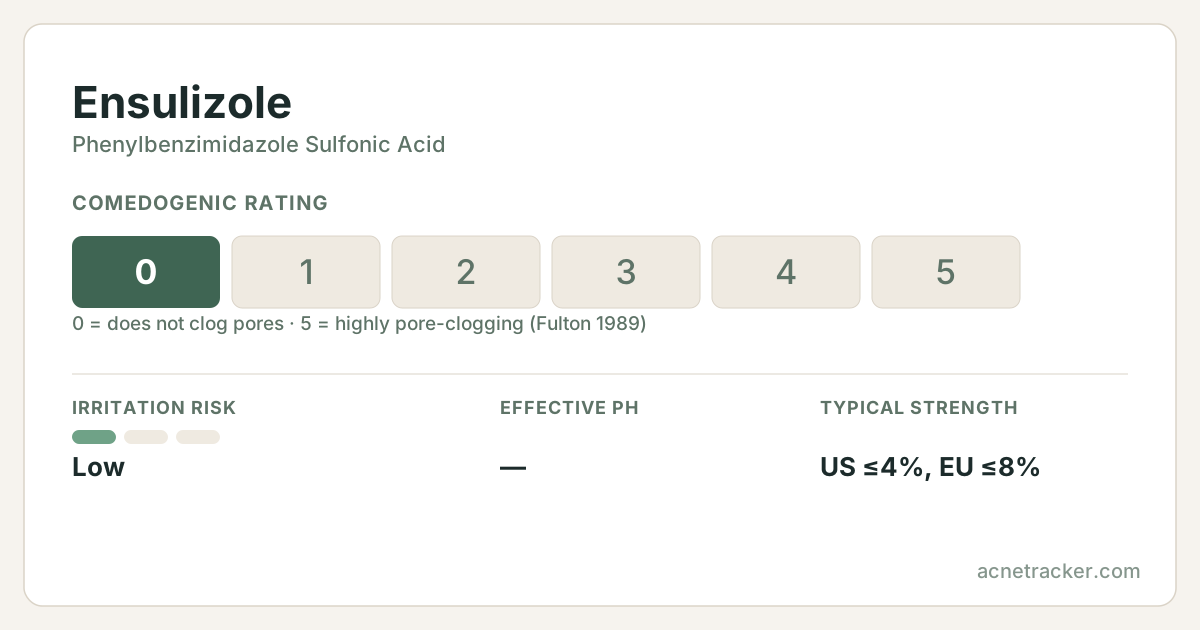
Ensulizole, also known as phenylbenzimidazole sulfonic acid or PBSA, is a UVB sunscreen filter with an unusual property among chemical filters: it is water-soluble. Most organic UV filters are oily, which makes formulas feel rich; ensulizole instead dissolves in water, so it enables very light, fluid, non-greasy sunscreens and is popular in daily moisturizers and cosmetics where a weightless finish matters. It protects against UVB only and gives essentially no UVA coverage, so it is always combined with UVA filters. It is approved in both the United States and the European Union.
Quick facts
- Comedogenic rating
- our estimate — not measured
- Irritation risk
- Low
- Effective pH
- —
- Typical strength
- US ≤4%, EU ≤8%
- Pregnancy
- Considered safe
- Suits skin types
- oilycombinationnormalacne-prone
Where this number comes from
No one has published a comedogenic rating for this ingredient. Fulton's 1989 table tested about 250 raw materials and this was not among them, and we found no later study measuring it. The figure shown is our own reasoning from the ingredient's chemistry and how it is used — treat it as an estimate, not a measurement.
Fulton read his own scale as 0-1 not significant, 2-3 borderline, 4-5 positive. The assay is the rabbit ear at 10% dilution, which the paper itself calls extremely sensitive and not fully predictive of human skin. Ratings describe the raw ingredient; concentration and formulation change real-world behaviour.
Caution profile
The four published fields on this page, on one 0–5 scale. Further from the centre means more care is needed — never that the ingredient is worse.
Derived, not measured: pore-clogging is the published comedogenic rating; irritation maps low/moderate/high to 1/3/5; pregnancy maps safe/caution/avoid to 0/3/5; skin-type limits is how many of the seven skin types this entry does NOT list. Every input is printed in words in the quick-facts card above.
Show the numbers
| Metric | 0–5 | Published field |
|---|---|---|
| Pore-clogging | 0 | 0/5 |
| Irritation | 1 | Low |
| Skin-type limits | 2.1 | 4/7 |
| Pregnancy | 0 | Considered safe |
Working pH and typical strength
Where this ingredient is formulated to sit, and at what concentration.
Both bars come from the fields above: the pH window and the typical strength range published for this ingredient. The tinted column is healthy skin's surface pH (about 4.7–5.75).
Show the numbers
| Metric | 0–5 |
|---|---|
| Typical strength | US ≤4%, EU ≤8% |
What is it?
Ensulizole is an organic filter that absorbs UVB light with a peak near 302 nanometres, and because it carries a sulfonic acid group it is soluble in water rather than oil. This water solubility is its defining feature: it lets formulators put UV protection into the water phase and build sheer, quick-absorbing textures that feel more like a serum than a cream. It offers no meaningful UVA protection, so it must be paired with UVA filters such as avobenzone or minerals like titanium-dioxide for broad-spectrum products. It is generally photostable and well tolerated, and is often chosen for oily and acne-prone skin that dislikes heavy sunscreens.
Benefits
Weightless, non-greasy feel
Because it is water-soluble, ensulizole enables sheer, fast-absorbing sunscreens and moisturizers that suit oily and acne-prone skin better than oily formulas.
Effective UVB protection
It absorbs sunburn-causing UVB efficiently, contributing to SPF in lightweight daily products and tinted moisturizers.
Cosmetically versatile
Its water solubility lets brands build UV protection into serums and fluids that layer invisibly under makeup and over vitamin-c.
Widely approved
It is permitted in both the US and EU and has a long track record, pairing with UVA filters like avobenzone for broad-spectrum coverage.
How to use
Ensulizole appears in finished sunscreens and daily moisturizers; use them as your morning SPF and reapply every two hours in strong sun. Since it protects only against UVB, always choose a broad-spectrum product so UVA is handled by partners such as avobenzone or titanium-dioxide. Its light, water-based feel makes it ideal if you find typical sunscreens greasy, and it layers cleanly under makeup. As with all UVB-only filters, do not rely on it alone for serious sun exposure.
Side effects
Ensulizole is well tolerated with a low rate of irritation and contact allergy. Like many UV filters it can generate free radicals when it absorbs light, so pairing it with antioxidants such as vitamin-c or vitamin-e is sensible, though this applies broadly to sunscreens. Keep it out of the eyes to avoid stinging. It has no notable systemic-absorption concerns at cosmetic use levels.
Who should avoid it
There is no group that specifically needs to avoid ensulizole; it is considered acceptable in pregnancy and suits sensitive, oily skin. People wanting complete mineral formulas can choose zinc-oxide instead. Anyone with a rare allergy to it should patch test or switch to a mineral sunscreen.
Pairs well with
Frequently asked questions
Why is ensulizole used in light sunscreens?
Unlike most UV filters it is water-soluble, so it enables sheer, non-greasy, quick-absorbing textures, which is why it appears in fluid sunscreens and daily moisturizers.
Does ensulizole protect against UVA?
No. It only covers UVB, so it must be combined with UVA filters like avobenzone or minerals such as titanium-dioxide for broad-spectrum protection.
Is ensulizole approved in the US?
Yes. Ensulizole is approved for use in sunscreens in both the United States and the European Union.
Is ensulizole good for oily skin?
Yes. Its water-soluble, weightless feel makes it a good choice for oily and acne-prone skin that finds oily sunscreens too heavy.
Sources & further reading
Medical disclaimer
Find your personal acne triggers
Our free Acne Tracker lets you log breakouts, sleep, stress and diet, and shows you which factors correlate with your flare-ups.