Homosalate: Comedogenic Rating & Ingredient Analysis
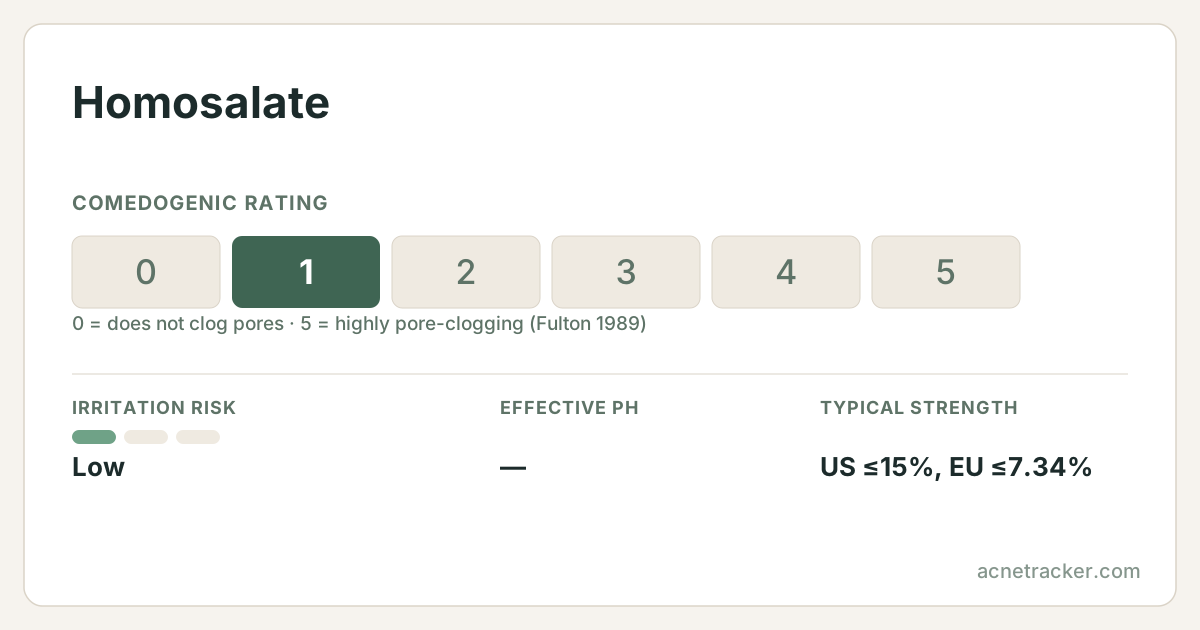
Homosalate is a salicylate-based UVB sunscreen filter found in a large share of chemical sunscreens, especially in the United States. On its own it is a relatively weak absorber, so it rarely does the heavy lifting for SPF. Its real usefulness is as an oily solvent: many UV filters are solid powders that need to be dissolved, and homosalate dissolves them beautifully, letting formulators pack more active into a cosmetically pleasant lotion. It is approved in both the US and the EU, but the EU lowered its permitted level after a safety review flagged possible endocrine effects, illustrating how regulators weigh emerging data.
Quick facts
- Comedogenic rating
- our estimate — not measured
- Irritation risk
- Low
- Effective pH
- —
- Typical strength
- US ≤15%, EU ≤7.34%
- Pregnancy
- Ask your doctor
- Suits skin types
- oilycombinationnormalmature
Where this number comes from
No one has published a comedogenic rating for this ingredient. Fulton's 1989 table tested about 250 raw materials and this was not among them, and we found no later study measuring it. The figure shown is our own reasoning from the ingredient's chemistry and how it is used — treat it as an estimate, not a measurement.
Fulton read his own scale as 0-1 not significant, 2-3 borderline, 4-5 positive. The assay is the rabbit ear at 10% dilution, which the paper itself calls extremely sensitive and not fully predictive of human skin. Ratings describe the raw ingredient; concentration and formulation change real-world behaviour.
Caution profile
The four published fields on this page, on one 0–5 scale. Further from the centre means more care is needed — never that the ingredient is worse.
Derived, not measured: pore-clogging is the published comedogenic rating; irritation maps low/moderate/high to 1/3/5; pregnancy maps safe/caution/avoid to 0/3/5; skin-type limits is how many of the seven skin types this entry does NOT list. Every input is printed in words in the quick-facts card above.
Show the numbers
| Metric | 0–5 | Published field |
|---|---|---|
| Pore-clogging | 1 | 1/5 |
| Irritation | 1 | Low |
| Skin-type limits | 2.1 | 4/7 |
| Pregnancy | 3 | Ask your doctor |
Working pH and typical strength
Where this ingredient is formulated to sit, and at what concentration.
Both bars come from the fields above: the pH window and the typical strength range published for this ingredient. The tinted column is healthy skin's surface pH (about 4.7–5.75).
Show the numbers
| Metric | 0–5 |
|---|---|
| Typical strength | US ≤15%, EU ≤7.34% |
What is it?
Homosalate is an ester of salicylic acid and a menthol-derived alcohol, absorbing UVB with a peak near 306 nanometres. Because its absorbance is modest and it is not strongly photostable, it is almost never used as a standalone filter; instead it partners with stronger absorbers and helps stabilize and dissolve them, notably avobenzone. In 2021 the EU's Scientific Committee on Consumer Safety concluded that homosalate was not safe at the previously allowed 10% because of potential endocrine activity, and set a new limit of 7.34% in face products. The US FDA still permits up to 15% while it collects more data, a clear example of the two systems diverging.
Benefits
Dissolves other UV filters
Its main job is as a solvent, turning powdery filters into a smooth liquid so brands can build high-SPF formulas that still feel light.
Adds UVB coverage
It absorbs sunburn-causing UVB, contributing modestly to overall SPF as part of a multi-filter blend.
Helps stabilize partners
Alongside octocrylene and octisalate it supports avobenzone, extending how long a sunscreen's UVA protection lasts in sunlight.
Cosmetically elegant
As an oily liquid it spreads easily and leaves no white cast, unlike heavy loads of zinc-oxide, making it useful in daily wear formulas.
How to use
You will only meet homosalate inside finished sunscreens, applied as your daily SPF and reapplied every two hours in sun. Since it is a supporting UVB filter, always pick a product labelled broad-spectrum so UVA is covered by partners such as avobenzone. If you follow EU guidance, note that European face sunscreens now cap homosalate lower than US ones; both remain effective when used at the labelled amount. Layer it over antioxidant serums with vitamin-e for added defence against free radicals.
Side effects
Homosalate is generally well tolerated on the skin with a low rate of irritation and allergy. The safety questions are about potential endocrine (hormone-mimicking) activity seen in laboratory studies, which led the EU to reduce the allowed concentration. There is no demonstrated harm to people at real cosmetic exposures, and both the EU and US continue to permit it within their respective limits, so the practical takeaway is precautionary rather than alarming.
Who should avoid it
Given the endocrine data, some people choose to limit homosalate during pregnancy and breastfeeding and use mineral sunscreens with titanium-dioxide instead, as a precaution rather than a proven need. People with salicylate sensitivity may prefer to avoid it. For most adults it is a safe, established filter used within regulated limits.
Pairs well with
Frequently asked questions
Why did the EU lower the homosalate limit?
A 2021 EU safety review flagged possible endocrine activity and concluded 10% was not proven safe, so the limit for face products was cut to 7.34%. The US still allows up to 15%.
Does homosalate protect my skin much on its own?
Not really. It is a weak UVB filter used mainly to dissolve and stabilize stronger filters. It works as part of a blend, not alone.
Is homosalate safe in pregnancy?
No harm is proven at cosmetic doses, but because of endocrine data some prefer mineral sunscreens during pregnancy as a precaution. Discuss with your doctor if unsure.
Is homosalate the same as salicylic acid?
No. It is an ester derived from salicylic acid but behaves as a UV filter and solvent, not as an exfoliating acid, and it does not treat acne.
Sources & further reading
Medical disclaimer
Find your personal acne triggers
Our free Acne Tracker lets you log breakouts, sleep, stress and diet, and shows you which factors correlate with your flare-ups.