Activated Charcoal: Comedogenic Rating & Ingredient Analysis
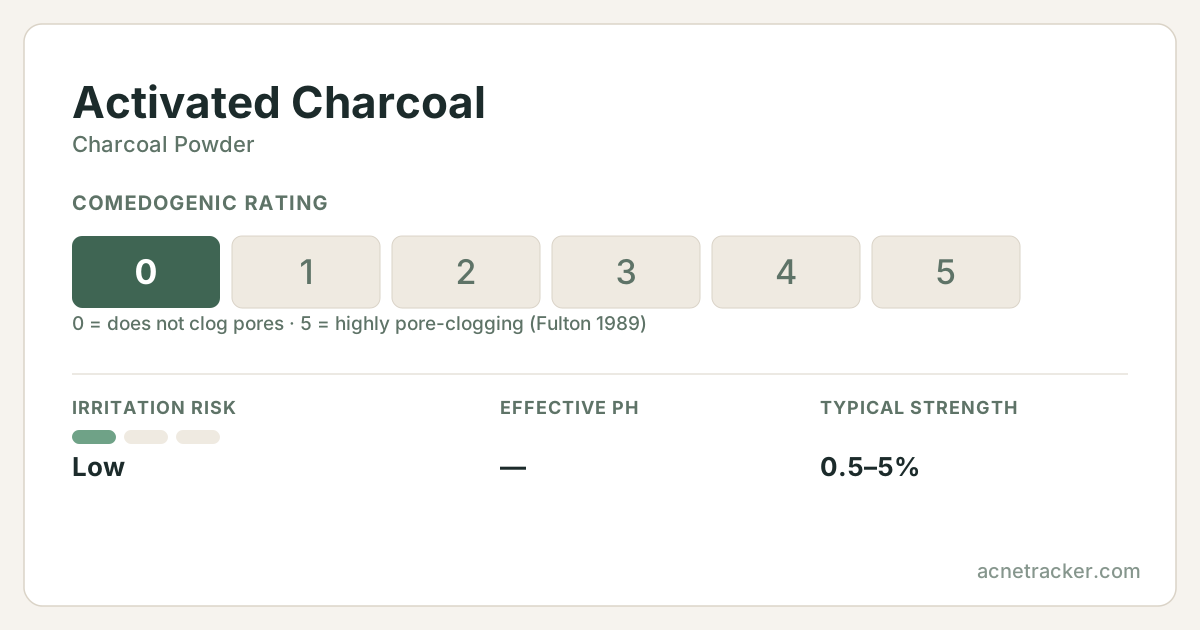
Activated charcoal is a fine, highly porous black powder that has become a signature ingredient in oil-control masks and cleansers. Its appeal comes from its enormous internal surface area, which lets it adsorb oil and grime from the skin's surface during a wash-off treatment. It is genuinely useful for mopping up excess sebum and giving oily skin a temporarily clean, matte feel, but its powers are frequently overstated. Charcoal cannot draw impurities from deep within pores, and it does not detox the skin — understanding what it actually does keeps expectations realistic.
Quick facts
- Comedogenic rating
- our estimate — not measured
- Irritation risk
- Low
- Effective pH
- —
- Typical strength
- 0.5–5%
- Pregnancy
- Considered safe
- Suits skin types
- oilycombinationacne-prone
Where this number comes from
No one has published a comedogenic rating for this ingredient. Fulton's 1989 table tested about 250 raw materials and this was not among them, and we found no later study measuring it. The figure shown is our own reasoning from the ingredient's chemistry and how it is used — treat it as an estimate, not a measurement.
Fulton read his own scale as 0-1 not significant, 2-3 borderline, 4-5 positive. The assay is the rabbit ear at 10% dilution, which the paper itself calls extremely sensitive and not fully predictive of human skin. Ratings describe the raw ingredient; concentration and formulation change real-world behaviour.
Caution profile
The four published fields on this page, on one 0–5 scale. Further from the centre means more care is needed — never that the ingredient is worse.
Derived, not measured: pore-clogging is the published comedogenic rating; irritation maps low/moderate/high to 1/3/5; pregnancy maps safe/caution/avoid to 0/3/5; skin-type limits is how many of the seven skin types this entry does NOT list. Every input is printed in words in the quick-facts card above.
Show the numbers
| Metric | 0–5 | Published field |
|---|---|---|
| Pore-clogging | 0 | 0/5 |
| Irritation | 1 | Low |
| Skin-type limits | 2.9 | 3/7 |
| Pregnancy | 0 | Considered safe |
Working pH and typical strength
Where this ingredient is formulated to sit, and at what concentration.
Both bars come from the fields above: the pH window and the typical strength range published for this ingredient. The tinted column is healthy skin's surface pH (about 4.7–5.75).
Show the numbers
| Metric | 0–5 |
|---|---|
| Typical strength | 0.5–5% |
What is it?
Activated charcoal is carbon that has been processed to riddle it with tiny pores, hugely increasing its surface area. This is the same property that makes it useful in water filters and in medicine for certain poisonings, where it binds substances by adsorption — molecules sticking to its surface. On the skin, in a wash-off mask or cleanser, it can bind surface oil and loose debris, which is then rinsed away. Because the contact is brief and on the surface, its effect is superficial and temporary rather than deep or transformative. It is chemically inert and does not penetrate the skin, so it is not an active in the way an acid or retinoid is.
Benefits
Absorbs surface oil
Charcoal's porous structure adsorbs excess sebum and grime from the skin's surface, giving oily and combination skin a fresher, matte feel after a wash-off treatment.
Deep-clean sensation
In cleansers and masks it contributes to a satisfying clean feeling, helping to lift away the day's build-up of oil, sweat and residue before rinsing.
Suits oily, congested skin
Its oil-absorbing character makes it a sensible mask ingredient for people whose skin runs shiny and feels clogged, used periodically rather than daily.
Gentle and inert
Charcoal is chemically inert and non-comedogenic, so it does not irritate or clog on its own — it simply adsorbs and rinses away without leaving actives behind.
How to use
Activated charcoal is best used in wash-off masks and cleansers rather than left on the skin. Apply a charcoal mask to clean skin once or twice a week, leave it for the directed time without letting it fully dry and crack, then rinse and follow with moisturiser. In a cleanser, use it as you would any face wash. Do not over-rely on it: too-frequent use of strongly absorbent masks can leave skin tight and dry, so balance it with hydration.
Side effects
Charcoal itself is inert and rarely a problem, but strongly absorbent masks can over-dry the skin if used too often, leaving it tight or flaky. Any irritation from a charcoal product is usually due to other ingredients, fragrance, or a mask being left on until it hardens. Peel-off charcoal masks in particular can tug at the skin and cause discomfort. Reduce frequency if your skin feels stripped.
Who should avoid it
There is little reason to strictly avoid charcoal, but dry and sensitive skin should limit strongly absorbent masks, which can worsen dryness. Avoid harsh peel-off charcoal masks if your skin is fragile. If a specific product irritates, the cause is likely another ingredient rather than the charcoal itself.
Pairs well with
Frequently asked questions
Does charcoal detox the skin?
No. 'Detox' is marketing language. Charcoal adsorbs surface oil and debris during a wash-off treatment, but it does not draw toxins out of the skin or clean deep inside pores.
Is charcoal good for oily skin?
It can be, as a periodic mask or cleanser ingredient, because it absorbs excess surface oil and leaves skin feeling matte. Use it a couple of times a week rather than daily.
Does charcoal remove blackheads?
Not really. It absorbs surface oil but cannot pull plugs out of pores. Peel-off charcoal masks that claim to remove blackheads mostly lift off surface debris and vellus hair, not the clog itself.
Can I use a charcoal mask every day?
It is better not to. Frequent use of absorbent masks can over-dry the skin. Once or twice a week, followed by moisturiser, is plenty for most people.
Is charcoal safe for the skin?
Yes. Charcoal is chemically inert, non-comedogenic and does not penetrate the skin. The main risk is over-drying from too-frequent use of strong masks, not the charcoal itself.
Where this ingredient shows up here
Counted across this database, not the web — these are the pages on this site that reason about this ingredient.
Condition pages 1
Sources & further reading
Medical disclaimer
Find your personal acne triggers
Our free Acne Tracker lets you log breakouts, sleep, stress and diet, and shows you which factors correlate with your flare-ups.